一次诡异的内存泄漏
原文出处:一次诡异的内存泄漏
缘起
最近在补一些基础知识,恰好涉及到了智能指针std::weak_ptr在解决std::shared_ptr时候循环引用的问题,如下:
class A {
public:
    std::weak_ptr<B> b_ptr;
};

class B {
public:
    std::weak_ptr<A> a_ptr;
};

auto a = std::make_shared<A>();
auto b = std::make_shared<B>();

a->b_ptr = b;
b->a_ptr = a;
就问了下,通常的用法是将A或者B中间的某一个变量声明为std::weak_ptr,如果两者都声明为std::weak_ptr会有什么问题?
咱们先不论这个问题本身,在随后的讨论中,风神突然贴了段代码:
#include <chrono>
#include <memory>
#include <thread>
using namespace std;

struct A {
    char buffer[1024 * 1024 * 1024]; // 1GB
    weak_ptr<A> next;
};

int main() {
    while (true) {
        auto a0 = make_shared<A>();
        auto a1 = make_shared<A>();
        auto a2 = make_shared<A>();

        a0->next = a1;
        a1->next = a2;
        a2->next = a0;

        // this weak_ptr leak:
        new weak_ptr<A>{a0};

        this_thread::sleep_for(chrono::seconds(3));
    }
    return 0;
}
说实话,当初看了这个代码第一眼,是存在内存泄漏的(new一个weak_ptr没有释放),而没有理解风神这段代码真正的含义,于是在本地把这段代码编译运行了下,我的乖乖,内存占用如图:
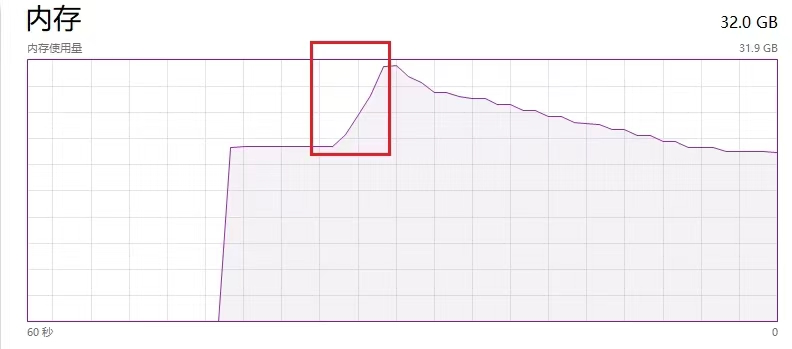
emm,虽然存在内存泄漏,但也不至于这么大,于是网上进行了搜索,直至我看到了下面这段话:
make_shared只分配一次内存, 这看起来很好. 减少了内存分配的开销. 问题来了,weak_ptr会保持控制块(强引用,以及弱引用的信息)的生命周期, 而因此连带着保持了对象分配的内存, 只有最后一个weak_ptr离开作用域时, 内存才会被释放. 原本强引用减为 0 时就可以释放的内存, 现在变为了强引用, 若引用都减为 0 时才能释放, 意外的延迟了内存释放的时间. 这对于内存要求高的场景来说, 是一个需要注意的问题.
如果介意上面new那点泄漏的话,不妨修改代码如下:
#include <chrono>
#include <memory>
#include <thread>
using namespace std;

struct A {
    char buffer[1024 * 1024 * 1024]; // 1GB
    weak_ptr<A> next;
};

int main() {
    std::weak_ptr<A> wptr;
    {
        auto sptr = make_shared<A>();
        wptr = sptr;
    }

    this_thread::sleep_for(chrono::seconds(30));
    return 0;
}
也就是说,对于std::shared_ptr ptr(new Obj),形如下图:
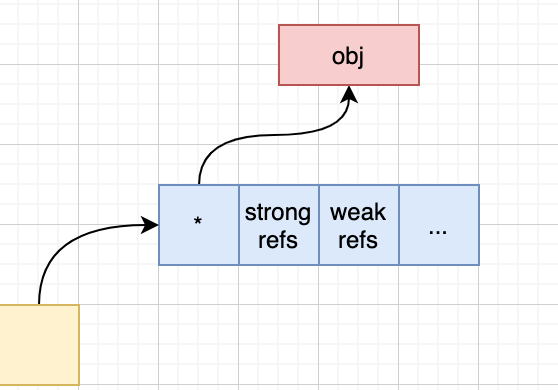
而对于std::make_shared,形如下图:
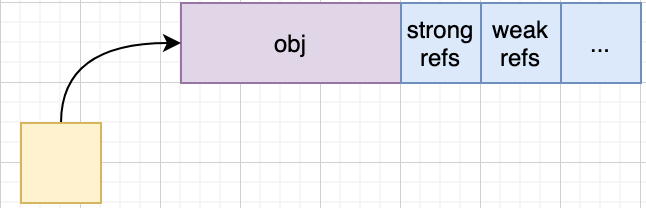
好了,理由上面已经说明白了,不再赘述了,如果你想继续分析的话,请看下文,否则~~
原因
虽然上节给出了原因,不过还是好奇心驱使,想从源码角度去了解下,于是打开了好久没看的gcc源码。
std::make_shared
首先看下它的定义:
template<typename _Tp, typename... _Args>
inline shared_ptr<_Tp> make_shared(_Args&&... __args) {
  typedef typename std::remove_cv<_Tp>::type _Tp_nc;
  return std::allocate_shared<_Tp>(std::allocator<_Tp_nc>(),
      std::forward<_Args>(__args)...);
}
这个函数函数体只有一个std::std::allocate_shared,接着看它的定义:
template<typename _Tp, typename _Alloc, typename... _Args>
inline shared_ptr<_Tp>
allocate_shared(const _Alloc& __a, _Args&&... __args) {
  return shared_ptr<_Tp>(_Sp_alloc_shared_tag<_Alloc>{__a},
      std::forward<_Args>(__args)...);
}
创建了一个shared_ptr对象,看下其对应的构造函数:
template<typename _Alloc, typename... _Args>
shared_ptr(_Sp_alloc_shared_tag<_Alloc> __tag, _Args&&... __args)
  : __shared_ptr<_Tp>(__tag, std::forward<_Args>(__args)...) { }
接着看__shared_ptr这个类对应的构造函数:
template<typename _Alloc, typename... _Args>
__shared_ptr(_Sp_alloc_shared_tag<_Alloc> __tag, _Args&&... __args)
  : _M_ptr(), _M_refcount(_M_ptr, __tag, std::forward<_Args>(__args)...)
{ _M_enable_shared_from_this_with(_M_ptr); }
其中,_M_refcount的类型为__shared_count,也就是说我们通常所说的引用计数就是由其来管理。
因为调用make_shared函数,所以这里的_M_ptr指针也就是相当于一个空指针,然后继续看下_M_refcount(请注意_M_ptr作为参数传入)定
义:
template<typename _Tp, typename _Alloc, typename... _Args>
__shared_count(_Tp*& __p, _Sp_alloc_shared_tag<_Alloc> __a, _Args&&... __args) {
  typedef _Sp_counted_ptr_inplace<_Tp, _Alloc, _Lp> _Sp_cp_type; // L1
  typename _Sp_cp_type::__allocator_type __a2(__a._M_a); // L2
  auto __guard = std::__allocate_guarded(__a2);
  _Sp_cp_type* __mem = __guard.get(); // L3
  auto __pi = ::new (__mem)_Sp_cp_type(__a._M_a, std::forward<_Args>(__args)...); // L4
  __guard = nullptr;
  _M_pi = __pi;
  __p = __pi->_M_ptr(); // L5
}
这块代码当时看了很多遍,一直不明白在没有显示分配对象内存的情况下,是如何使用placement new的,直至今天上午,灵光一闪,突然明白了,且听慢慢道来。
首先看下L1行,其声明了模板类_Sp_counted_ptr_inplace的别名为_Sp_cp_type,其定义如下:
template<typename _Tp, typename _Alloc, _Lock_policy _Lp>
class _Sp_counted_ptr_inplace final : public _Sp_counted_base<_Lp>
{
  class _Impl : _Sp_ebo_helper<0, _Alloc>
  {
    typedef _Sp_ebo_helper<0, _Alloc>    _A_base;

  public:
    explicit _Impl(_Alloc __a) noexcept : _A_base(__a) { }

    _Alloc& _M_alloc() noexcept { return _A_base::_S_get(*this); }

    __gnu_cxx::__aligned_buffer<_Tp> _M_storage;
  };

public:
  using __allocator_type = __alloc_rebind<_Alloc, _Sp_counted_ptr_inplace>;

  // Alloc parameter is not a reference so doesn't alias anything in __args
  template<typename... _Args>
  _Sp_counted_ptr_inplace(_Alloc __a, _Args&&... __args)
  : _M_impl(__a)
  {
    // _GLIBCXX_RESOLVE_LIB_DEFECTS
    // 2070.  allocate_shared should use allocator_traits<A>::construct
    allocator_traits<_Alloc>::construct(__a, _M_ptr(),
        std::forward<_Args>(__args)...); // might throw
  }

  ~_Sp_counted_ptr_inplace() noexcept { }

  virtual void
  _M_dispose() noexcept
  {
    allocator_traits<_Alloc>::destroy(_M_impl._M_alloc(), _M_ptr());
  }

  // Override because the allocator needs to know the dynamic type
  virtual void
  _M_destroy() noexcept
  {
    __allocator_type __a(_M_impl._M_alloc());
    __allocated_ptr<__allocator_type> __guard_ptr{ __a, this };
    this->~_Sp_counted_ptr_inplace();
  }

private:
  friend class __shared_count<_Lp>; // To be able to call _M_ptr().

  _Tp* _M_ptr() noexcept { return _M_impl._M_storage._M_ptr(); }

  _Impl _M_impl;
};
这个类继承于_Sp_counted_base,这个类定义不再次列出,需要注意的是其中有两个变量:
_Atomic_word  _M_use_count;     // #shared
_Atomic_word  _M_weak_count;    // #weak + (#shared != 0)
第一个为强引用技术,也就是shared对象引用计数,另外一个为弱因为计数。
继续看这个类,里面定义了一个class_Impl,其中我们创建的对象类型就在这个类里面定义,即__gnu_cxx::__aligned_buffer<_Tp> _M_storage;
接着看L2,这行定义了一个对象__a2,其对象类型为using __allocator_type = __alloc_rebind<_Alloc, _Sp_counted_ptr_inplace>;,这行的意思是重新封装rebind_alloc<_Sp_counted_ptr_inplace>
继续看L3,在这一行中会创建一块内存,这块内存中按照顺序为创建对象、强引用计数、弱引用计数等(也就是说分配一大块内存,这块内存中包含对象、强、弱引用计数所需内存等),在创建这块内存的时候,强、弱引用计数已经被初始化
最后是L3,这块调用了placement new来创建,其中调用了对象的构造函数:
template<typename... _Args>
  _Sp_counted_ptr_inplace(_Alloc __a, _Args&&... __args)
  : _M_impl(__a)
  {
    // _GLIBCXX_RESOLVE_LIB_DEFECTS
    // 2070.  allocate_shared should use allocator_traits<A>::construct
    allocator_traits<_Alloc>::construct(__a, _M_ptr(),
        std::forward<_Args>(__args)...); // might throw
  }
至此,整个std::make_shared流量已经完整的梳理完毕,最后返回一个shared_ptr对象。
好了,下面继续看下令人迷惑的,存在大内存不分配的这行代码:
new weak_ptr<A>{a0};
其对应的构造函数如下:
template<typename _Yp, typename = _Compatible<_Yp>>
    __weak_ptr(const __shared_ptr<_Yp, _Lp>& __r) noexcept
    : _M_ptr(__r._M_ptr), _M_refcount(__r._M_refcount)
    { }
其中_M_refcount的类型为__weak_count,而__r._M_refcount即常说的强引用计数类型为__shared_count,其继承于接着往下看:
__weak_count(const __shared_count<_Lp>& __r) noexcept
: _M_pi(__r._M_pi)
{
  if (_M_pi != nullptr)
  _M_pi->_M_weak_add_ref();
}
emm,弱引用计数加1,也就是说此时_M_weak_count为1。
接着,退出作用域,此时有std::make_shared创建的对象开始释放,因此其内部的成员变量r._M_refcount也跟着释放:
~__shared_count() noexcept
{
  if (_M_pi != nullptr)
    _M_pi->_M_release();
}
接着往下看_M_release()实现:
template<>
inline void
_Sp_counted_base<_S_single>::_M_release() noexcept
{
  if (--_M_use_count == 0)
    {
      _M_dispose();
      if (--_M_weak_count == 0)
        _M_destroy();
    }
}
此时,因为shared_ptr对象的引用计数本来就为1(没有其他地方使用),所以if语句成立,执行_M_dispose()函数,在分析这个函数之前,先看下前面提到的代码:
__shared_ptr(_Sp_alloc_shared_tag<_Alloc> __tag, _Args&&... __args)
    : _M_ptr(), _M_refcount(_M_ptr, __tag, std::forward<_Args>(__args)...)
    { _M_enable_shared_from_this_with(_M_ptr); }
因为是使用std::make_shared()进行创建的,所以_M_ptr为空,此时传入_M_refcount的第一个参数也为空。接着看_M_dispose()定义:
template<>
  inline void
  _Sp_counted_ptr<nullptr_t, _S_single>::_M_dispose() noexcept { }
template<>
  inline void
  _Sp_counted_ptr<nullptr_t, _S_mutex>::_M_dispose() noexcept { }
template<>
  inline void
  _Sp_counted_ptr<nullptr_t, _S_atomic>::_M_dispose() noexcept { }
因为传入的指针为nullptr,因此调用了_Sp_counted_ptr的特化版本,因此_M_dispose()这个函数什么都没做。因为_M_pi->_M_weak_add_ref();这个操作,此时这个计数经过减1之后不为0,因此没有没有执行_M_destroy()操作,因此之前申请的大块内存没有被释放,下面是_M_destroy()实现:
virtual void
_M_destroy() noexcept
{
  __allocator_type __a(_M_impl._M_alloc());
  __allocated_ptr<__allocator_type> __guard_ptr{ __a, this };
  this->~_Sp_counted_ptr_inplace();
}
也就是说真正调用了这个函数,内存才会被分配,示例代码中,显然不会,这就是造成内存一直不被释放的原因。
总结
下面解释下我当时阅读这块代码最难理解的部分,下面是make_shared执行过程:
_Sp_counted_base有两个成员变量,分别为_M_use_count用于表示强引用计数和_M_weak_count用于表示弱引用计数__shared_count继承于_Sp_counted_base,其内部有一个变量_M_ptr指向对象指针__shared_ptr中存在成员变量__shared_count- 使用
make_shared()函数创建shared_ptr时候,会创建__shared_count对象 - 在创建
__shared_count对象时候,存在变量_Sp_counted_ptr_inplace _Sp_counted_ptr_inplace继承于_Sp_counted_base_Sp_counted_ptr_inplace会存在一个class Impl,其中包含对象Obj- 在创建其内部会使用rebind重新封装
rebind_alloc<_Sp_counted_ptr_inplace> _Sp_counted_ptr_inplace获取其分配器,然后进程get()操作,此时会创建一块大小为_Sp_counted_ptr_inplace的对象(这个大小为Obj大小 + 其本身继承的_Sp_counted_base大小等),且顺序为对象、强引用计数、弱引用计数等- 使用
placement new对上述分配的内存块进行初始化(只初始化Obj大小不符,引用计数等已经初始化完成) - 创建
shared_ptr,因为使用的make_shared初始化,所以传入的指针为空,相应的_Sp_counted_base中的_M_ptr也为空
下面是析构过程:
- 析构
shared_ptr对象的同时,释放其内部成员变量_M_use_count _M_use_count调用Release()函数,在这个函数中,如果强引用计数为1,则调用_M_dispose()函数- 在
_M_dispose()中,会调用_Sp_counted_ptr的特化版本,即不进行任何操作 - 判断弱因为计数是否为1,如果是则调用
_M_destroy(),此时才会真正的释放内存块
整体看下来,比较重要的一个类就是_Sp_counted_base不仅充当引用计数功能,还充当内存管理功能。从上面的分析可以看到,_Sp_counted_base负责释放用户申请的申请的内存,即
- 当
_M_use_count递减为 0 时,调用_M_dispose()释放 *this 管理的资源 - 当
_M_weak_count递减为 0 时,调用_M_destroy()释放 *this 对象
最后,借助群里经常说的一句话cpp? 狗都不学结束本文。