OOC 面向对象 C 语言编程实践
原文出处:OOC 面向对象 C 语言编程实践
面向对象是一种编程思想,虽然C并没有提供面向对象的语法糖,但仍然可以用面向对象的思维来抽象和使用。这里分享一套C面向对象的写法,可以完成面向对象编程并进行流畅的抽象。这套写法是在实践中不断调整的结果,目前已经比较稳定,进行了大量的功能编写。
这套OOC有以下特性:
- 没有强行去模仿c++的语法设定,而是使用C的特性去面向对象设计
- 实现继承,组合,封装,多态的特性
- 一套命名规范去增加代码的可读性
第一,封装
在C中可以用struct来封装数据,如果是方法,我们就需要用函数指针存放到struct里面来模拟。
typedef struct Drawable Drawable;
struct  Drawable
{
     float positionX;
     float positionY;
};
typedef struct {
    Drawable* (*Create)                ();
    void      (*Init)                  (Drawable* outDrawable);
}
_ADrawable_;

extern _ADrawable_ ADrawable[1];
static void InitDrawable(Drawable* drawable)
{
     drawable->positionX = 0.0f;
     drawable->positionY = 0.0f;
}

static Drawable* Create()
{
    Drawable* drawable = (Drawable*) malloc(sizeof(Drawable));
    InitDrawable(drawable);

    return drawable;
}

static void Init(Drawable* outDrawable)
{
    InitDrawable(outDrawable);
}

_ADrawable_ ADrawable[1] =
{
    Create,
    Init,
};
- 数据我们封装在Drawable结构里,通过Create可以再堆上创建需要自己free,Init是在栈上创建
- 函数封装在ADrawable这个全局单例对象里,由于没有this指针,所有方法第一个参数需要传入操作对象
- Create和Init方法将会管理,对象的数据初始化工作。如果对象含有其它对象,就需要调用其Create或Init方法
第二,继承和组合
typedef struct Drawable Drawable;
struct  Drawable
{
     Drawable* parent;
     Color     color[1];
};
- 继承,就是在结构体里,嵌入另一个结构体。这样malloc一次就得到全部的内存空间,释放也就一次。嵌入的结构体就是父类,子类拥有父类全部的数据空间内容。
- 组合,就是在结构体,存放另一个结构体的指针。这样创建结构体时候,要需要调用父类的Create方法去生成父类空间,释放的时候也需要额外释放父类空间。
- 这里parent就是组合,color就是继承。
- 继承是一种强耦合,无论如何子类拥有父类全部的信息。
- 组合是一种低耦合,如果不初始化,子类只是存放了一个空指针来占位关联。
- 可以看到,C里面一个结构体可以,继承任意多个父类,也可以组合任意多个父类。
- color[1] 使用数组形式,可以直接把color当做指针使用
子类访问父类,可以直接通过成员属性。那么如果通过父类访问子类呢 ? 通过一个宏定义来实现这个功能。
/**
 * Get struct pointer from member pointer
 */
#define StructFrom2(memberPtr, structType) \
    ((structType*) ((char*) memberPtr - offsetof(structType, memberPtr)))


/**
 * Get struct pointer from member pointer
 */
#define StructFrom3(memberPtr, structType, memberName) \
    ((structType*) ((char*) memberPtr - offsetof(structType, memberName)))
typedef struct Sprite Sprite;
struct  Sprite
{
    Drawable drawable[1];
};
Sprite* sprite = StructFrom2(drawable, Sprite);
这样,我们就可以,通过Sprite的父类Drawable属性,来获得子类Sprite的指针。其原理,是通过offsetof获得成员偏移量,然后用成员地址偏移到子类地址上。有了这个机制,我们就可以实现多态,接口等抽象层。
我们可以在接口函数中,统一传入父类对象,就可以拿到具体的子类指针,执行不同的逻辑,让接口方法体现出多态特性。
第三, 多态
typedef struct Drawable Drawable;
struct  Drawable
{
     /** Default 0.0f */
     float     width;
     float     height;

     /**
      * Custom draw called by ADrawable's Draw, not use any openGL command
      */
     void (*Draw)  (Drawable* drawable);
};
当,我们把一个函数指针放入,结构体对象的时候。意味着,在不同的对象里,Draw函数可以替换为不同的实现。而不是像在ADrawable里面的函数只有一个固定的实现。在子类继承Drawable的时候,我们可以给Draw赋予具体的实现。而统一的调用Draw(Drawable* drawable)的时候,就会体现出多态特性,不同的子类有不懂的实现。
typedef struct
{
    Drawable drawable[1];
}
Hero;
typedef struct
{
    Drawable drawable[1];
}
Enemy;
Drawable drawables[] =
{
     hero->drawable,
     enemy->drawable,
};

for (int i = 0; i < 2; i++)
{
    Drawable* drawable = drawables[i];
    drawable->Draw(drawable);
}
在Hero和Enemy的Create函数中,我们分别实现Draw(Drawable* drawable)函数。如果,我们有一个绘制队列,里面都是Drawable对象。传入Hero和Enemy的Drawable成员属性。在统一绘制调用中,drawable->Draw(drawable),就会分别调用Hero和Enemy不同的draw函数实现,体现了多态性。
第四,重写父类方法
在继承链中,我们常常需要重写父类方法,有时候还需要调用父类方法。
typedef struct
{
    Sprite sprite[1];
}
SpriteBatch;
比如,SpriteBatch 继承 Sprite,我们需要重写Draw方法,还需要调用Sprite的Draw方法。那么我们就需要把Sprite的Draw方法公布出来。
typedef struct
{
   Drawable drawable[1];
}
Sprite;

typedef struct
{
    void (*Draw)(Drawable* drawable);
}
_ASprite_;

extern _ASprite_ ASprite;
这样,每个Sprite的Draw方法可以,通过ASprite的Draw访问。
// override
static void SpriteBatchDraw(Drawable* drawable)
{
      // call father
      ASprite->Draw(drawable);
}

spriteBatch->sprite->drawable->Draw = SpriteBatchDraw;
那么,SpriteBatch就重写了父类的Draw方法,也能够调用父类的方法了。
第五,内存管理
一个malloc对应一个free,所以Create出来的对象需要自己手动free。关键是,在于组合的情况。就是对象内有别的对象的指针,有些是自己malloc的,有些是共用的。其实,计数器是一个简单的方案,但我仍然觉得复杂了。在想到更好的方案之前,我倾向于更原始的手动方法,给有需要内存管理的对象添加Release方法。
typedef struct
{
    Drawable* parent;
    Array*    children;
}
Drawable;

typedef struct
{
    void (*Release)(Drawable* drawable);
}
_ADrawable_;

extern _ADrawable_ ADrawable;
Drawable 含有两个指针, 一个是parent可能别的对象也会使用,所以这个parent在Release函数中不能确定释放。还有一个children这个数组本身是可以释放的,所以在Create函数里,我们自己malloc的,都要在Release方法里自己free。
所以,对于Create方法我们需要free + Release。对于Init 只需要调用Release方法就可以释放完全了。那么,parent这种公用的指针,就需要paren对象自己在合适的时机去释放自己。肯定没有计数器来的方便,但是这个足够简单开销也很小。
原文出处:C中的继承和多态
2010-09-23 00:27 by 吴秦, ... 阅读, ... 评论, 收藏, 编辑
1、引言
继承和多态是面向对象语言最强大的功能。有了继承和多态,我们可以完成代码重用。在C中有许多技巧可以实现多态。本文的目的就是演示一种简单和容易的技术,在C中应用继承和多态。通过创建一个VTable(virtual table)和在基类和派生类对象之间提供正确的访问,我们能在C中实现继承和多态。VTable能通过维护一张函数表指针表来实现。为了提供基类和派生类对象之间的访问,我们可以在基类中维护派生类的引用和在派生类中维护基类的引用。
2、说明
在C中实现继承和多态之前,我们应该知道类(Class)在C中如何表示。
2.1、类在C中的表示
考虑C++中的一个类"Person"。
//Person.h
class Person
{
private:
    char* pFirstName;
    char* pLastName;
public:
    Person(const char* pFirstName, const char* pLastName);    //constructor
    ~Person();    //destructor
    void displayInfo();
    void writeToFile(const char* pFileName);
};
在C中表示上面的类,我们可以使用结构体,并用操作结构体的函数表示成员函数。
//Person.h
typedef struct _Person
{
    char* pFirstName;
    char* pLastName;
}Person;
new_Person(const char* const pFirstName, const char* const pLastName);    //constructor
delete_Person(Person* const pPersonObj);    //destructor
void Person_DisplayInfo(Person* const pPersonObj);
void Person_WriteToFile(Person* const pPersonObj, const char* const pFileName);
这里,定义的操作结构体Person的函数没有封装。为了实现封装,即绑定数据、函数、函数指针。我们需要创建一个函数指针表。构造函数new_Person()将设置函数指针值以指向合适的函数。这个函数指针表将作为对象访问函数的接口。
下面我们重新定义C中实现类Person。
//Person.h
typedef struct _Person Person;
//declaration of pointers to functions
typedef void    (*fptrDisplayInfo)(Person*);
typedef void    (*fptrWriteToFile)( Person*, const char*);
typedef void    (*fptrDelete)( Person *) ;
//Note: In C all the members are by default public. We can achieve
//the data hiding (private members), but that method is tricky.
//For simplification of this article
// we are considering the data members     //public only.
typedef struct _Person
{
    char* pFName;
    char* pLName;
    //interface for function
    fptrDisplayInfo   Display;
    fptrWriteToFile   WriteToFile;
    fptrDelete      Delete;
}Person;
person* new_Person(const char* const pFirstName,
                   const char* const pLastName); //constructor
void delete_Person(Person* const pPersonObj);    //destructor
void Person_DisplayInfo(Person* const pPersonObj);
void Person_WriteToFile(Person* const pPersonObj, const char* pFileName);
new_Person()函数作为构造函数,它返回新创建的结构体实例。它初始化函数指针接口去访问其它成员函数。这里要注意的一点是,我们仅仅定义了那些允许公共访问的函数指针,并没有给定私有函数的接口。让我们看一下new_Person()函数或C中类Person的构造函数。
//Person.c
person* new_Person(const char* const pFirstName, const char* const pLastName)
{
    Person* pObj = NULL;
    //allocating memory
    pObj = (Person*)malloc(sizeof(Person));
    if (pObj == NULL)
    {
        return NULL;
    }
    pObj->pFirstName = malloc(sizeof(char)*(strlen(pFirstName)+1));
    if (pObj->pFirstName == NULL)
    {
        return NULL;
    }
    strcpy(pObj->pFirstName, pFirstName);
    pObj->pLastName = malloc(sizeof(char)*(strlen(pLastName)+1));
    if (pObj->pLastName == NULL)
    {
        return NULL;
    }
    strcpy(pObj->pLastName, pLastName);
    //Initializing interface for access to functions
    pObj->Delete = delete_Person;
    pObj->Display = Person_DisplayInfo;
    pObj->WriteToFile = Person_WriteToFile;
    return pObj;
}
创建完对象之后,我们能够访问它的数据成员和函数。
Person* pPersonObj = new_Person("Anjali", "Jaiswal");
//displaying person info
pPersonObj->Display(pPersonObj);
//writing person info in the persondata.txt file
pPersonObj->WriteToFile(pPersonObj, "persondata.txt");
//delete the person object
pPersonObj->Delete(pPersonObj);
pPersonObj = NULL;
注意:不像C++,在C中我们不能在函数中直接访问数据成员。在C++中,可以隐式通过“this”指针直接访问数据成员。我们知道C中是没有“this”指针的,通过显示地传递对象给成员函数。在C中为了访问类的数据成员,我们需要把调用对象作为函数参数传递。上面的例子中,我们把调用对象作为函数的第一个参数,通过这种方法,函数可以访问对象的数据成员。
3、在C中类的表现
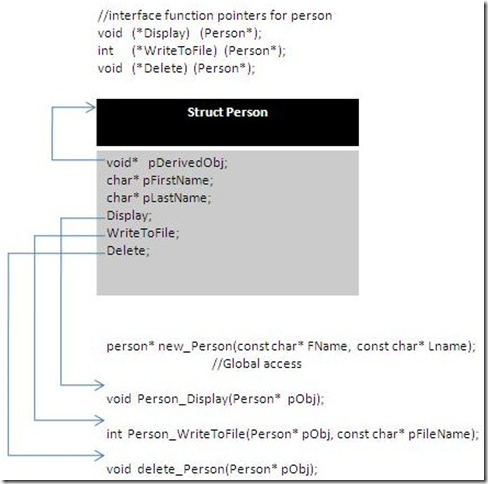
Person类的表示——检查初始化接口指向成员函数:
3.1、继承和多态的简单例子
继承-Employee类继承自Person类:
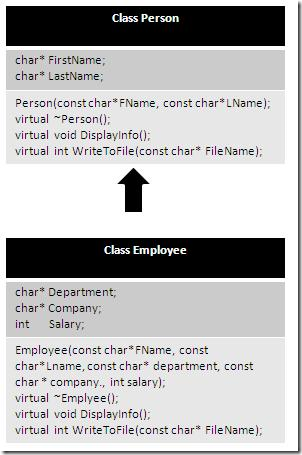
在上面的例子中,类Employee继承类Person的属性。因为DisplayInfo()和WriteToFile()函数是virtual的,我们能够从Person的实例访问Employee对象中的同名函数。为了实现这个,我们创建Person实例的时候也初始化Employee类。多态使这成为可能。在多态的情况下,去解析函数调用,C++使用VTable——即一张函数指针表。
前面我们在结构体中维护的指向函数的指针接口的作用类似于VTable。
//Polymorphism in C++
Person PersonObj("Anjali", "Jaiswal");
Employee EmployeeObj("Gauri", "Jaiswal", "HR", "TCS", 40000);
Person* ptrPersonObj = NULL;
//preson pointer pointing to person object
ptrPersonObj = &PersonObj;
//displaying person info
ptrPersonObj ->Display();
//writing person info in the persondata.txt file
ptrPersonObj ->WriteToFile("persondata.txt");
//preson pointer pointing to employee object
ptrPersonObj = &EmployeeObj;
//displaying employee info
ptrPersonObj ->Display();
//writing empolyee info in the employeedata.txt file
ptrPersonObj ->WriteToFile("employeedata.txt");
在C中,继承可以通过在派生类对象中维护一个基类对象的引用来完成。在基类实例的帮助下,women可以访问基类的数据成员和函数。然而,为了实现多态,街垒对象应该能够访问派生类对象的数据。为了实现这个,基类应该有访问派生类的数据成员的权限。
为了实现虚函数,派生类的函数签名应该和基类的函数指针类似。即派生类函数将以基类对象的一个实例为参数。我们在基类中维护一个派生类的引用。在函数实现上,我们可以从派生类的引用访问实际派生类的数据。
3.2、在C中结构体中的等效表示
C中的继承-Person和Employee结构体:
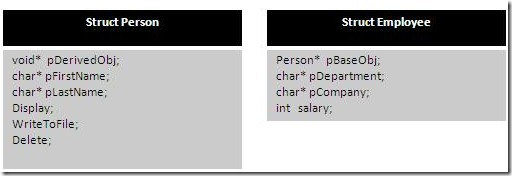
如图所示,我们在基类结构体中声明了一个指针保存派生类对像,并在派生类结构体中声明一个指针保存基类对象。
在基类对象中,函数指针指向自己的虚函数。在派生类对象的构造函数中,我们需要使基类的接口指向派生类的成员函数。这使我们可以通过基类对象(多态)灵活的调用派生类函数。更多细节,请检查Person和Employee对象的构造函数。
当我们讨论C++中的多态时,有一个对象销毁的问题。为了正确的清楚对象,它使用虚析构函数。在C中,这可以通过使基类的删除函数指针指向派生类的析构函数。派生类的析构函数清楚派生类的数据和基类的数据和对象。注意:检查例子的源码中,实现须构造函数和虚函数的实现细节。
创建Person对象
//Person.h
typedef struct _Person Person;
//pointers to function
typedef void    (*fptrDisplayInfo)(Person*);
typedef void    (*fptrWriteToFile)(Person*, const char*);
typedef void    (*fptrDelete)(Person*) ;
typedef struct _person
{
    void* pDerivedObj;
    char* pFirstName;
    char* pLastName;
    fptrDisplayInfo Display;
    fptrWriteToFile WriteToFile;
    fptrDelete        Delete;
}person;
Person* new_Person(const char* const pFristName,
                   const char* const pLastName);    //constructor
void delete_Person(Person* const pPersonObj);    //destructor
void Person_DisplayInfo(Person* const pPersonObj);
void Person_WriteToFile(Person* const pPersonObj, const char* const pFileName);
//Person.c
//construction of Person object
Person* new_Person(const char* const pFirstName, const char* const pLastName)
{
    Person* pObj = NULL;
    //allocating memory
    pObj = (Person*)malloc(sizeof(Person));
    if (pObj == NULL)
    {
        return NULL;
    }
    //pointing to itself as we are creating base class object
    pObj->pDerivedObj = pObj;
    pObj->pFirstName = malloc(sizeof(char)*(strlen(pFirstName)+1));
    if (pObj->pFirstName == NULL)
    {
        return NULL;
    }
    strcpy(pObj->pFirstName, pFirstName);
    pObj->pLastName = malloc(sizeof(char)*(strlen(pLastName)+1));
    if (pObj->pLastName == NULL)
    {
        return NULL;
    }
    strcpy(pObj->pLastName, pLastName);
    //Initializing interface for access to functions
    //destructor pointing to destrutor of itself
    pObj->Delete = delete_Person;
    pObj->Display = Person_DisplayInfo;
    pObj->WriteToFile = Person_WriteToFile;
    return pObj;
}
Person对象的结构
创建Employee对象
//Employee.h
#include "Person.h"
typedef struct _Employee Employee;
//Note: interface for this class is in the base class
//object since all functions are virtual.
//If there is any additional functions in employee add
//interface for those functions in this structure
typedef struct _Employee
{
    Person* pBaseObj;
    char* pDepartment;
    char* pCompany;
    int nSalary;
    //If there is any employee specific functions; add interface here.
}Employee;
Person* new_Employee(const char* const pFirstName, const char* const pLastName,
        const char* const pDepartment, const char* const pCompany,
        int nSalary);    //constructor
void delete_Employee(Person* const pPersonObj);    //destructor
void Employee_DisplayInfo(Person* const pPersonObj);
void Employee_WriteToFile(Person* const pPersonObj, const char* const pFileName);
//Employee.c
Person* new_Employee(const char* const pFirstName, const char* const pLastName,
                     const char* const pDepartment,
                     const char* const pCompany, int nSalary)
{
    Employee* pEmpObj;
    //calling base class construtor
    Person* pObj = new_Person(pFirstName, pLastName);
    //allocating memory
    pEmpObj = malloc(sizeof(Employee));
    if (pEmpObj == NULL)
    {
        pObj->Delete(pObj);
        return NULL;
    }
    pObj->pDerivedObj = pEmpObj; //pointing to derived object
    //initialising derived class members
    pEmpObj->pDepartment = malloc(sizeof(char)*(strlen(pDepartment)+1));
    if(pEmpObj->pDepartment == NULL)
    {
        return NULL;
    }
    strcpy(pEmpObj->pDepartment, pDepartment);
    pEmpObj->pCompany = malloc(sizeof(char)*(strlen(pCompany)+1));
    if(pEmpObj->pCompany== NULL)
    {
        return NULL;
    }
    strcpy(pEmpObj->pCompany, pCompany);
    pEmpObj->nSalary = nSalary;
    //Changing base class interface to access derived class functions
    //virtual destructor
    //person destructor pointing to destrutor of employee
    pObj->Delete = delete_Employee;
    pObj->Display = Employee_DisplayInfo;
    pObj->WriteToFile = Employee_WriteToFile;
    return pObj;
}
Employee对象的结构
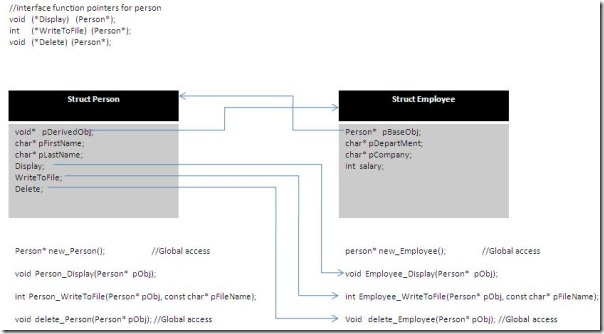
注意:从基类函数到派生类函数改变了接口(VTable)中指针位置。现在我们可以从基类(多态)访问派生类函数。我们来看如何使用多态。
Person* PersonObj = new_Person("Anjali", "Jaiswal");
Person* EmployeeObj = new_Employee("Gauri", "Jaiswal","HR", "TCS", 40000);
//accessing person object
//displaying person info
PersonObj->Display(PersonObj);
//writing person info in the persondata.txt file
PersonObj->WriteToFile(PersonObj,"persondata.txt");
//calling destructor
PersonObj->Delete(PersonObj);
//accessing to employee object
//displaying employee info
EmployeeObj->Display(EmployeeObj);
//writing empolyee info in the employeedata.txt file
EmployeeObj->WriteToFile(EmployeeObj, "employeedata.txt");
//calling destrutor
EmployeeObj->Delete(EmployeeObj);
结论
使用上面描述的简单的额外代码能是过程式C语言有多态和继承的特性。我们简单的使用函数指针创建一个VTable和在基类和派生类对象中交叉维护引用。用这些简单的步骤,我们在C中可以实现继承和多态。
声明:本文为译文,原文通道-[Inheritance and Polymorphism in
C](http://www.codeproject.com/KB/cpp/InheritancePolymorphismC.aspx)
例子代码下载:http://files.cnblogs.com/skynet/PolymorphisminC.zip