CocoaPods历险记04
原文出处:6. PodSpec 管理策略
本文目录
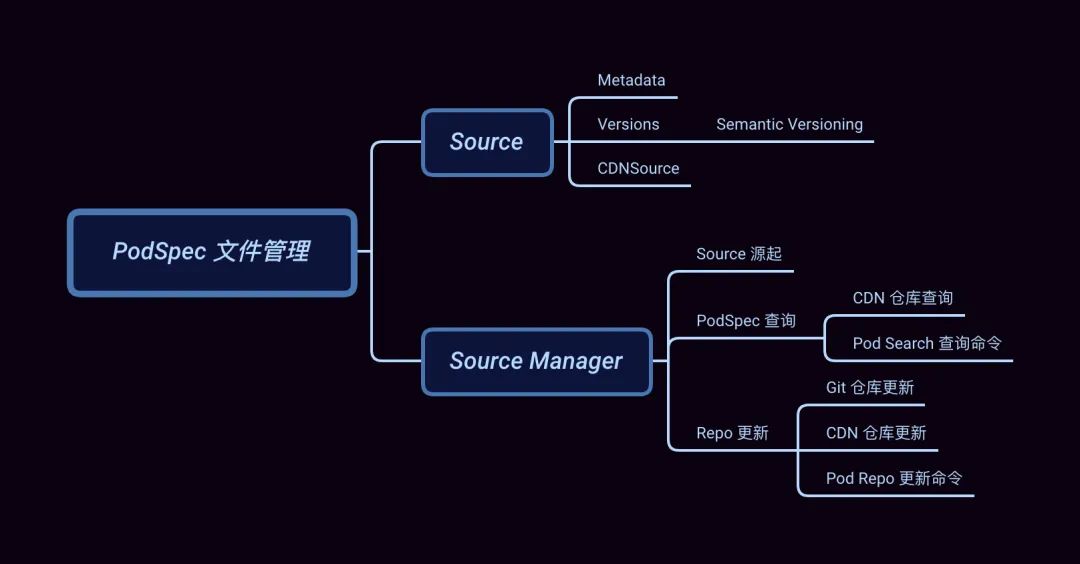
引子
本文是 Core 的最后一篇,它与另外两篇文章「Podfile 解析逻辑」和「PodSpec 文件分析」共同支撑起 CocoaPods 世界的骨架。
CocoaPods-Core 这个库之所以被命名为 Core 就是因为它包含了 Podfile -> Spec Repo -> PodSpec这条完整的链路,将散落各地的依赖库连接起来并基于此骨架不断地完善功能。
从提供各种便利的命令行工具,到依赖库与主项目的自动集成,再到提供多样的 Xcode 编译配置、单元测试、资源管理等等,最终形成了我们所见的CocoaPods。
今天我们就来聊聊 Spec Repo 这个 PodSpec 的聚合仓库以及它的演变与问题。
Source
作为 PodSpec 的聚合仓库,Spec Repo 记录着所有 pod 所发布的不同版本的 PodSpec 文件。该仓库对应到Core 的数据结构为 Source,即为今天的主角。
整个 Source 的结构比较简单,它基本是围绕着 Git 来做文章,主要是对 PodSpec 文件进行各种查找更新操作。结构如下:
## 用于检查 spec 是否符合当前 Source 要求
require 'cocoapods-core/source/acceptor'
## 记录本地 source 的集合
require 'cocoapods-core/source/aggregate'
## 用于校验 source 的错误和警告
require 'cocoapods-core/source/health_reporter'
## source 管理器
require 'cocoapods-core/source/manager'
## source 元数据
require 'cocoapods-core/source/metadata'

module Pod
  class Source
    ## 仓库默认的 Git 分支
    DEFAULT_SPECS_BRANCH = 'master'.freeze
    ## 记录仓库的元数据
    attr_reader :metadata
    ## 记录仓库的本地地址
    attr_reader :repo
    ## repo 仓库地址 ~/.cocoapods/repos/{repo_name}
    def initialize(repo)
      @repo = Pathname(repo).expand_path
      @versions_by_name = {}
      refresh_metadata
    end
    ## 读取 Git 仓库中的 remote url 或 .git 目录
    def url
      @url ||= begin
        remote = repo_git(%w(config --get remote.origin.url))
        if !remote.empty?
          remote
        elsif (repo + '.git').exist?
          "file://#{repo}/.git"
        end
      end
    end

    def type
      git? ? 'git' : 'file system'
    end
    ## ...
  end
end
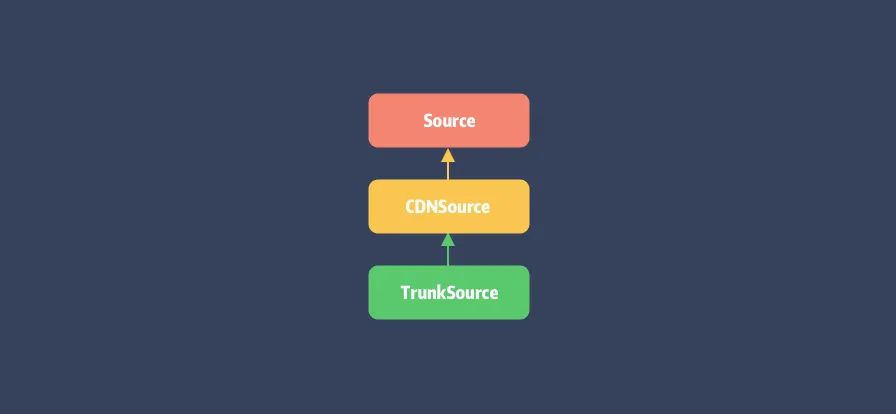
Source 还有两个子类 CDNSource 和 TrunkSource,TrunkSouce 是 CocoaPods 的默认仓库。
在版本 1.7.2 之前 Master Repo 的 URL 指向为 GitHub 的 Specs 仓库[1],这也是造成我们每次 pod install 或 pod update 慢的原因之一。
它不仅保存了近 10 年来 PodSpec 文件同时还包括 Git 记录,再加上墙的原因,每次更新都非常痛苦。
而在 1.7.2 之后 CocoaPods 的默认 Source 终于改为了 CDN 指向,同时支持按需下载,缓解了 pod 更新和磁盘占用过大问题。
Source 的依赖关系如下:
回到 Source 来看其如何初始化的,可以看到其构造函数 #initialize(repo) 将传入的 repo 地址保存后,直接调用了#refresh_metadata 来完成元数据的加载:
def refresh_metadata
  @metadata = Metadata.from_file(metadata_path)
end

def metadata_path
  repo + 'CocoaPods-version.yml'
end
Metadata
Metadata 是保存在 repo 目录下,名为 CocoaPods-version.yml 的文件,用于记录该 Source 所支持的 CocoaPods 的版本以及仓库的分片规则。
autoload :Digest, 'digest/md5'
require 'active_support/hash_with_indifferent_access'
require 'active_support/core_ext/hash/indifferent_access'

module Pod
  class Source
    class Metadata
      ## 最低可支持的 CocoaPods 版本,对应字段 `min`
      attr_reader :minimum_cocoapods_version
      ## 最高可支持的 CocoaPods 版本,对应字段 `max`
      attr_reader :maximum_cocoapods_version
      ## 最新 CocoaPods 版本,对应字段 `last`
      attr_reader :latest_cocoapods_version
      ## 规定截取的关键字段的前缀长度和数量
      attr_reader :prefix_lengths
      ## 可兼容的 CocoaPods 最新版本
      attr_reader :last_compatible_versions
      ## ...
    end
  end
end
这里以笔者 💻 环境中 Master 仓库下的 CocoaPods-version.yml 文件内容为例:
---
min: 1.0.0
last: 1.10.0.beta.1
prefix_lengths:
- 1
- 1
- 1
最低支持版本为 1.0.0,最新可用版本为 1.10.0.beta.1,以及最后这个 prefix_lengths 为 [1, 1, 1]的数组。那么这个 prefix_lengths 的作用是什么呢 ?
要回答这个问题,我们先来看一张 Spec Repo 的目录结构图:
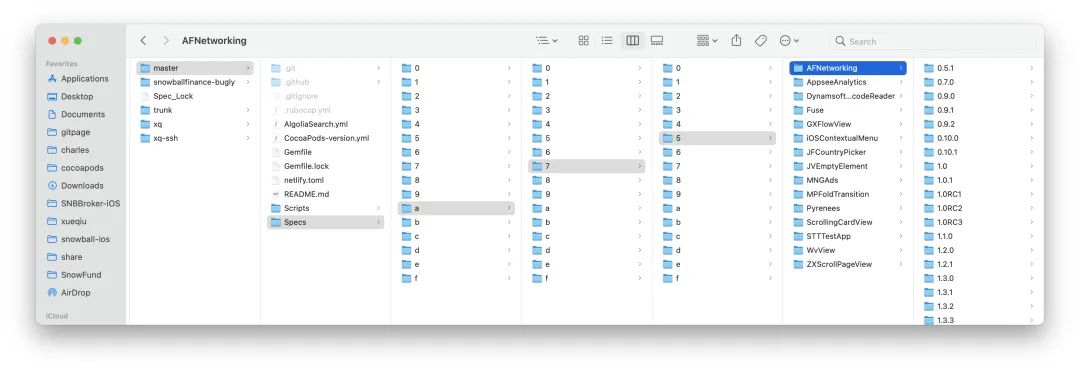
再 🤔 另外一个问题,为什么 CocoaPods 生成的目录结构是这样 ?
其实在 2016 年 CocoaPods Spec 仓库下的所有文件都在同级目录,不像现在这样做了分片。这个是为了解决当时用户的吐槽:GitHub 下载慢[2],最终解决方案的结果就如你所见:将 Git 仓库进行了分片。
那么问题来了,为什么分片能够提升 GitHub 下载速度?
很重要的一点是 CocoaPods 的 Spec Repo 本质上是 Git 仓库,而 Git 在做变更管理的时候,会记录目录的变更,每个子目录都会对应一个 Git model。
而当目录中的文件数量过多的时候,Git 要找出对应的变更就变得十分困难。有兴趣的同学可以查看官方说明[3]。
另外再补充一点,在 Linux 中最经典的一句话是:一切皆文件,不仅普通的文件和目录,就连块设备、管道、socket 等,也都是统一交给文件系统管理的。
也就是说就算不用 Git 来管理 Specs 仓库,当目录下存在数以万计的文件时,如何高效查找目标文件也是需要考虑的问题。
备注:关于文件系统层次结构有兴趣的同学可以查看FHS 标准[4],以及这篇文章:「一口气搞懂「文件系统」,就靠这 25 张图了」
回到 CocoaPods,如何对 Master 仓库目录进行分片就涉及到 metadata 类中的关键方法:
def path_fragment(pod_name, version = nil)
  prefixes = if prefix_lengths.empty?
               []
             else
               hashed = Digest::MD5.hexdigest(pod_name)
               prefix_lengths.map do |length|
                 hashed.slice!(0, length)
               end
             end
  prefixes.concat([pod_name, version]).compact
end
#path_fragment 会依据 pod_name 和 version 来生成 pod 对应的索引目录:
- 首先对
pod_name进行 MD5 计算获取摘要; - 遍历
prefix_lengths对生成的摘要不断截取指定的长度作为文件索引。
以 AFNetworking 为例:
$ Digest::MD5.hexdigest('AFNetworking')
"a75d452377f3996bdc4b623a5df25820"
由于我们的 prefix_lengths 为 [1, 1, 1] 数组,那么它将会从左到右依次截取出一个字母,即:a、7、5,这三个字母作为索引目录,它正好符合我们 👆 目录结构图中 AFNetworking 的所在位置。
Versions
要找到 Podfile 中限定版本号范围的 PodSpec 文件还需要需要最后一步,获取当前已发布的 Versions 列表,并通过比较Version 得出最终所需的 PodSpec 文件。
在上一步已通过 metadata 和 pod_name 计算出 pod 所在目录,接着就是找到 pod 目录下的 Versions 列表:
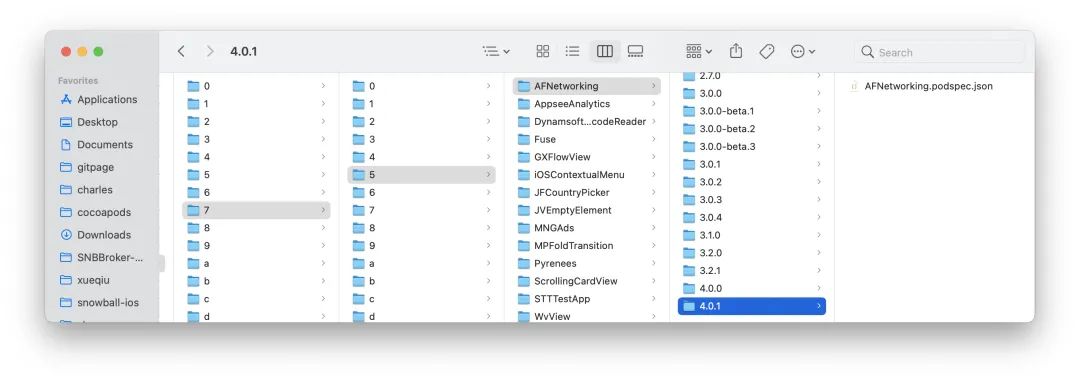
获取 Versions:
def versions(name)
  return nil unless specs_dir
  raise ArgumentError, 'No name' unless name
  pod_dir = pod_path(name)
  return unless pod_dir.exist?
  @versions_by_name[name] ||= pod_dir.children.map do |v|
    basename = v.basename.to_s
    begin
      Version.new(basename) if v.directory? && basename[0, 1] != '.'
    rescue ArgumentError
    raise Informative, 'An unexpected version directory ...'
    end
  end.compact.sort.reverse
end
该方法重点在于将 pod_dir 下的每个目录都转换成为了 Version 类型,并在最后进行了 sort 排序。
#versions方法主要在pod search命令中被调用,后续会介绍。
来搂一眼 Version 类:
class Version < Pod::Vendor::Gem::Version
  METADATA_PATTERN = '(\+[0-9a-zA-Z\-\.]+)'
  VERSION_PATTERN = "[0-9]+(\\.[0-9a-zA-Z\\-]+)*#{METADATA_PATTERN}?"
  ## ...
end
该 Version 继承于 Gem::Version[6] 并对其进行了扩展,实现了语义化版本号的标准,sort 排序也是基于语义化的版本来比较的,这里我们稍微展开一下。
Semantic Versioning
语义化版本号(Semantic Versioning[7] 简称:SemVer)绝对是依赖管理工具绕不开的坎。
语义化的版本就是让版本号更具语义化,可以传达出关于软件本身的一些重要信息而不只是简单的一串数字。
我们每次对 Pod 依赖进行更新,最后最重要的一步就是更新正确的版本号,一旦发布出去,再要更改就比较麻烦了。
SemVer[8] 是由 Tom Preston-Werner 发起的一个关于软件版本号的命名规范,该作者为 Gravatars 创办者同时也是 GitHub 联合创始人。
那什么是语义化版本号有什么特别呢 ?我们以 AFNetworking 的 release tag 示例:
3.0.0
3.0.0-beta.1
3.0.0-beta.2
3.0.0-beta.3
3.0.1
这些 tags 并非随意递增的,它们背后正是遵循了语义化版本的标准。
基本规则
- 软件的版本通常由三位组成,如:X.Y.Z。
- 版本是严格递增的,
- 在发布重要版本时,可以发布 alpha, rc 等先行版本,
- alpha 和 rc 等修饰版本的关键字后面可以带上次数和 meta 信息,
版本格式:
主版本号.次版本号.修订号
版本号递增规则如下:
| Code status | Stage | Example version |
|---|---|---|
| 新品首发 | 从 1.0.0 开始 | 1.0.0 |
| 向后兼容的 BugFix | 增加补丁号 Z | 1.0.1 |
| 向后兼容的 Feature | 增加次版本号 Y | 1.1.0 |
| 向后不兼容的改动 | 增加主版本号 X | 2.0.0 |
| 重要版本的预览版 | 补丁号后添加 alpha, rc | 2.1.0-rc.0 |
关于 CocoaPods 的 Version 使用描述,传送门[9]。
CDNSource
CocoaPods 在 1.7.2 版本正式将 Master 仓库托管到 Netlify 的 CDN 上,当时关于如何支持这一特性的文章和说明铺天盖地,这里还是推荐大家看官方说明[10]。另外,当时感受是似乎国内的部分 iOS 同学都炸了,各种标题党:什么最完美的升级 等等。
所以这里明确一下,对于 CocoaPods 的 Master 仓库支持了 CDN 的行为,仅解决了两个问题:
- 利用 CDN 节点的全球化部署解决内容分发慢,提高 Specs 资源的下载速度。
- 通过 Specs 按需下载摆脱了原有 Git Repo 模式下本地仓库的磁盘占用过大,操作卡的问题。
然而,仅仅对 PodSpec 增加了 CDN 根本没能解决 GFW 导致的 GitHub 源码校验、更新、下载慢的问题。只能说路漫漫其修远兮。
PS:作为 iOS 工程师,就经常被前端同学吐槽:你看这 CocoaPods 也太垃圾了吧!!!一旦删掉
Pods目录重新 install 就卡半天,缓存基本不生效,哪像 npm 多快 balabala ...
先来看 CDNSource 结构:
require 'cocoapods-core/source'
## ...
module Pod
  class CDNSource < Source
    def initialize(repo)
      ## 标记是否正在同步文件
      @check_existing_files_for_update = false
      ## 记录时间用于对比下载文件的新旧程度,以确认是否需要更新保存所下的资源
      @startup_time = Time.new
      ## 缓存查询过的 PodSpec 资源
      @version_arrays_by_fragment_by_name = {}
      super(repo)
    end

    def url
      @url ||= File.read(repo.join('.url')).chomp.chomp('/') + '/'
    end

    def type
      'CDN'
    end
    ## ...
  end
end
Source 类是基于 GitHub Repo 来同步更新 PodSpec,而 CDNSource 则是基于 CDN 服务所返回的 Response,因此将 Source 类的大部分方法重写了一个遍,具体会在 SourceManager 一节来展开。
最后看一下 TrunkSource 类:
module Pod
  class TrunkSource < CDNSource
    ## 新版落盘后仓库名称
    TRUNK_REPO_NAME = 'trunk'.freeze

    TRUNK_REPO_URL = 'https://cdn.cocoapods.org/'.freeze

    def url
      @url ||= TRUNK_REPO_URL
      super
    end
  end
end
核心就是重写了返回的 url,由于旧版 Spec 仓库名称为 master 为了加以区分,CDN 仓库则改名为 trunk。
Source Manager
Manager 作为 source 的管理类,其主要任务为 source 的添加和获取,而对 PodSpec 文件的更新和查找行为则交由 source 各自实现。不过由于一个 pod 库可能对应多个不同的 source,这里又产生出 Aggregate 类来统一 PodSpec 的查询。
它们的关系如下:
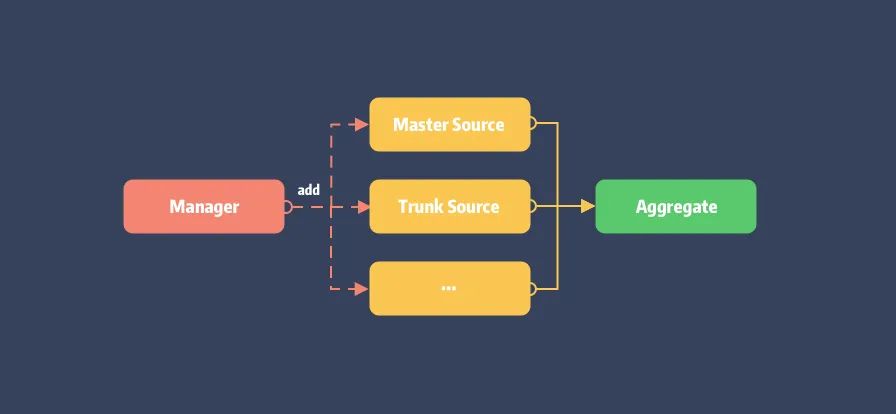
Manager 实现:
module Pod
  class Source
    class Manager
      attr_reader :repos_dir

      def initialize(repos_dir)
        @repos_dir = Pathname(repos_dir).expand_path
      end

      def source_repos
        return [] unless repos_dir.exist?
        repos_dir.children.select(&:directory?).sort_by { |d| d.basename.to_s.downcase }
      end

      def aggregate
        aggregate_with_repos(source_repos)
      end

      def aggregate_with_repos(repos)
        sources = repos.map { |path| source_from_path(path) }
        @aggregates_by_repos ||= {}
        @aggregates_by_repos[repos] ||= Source::Aggregate.new(sources)
      end

      def all
        aggregate.sources
      end
      ## ...
    end
  end
end
Manager 类的初始化仅需要传入当前 repos 目录,即 ~/.cocoapods/repos,而 Aggregate 的生成则保存 repos_dir 了目录下的 Source,用于后续处理。
先看 Source 的生成,在 #source_from_path 中:
def source_from_path(path)
  @sources_by_path ||= Hash.new do |hash, key|
    hash[key] = case
                when key.basename.to_s == Pod::TrunkSource::TRUNK_REPO_NAME
                  TrunkSource.new(key)
                when (key + '.url').exist?
                  CDNSource.new(key)
                else
                  Source.new(key)
                end
  end
  @sources_by_path[path]
end
以 repos_dir 下的目录名称来区分类型,而 CDNSource 则需要确保其目录下存在名为 .url 的文件。同时会对生成的 source 进行缓存。
最后看 Aggregate 结构,核心就两个 search 方法:
module Pod
  class Source
    class Aggregate
      attr_reader :sources

      def initialize(sources)
        raise "Cannot initialize an aggregate with a nil source: (#{sources})" if sources.include?(nil)
        @sources = sources
      end
      ## 查询依赖对应的 specs
      def search(dependency) ... end

      ## 查询某个 pod 以发布的 specs
      def search_by_name(query, full_text_search = false) ... end

      ## ...
  end
end
Source 源起
本节我们来谈谈 source 是如何添加到 repo_dir 目录下的。
由前面的介绍可知,每个 source 中自带 url,在 Source 类中 url 读取自 Git 仓库的 remote.origin.url 或本地 .git 目录,而在 CDNSource 中 url 则是读取自当前目录下的 .url 文件所保存的 URL 地址。
那 CDNSource 的 .url 文件是在什么时候被写入的呢 ?
这需要从 Podfile 说起。很多老项目的 Podfile 开头部分大都会有一行或多行 source 命令:
source 'https://github.com/CocoaPods/Specs.git'
source 'https://github.com/artsy/Specs.git'
用于指定项目中 PodSpec 的查找源,这些指定源最终会保存在 ~/.cocoapods/repos 目录下的仓库。
当敲下 pod install 命令后,在 #resolve_dependencies 阶段的依赖分析中将同时完成 sources 的初始化。
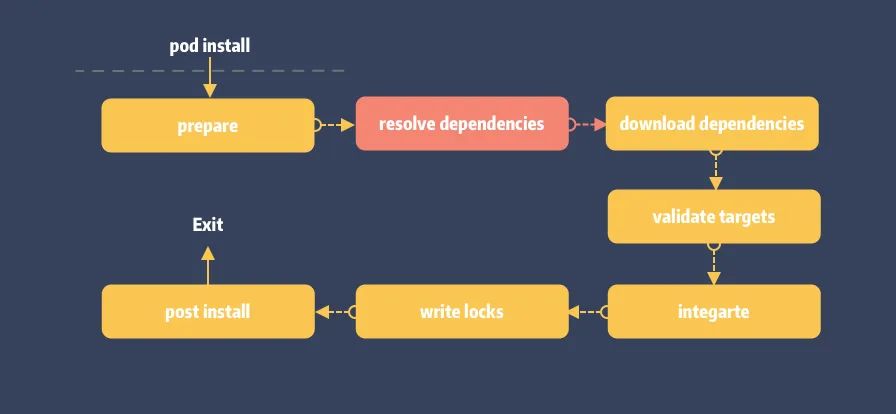
## lib/cocoapods/installer/analyzer.rb

def sources
  @sources ||= begin
    ## 省略获取 podfile、plugins、dependencies 的 source url ...
    sources = ...

    result = sources.uniq.map do |source_url|
      sources_manager.find_or_create_source_with_url(source_url)
    end
    unless plugin_sources.empty?
      result.insert(0, *plugin_sources)
      plugin_sources.each do |source|
        sources_manager.add_source(source)
      end
    end
    result
  end
end
获取 sources url 之后会通过 sources_manager 来完成 source 更新,逻辑在 CocoaPods 项目的 Manager 扩展中:
## lib/cocoapods/sources_manager.rb

module Pod
  class Source
    class Manager

      def find_or_create_source_with_url(url)
        source_with_url(url) || create_source_with_url(url)
      end

      def create_source_with_url(url)
        name = name_for_url(url)
        is_cdn = cdn_url?(url)
    ## ...
        begin
          if is_cdn
            Command::Repo::AddCDN.parse([name, url]).run
          else
            Command::Repo::Add.parse([name, url]).run
          end
        rescue Informative => e
          raise Informative, ## ...
        ensure
          UI.title_level = previous_title_level
        end
        source = source_with_url(url)
        raise "Unable to create a source with URL #{url}" unless source
        source
      end
      ## ...
    end
  end
end
查找会先调用 #source_with_url 进行缓存查询,如未命中则会先下载 Source 仓库,结束后重刷 aggreate 以更新 source。
## lib/cocoapods-core/source/manager.rb

def source_with_url(url)
  url = canonic_url(url)
  url = 'https://github.com/cocoapods/specs' if url =~ %r{github.com[:/]+cocoapods/specs}
  all.find do |source|
    source.url && canonic_url(source.url) == url
  end
end

def canonic_url(url)
  url.downcase.gsub(/\.git$/, '').gsub(%r{\/$}, '')
end
另外,仓库的下载的则会通过 #cdn_url? 方法区分,最后的下载则包裹在两个命令类中,概括如下:
- Repo::AddCDN:即
pod repo add-cdn命令,仅有的操作是将 url 写入.url文件中。 - Repo::Add:即
pod repo add命令,对于普通类型的 Source 仓库下载本质就是git clone操作。
简化后源的添加流程如下:
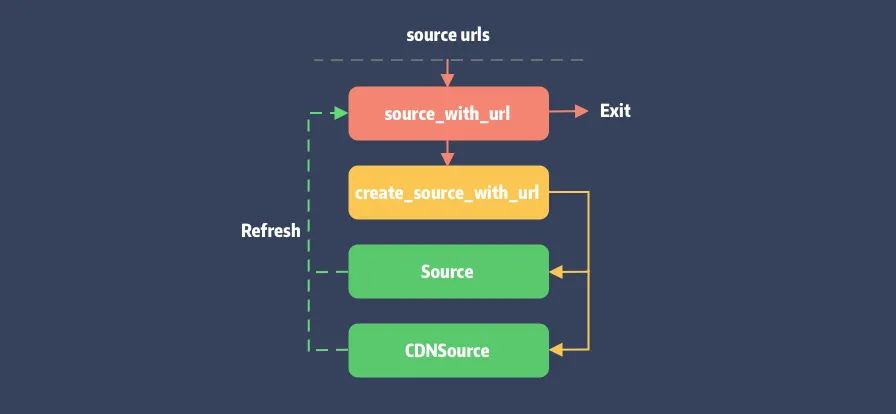
PodSpec 查询
同样在 #resolve_dependencies 的依赖仲裁阶段,当 Molinillo 依赖仲裁开始前,会触发缓存查询 #find_cached_set 并最终调用到 Aggregate 的 #search。完整调用栈放在 gist[11] 上。
我们来看看 #search 入口:
## lib/cocoapods-core/source/aggregate.rb

def search(dependency)
  found_sources = sources.select { |s| s.search(dependency) }
  unless found_sources.empty?
    Specification::Set.new(dependency.root_name, found_sources)
  end
end
Aggregate 先遍历当前 sources 并进行 dependency 查找。由于 Git 仓库保存了完整的 PodSpecs,只要能在分片目录下查询到对应文件即可,最终结果会塞入 Specification::Set 返回。
Specification::Set记录了当前 pod 关联的 Source,一个 pod 可能存在与多个不同的 Spec 仓库 中。
CDN 仓库查询
CDNSource 重写了 #search 实现:
## lib/cocoapods-core/cdn_source.rb

def search(query)
  unless specs_dir
    raise Informative, "Unable to find a source named: `#{name}`"
  end
  if query.is_a?(Dependency)
    query = query.root_name
  end

  fragment = pod_shard_fragment(query)
  ensure_versions_file_loaded(fragment)
  version_arrays_by_name = @version_arrays_by_fragment_by_name[fragment] || {}

  found = version_arrays_by_name[query].nil? ? nil : query

  if found
    set = set(query)
    set if set.specification_name == query
  end
end
逻辑两步走:
通过
#ensure_versions_file_loaded检查all_pods_versions文件,如果不存在会进行下载操作。如果当前 source 包含查询的 pod,会创建
Specification::Set作为查询结果,并在#specification_name方法内完成PodSpec的检查和下载。
1. all_pods_versions 文件下载
依据前面提到的分片规则会将 pod 名称 MD5 分割后拼成 URL。
以 AFNetworking 为例,经 #pod_shard_fragment 分割后获取的 fragment 为 [a, 7, 5],则拼接后的 URL 为 https://cdn.cocoapods.org/all_pods_versions_a_7_5.txt,下载后的内容大致如下:
AFNetworking/0.10.0/0.10.1/.../4.0.1
AppseeAnalytics/2.4.7/2.4.8/2.4.8.0/...
DynamsoftBarcodeReader/7.1.0/...
...
所包含的这些 pod 都是分片后得到的相同的地址,因此会保存在同一份 all_pods_versions 中。
def ensure_versions_file_loaded(fragment)
  return if !@version_arrays_by_fragment_by_name[fragment].nil? && !@check_existing_files_for_update

  index_file_name = index_file_name_for_fragment(fragment)
  download_file(index_file_name)
  versions_raw = local_file(index_file_name, &:to_a).map(&:chomp)
  @version_arrays_by_fragment_by_name[fragment] = versions_raw.reduce({}) do |hash, row|
    row = row.split('/')
    pod = row.shift
    versions = row

    hash[pod] = versions
    hash
  end
end

def index_file_name_for_fragment(fragment)
  fragment_joined = fragment.join('_')
  fragment_joined = '_' + fragment_joined unless fragment.empty?
  "all_pods_versions#{fragment_joined}.txt"
end
另外每一份 pods_version 都会对应生成一个文件用于保存 ETag,具体会在下一节会介绍。
2. PodSpec 文件下载
#specification_name 将从 all_pods_versions 索引文件中找出该 pod 所发布的版本号,依次检查下载对应版本的PodSpec.json 文件。
module Pod
  class Specification
    class Set
      attr_reader :name
      attr_reader :sources

      def specification_name
        versions_by_source.each do |source, versions|
          next unless version = versions.first
          return source.specification(name, version).name
        end
        nil
      end

      def versions_by_source
        @versions_by_source ||= sources.each_with_object({}) do |source, result|
          result[source] = source.versions(name)
        end
      end
      ## ...
    end
  end
end
绕了一圈后回到 Source 的 #versions 方法,由于 CDN Source 不会全量下载 pod 的 PodSpec 文件,在 #version[12] 的检查过程会进行下载操作。
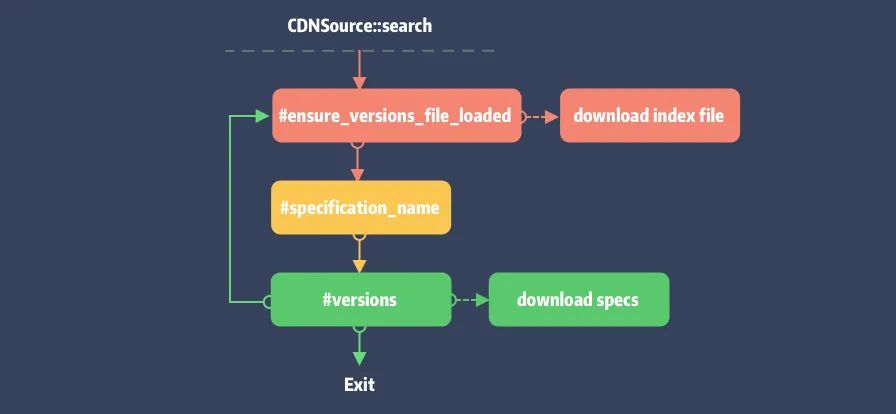
Pod Search 查询命令
CocoaPods 还提供了命令行工具 cocoapods-search 用于已发布的 PodSpec 查找:
$ pod search `QUERY`
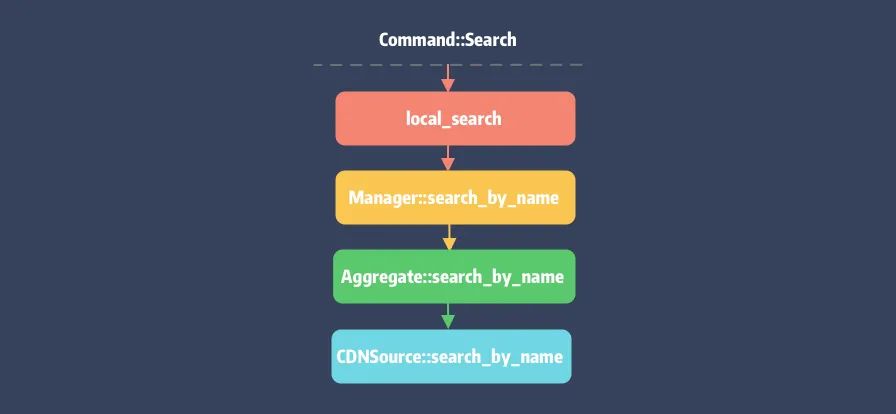
它提供了 Web 查询和本地查询。本地查询则不同于 #search,它需要调用 Aggregate 的 #search_by_name ,其实现同 #search 类似,最终也会走到 Source 的 #versions[13] 方法。
注意,Gti 仓库的
#search_by_name查询仍旧为文件查找,不会调用其#versions方法。
Repo 更新
pod install 执行过程如果带上了 \--repo-update 命令则在 #resolve_dependencies 阶段会触发 #update_repositories 更新 Spec 仓库:
## lib/cocoapods/installer/analyzer.rb

def update_repositories
  sources.each do |source|
    if source.updateable?
      sources_manager.update(source.name, true)
    else
      UI.message "Skipping ..."
    end
  end
  @specs_updated = true
end
不过 #update 的实现逻辑在 CocoaPods 项目的 Manager 扩展中:
## lib/cocoapods/sources_managers.rb

def update(source_name = nil, show_output = false)
  if source_name
    sources = [updateable_source_named(source_name)]
  else
    sources = updateable_sources
  end

  changed_spec_paths = {}

  ## Do not perform an update if the repos dir has not been setup yet.
  return unless repos_dir.exist?

  File.open("#{repos_dir}/Spec_Lock", File::CREAT) do |f|
    f.flock(File::LOCK_EX)
    sources.each do |source|
      UI.section "Updating spec repo `#{source.name}`" do
        changed_source_paths = source.update(show_output)
        changed_spec_paths[source] = changed_source_paths if changed_source_paths.count > 0
        source.verify_compatibility!
      end
    end
  end
  update_search_index_if_needed_in_background(changed_spec_paths)
end
获取指定名称的 source,对 aggregate 返回的全部 sources 进行 filter,如未指定则 sources 全量。
挨个调用
source.update(show_output),注意 Git 和 CDN 仓库的更新方式的不同。
Git 仓库更新
Git 仓库更新本质就是 Git 操作,即 git pull、git checkout 命令:
def update(show_output)
  return [] if unchanged_github_repo?
  prev_commit_hash = git_commit_hash
  update_git_repo(show_output)
  @versions_by_name.clear
  refresh_metadata
  if version = metadata.last_compatible_version(Version.new(CORE_VERSION))
    tag = "v#{version}"
    CoreUI.warn "Using the ..."
    repo_git(['checkout', tag])
  end
  diff_until_commit_hash(prev_commit_hash)
end
#update_git_repo 就是 git fetch + git reset --hard [HEAD] 的结合体,更新后会进行 cocoapods 版本兼容检查,最终输出 diff 信息。
CDN 仓库更新
Git 仓库是可以通过 Commit 信息来进行增量更新,那以静态资源方式缓存的 CDN 仓库是如何更新数据的呢 ?
像浏览器或本地缓存本质是利用 ETag 来进行 Cache-Control,关于 CDN 缓存可以看这篇:传送门[14]。
而 ETag 就是一串字符,内容通常是数据的哈希值,由服务器返回。首次请求后会在本地缓存起来,并在后续的请求中携带上 ETag 来确定缓存是否需要更新。如果 ETag 值相同,说明资源未更改,服务器会返回 304(Not Modified)响应码。
Core 的实现也是如此,它会将各请求所对应的 ETag 以文件形式存储:
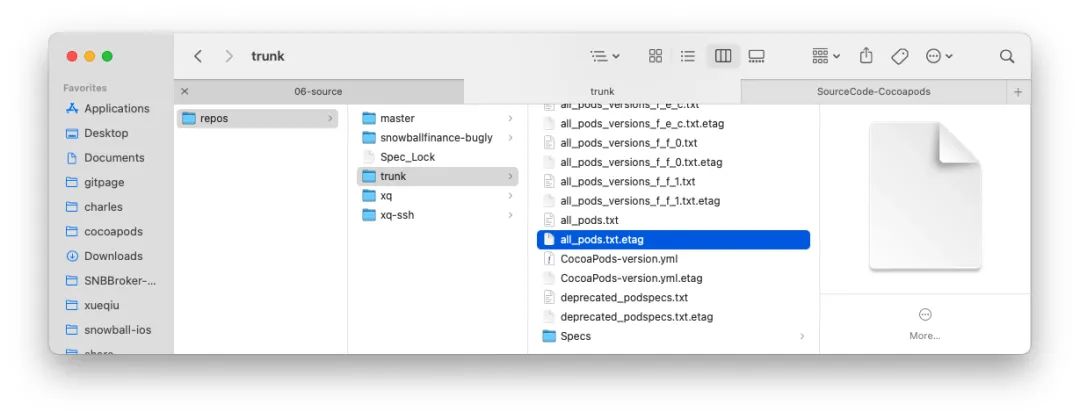
注意,在这个阶段 CDNSource 仅仅是更新当前目录下的索引文件,即 all_pods_versions_x_x_x.txt。
def update(_show_output)
  @check_existing_files_for_update = true
  begin
    preheat_existing_files
  ensure
    @check_existing_files_for_update = false
  end
  []
end

def preheat_existing_files
  files_to_update = files_definitely_to_update + deprecated_local_podspecs - ['deprecated_podspecs.txt']

  concurrent_requests_catching_errors do
    loaders = files_to_update.map do |file|
      download_file_async(file)
    end
    Promises.zip_futures_on(HYDRA_EXECUTOR, *loaders).wait!
  end
end
Pod Repo 更新命令
CocoaPods 对于 sources 仓库的更新也提供了命令行工具:
$ pod repo update `[NAME]`
其实现如下:
## lib/cocoapods/command/repo/update.rb

module Pod
  class Command
    class Repo < Command
      class Update < Repo
        def run
          show_output = !config.silent?
          config.sources_manager.update(@name, show_output)
          exclude_repos_dir_from_backup
        end
        ## ...
      end
    end
  end
end
在命令初始化时会保存指定的 Source 仓库名称 @name,接着通过 Mixin 的 config 来获取 sources_manager触发更新。
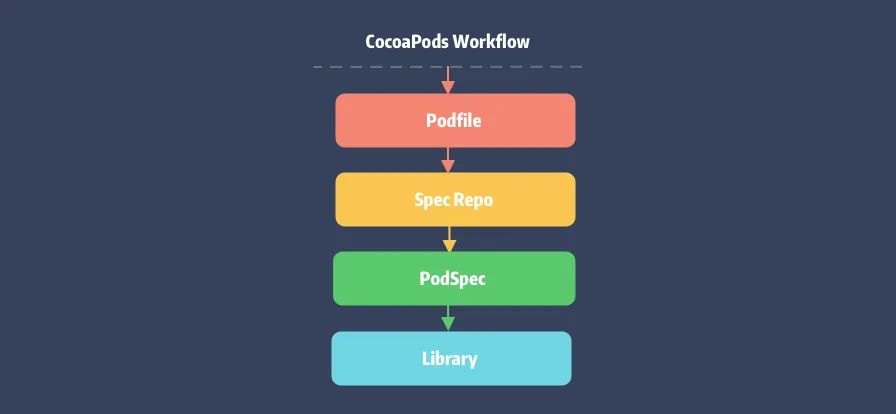
最后用一张图来收尾 CocoaPods Workflow:
总结
最后一篇 Core 的分析文章,重点介绍了它是如何管理 PodSpec 仓库以及 PodSpec 文件的更新和查找,总结如下:
了解 Source Manager 的各种数据结构以及它们之间的相互关系,各个类之间居然都做到了权责分明。
通过对 Metadata 的分析了解了 Source 仓库的演变过程,并剖析了存在的问题。
掌握了如何利用 CDN 来改造原有的 Git 仓库,优化 PodSpec 下载速度。
发现原来 CLI 工具不仅仅可以提供给用户使用,内部调用也不是不可以。
知识点问题梳理
这里罗列了五个问题用来考察你是否已经掌握了这篇文章,可以在评论区依次作答。如果没有掌握建议你加入收藏再次阅读:
逻辑两步走:
PodSpecs的聚合类有哪些,可以通过哪些手段来区分他们的类型?说说你对
Aggregate类的理解,以及它的主要作用?Source类是如何更新PodSpec?Core 是如何对仓库进行分片的,它的分片方式是否支持配置?
CDN 仓库是如何来更新
PodSpec文件?
参考资料
- Specs 仓库
- GitHub 下载慢
- 官方说明
- FHS 标准
- 传送门
- Gem::Version
- Semantic Versioning
- SemVer
- 传送门
- 官方说明
- gist
- version
- versions
- 传送门
原文出处:7. Molinillo 依赖校验
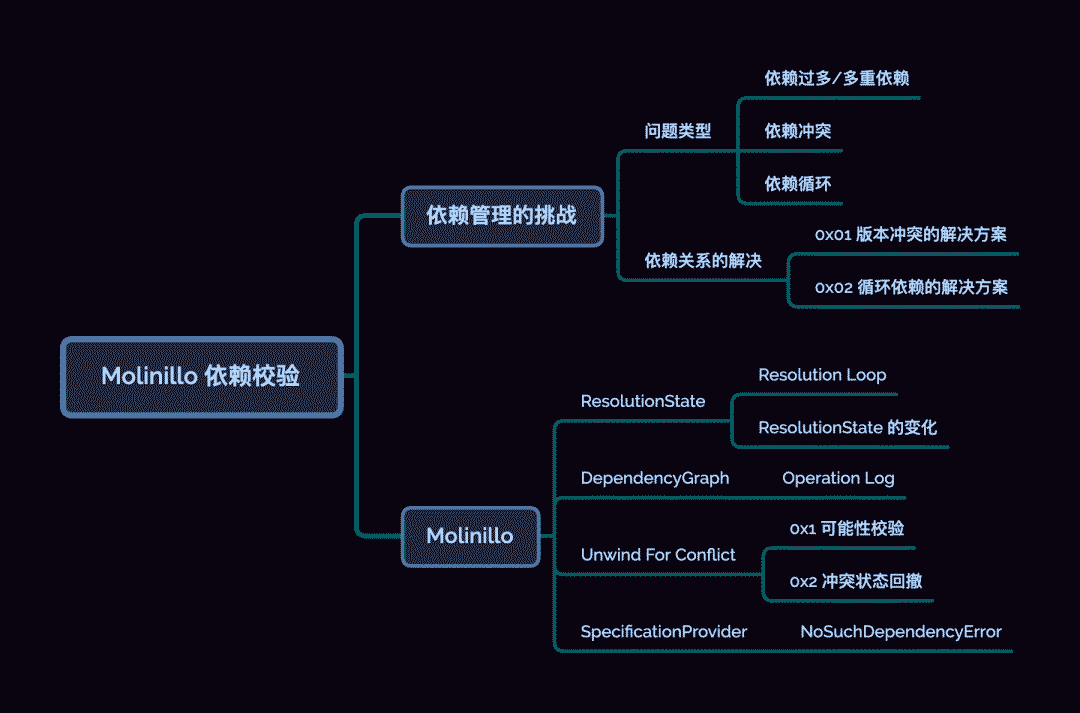
引子
通过「PodSpec 管理策略」对 CocaPods-Core 的分析,我们大体了解了 Pod 是如何被解析、查询与管理的。有了这些整体概念之后,我们就可以逐步深入 pod install 的各个细节。
今天我们就来聊聊 Pod 的依赖校验工具 --- Molinillo[1]。
开始前,需要聊聊依赖校验的背景。
依赖管理的挑战
同大多数包管理工具一样 Pod 会将传递依赖的包用扁平化的形式,安装至 workspace 目录 (即:Pods/)。
依赖传递:pod A 依赖于 pod B,而 pod B 依赖 Alamofire。
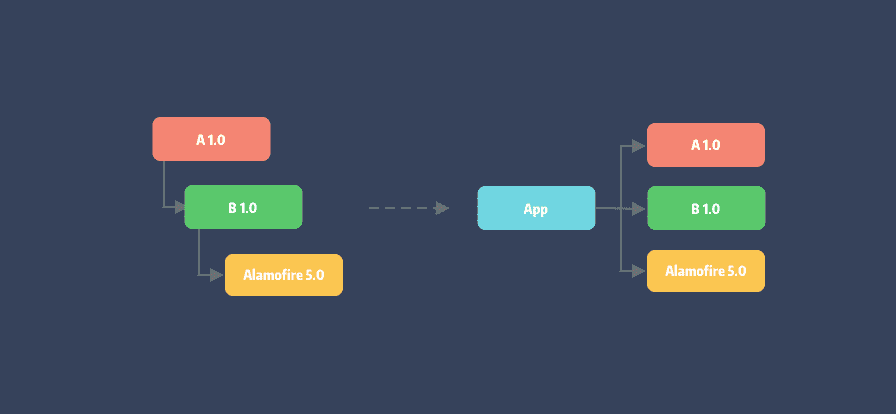
可以看到,经依赖解析原有的依赖树被拍平了,安装在同层目录中。
然而在大型项目中,遇到的更多情况可能像下面这样:
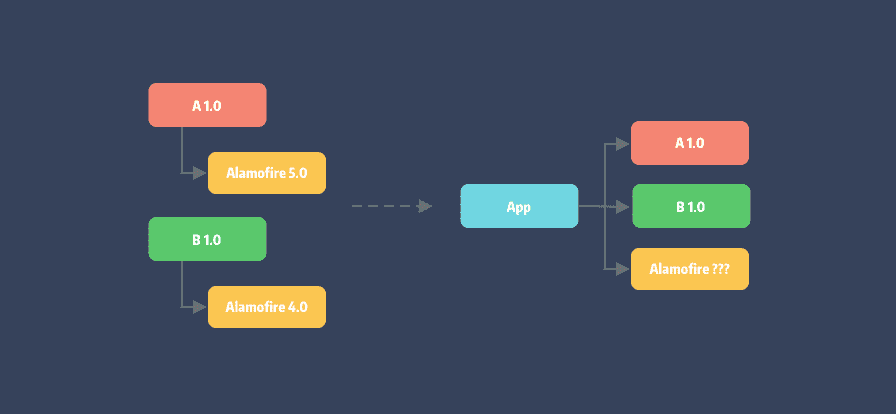
依赖冲突: 即 pod A 和 pod B 分别依赖不同版本的 Alamofire。这就是 依赖地狱[2] 的开始。
依赖地狱:指在操作系统中由于软件之间的依赖性不能被满足而引发的问题。
随着项目的迭代,我们不断引入依赖并最终形成错综复杂的网络。这使得项目的依赖性解析变得异常困难,甚至出现 致命错误[3]。
那么,产生的问题有哪些类型 ?
问题类型
依赖过多/多重依赖
即项目存在大量依赖关系,或者依赖本身有其自身依赖(依赖传递),导致依赖层级过深。像微信或淘宝这样的超级应用,其中的单一业务模块都可能存在这些问题,这将使得依赖解析过于复杂,且容易产生依赖冲突和依赖循环。
依赖冲突
即项目中的两个依赖包无法共存的情况。可能两个依赖库内部的代码冲突,也可能其底层依赖互相冲突。上面例子中因 Alamofire 版本不同产生的问题就是依赖冲突。
依赖循环
即依赖性关系形成一个闭合环路。如下图三个 pod 库之间互相依赖产生循环:
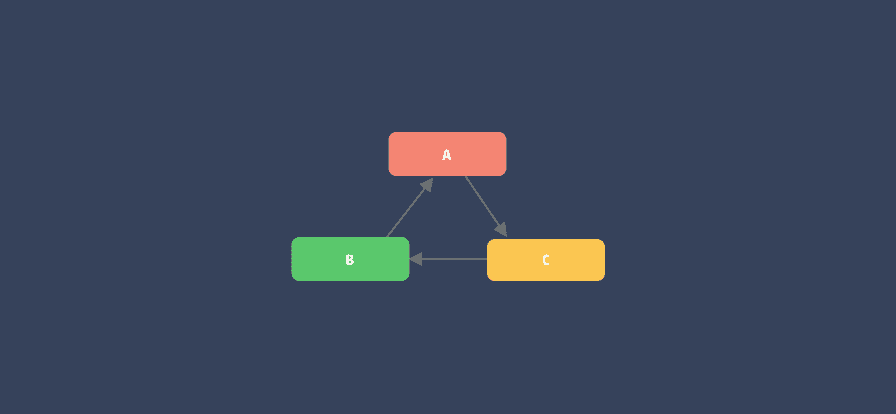
要判断依赖关系中是否存在依赖环,则需要通依赖仲裁算法来解决。
依赖关系的解决
对于依赖过多或者多重依赖问题,我们可通过合理的架构和设计模式来解决。而依赖校验主要解决的问题为:
- 检查依赖图是否存在版本冲突;
- 判断依赖图是否存在循环依赖;
版本冲突的解决方案
对于版本冲突可通过修改指定版本为带兼容性的版本范围问题来避免。如上面的问题有两个解决方案:
- 通过修改两个
pod的Alamofire版本约束为~> 4.0来解决。 - 去除两个
pod的版本约束,交由项目中的Podfile来指定。
不过这样会有一个隐患,由于两个 Pod 使用的主版本不同,可能带来 API 不兼容,导致 pod install
即使成功了,最终也无法编译或运行时报错。
还有一种解决方案,是基于语言特性来进行依赖性隔离。如 npm 的每个传递依赖包如果冲突都可以有自己的 node_modules 依赖目录,即一个依赖库可以存在多个不同版本。
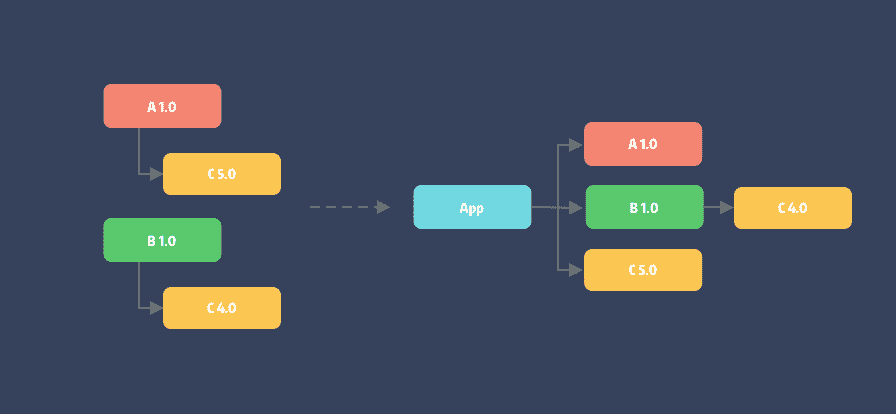
循环依赖的解决方案
循环依赖则需要需要进行数学建模生成 DAG 图,利用拓扑排序的拆点进行处理。通过确定依赖图是否为 DAG 图,来验证依赖关系的合理性。
一个 DAG 图的示例:
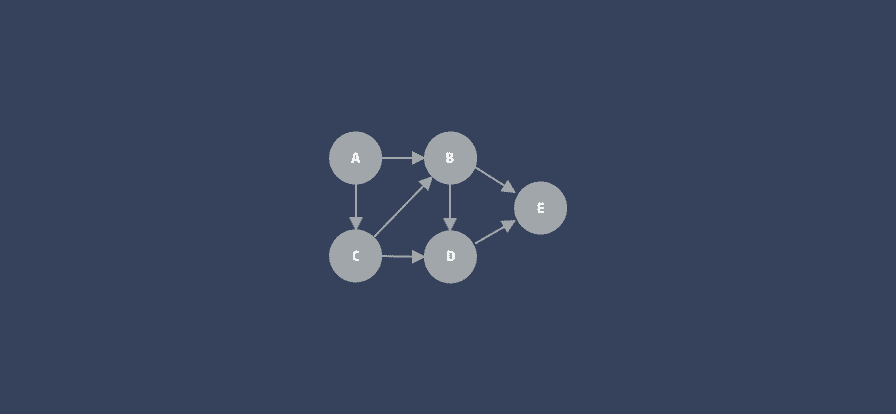
DAG 是图论中常见的一种描述问题的结构,全称 有向无环图 (Directed Acyclic Graph)。想了解更多,可查看冬瓜的文章 「从拓扑排序到 Carthage 依赖校验算法」。
另外,各种包管理工具的依赖校验算法也各不相同,有如 Dart 和 SwiftPM 所使用的 PubGrub[4],作者号称其为下一代依赖校验算法,Yarn 的 Selective dependency resolutions[5],还有我们今天聊到的 Molinillo。
Molinillo
Molinillo 作为通用的依赖解析工具,它不仅应用在 CocoaPods 中,在 Bundler 1.9 版本也采用 Molinillo。另外,值得注意的是 Bundler 在 Ruby 2.6 中被作为了默认的 Gem 工具内嵌。可以说 Ruby 相关的依赖工具都通过 Molinillo 完成依赖解析。
ResolutionState
Molinillo 算法的核心是基于回溯 (Backtracking)[6] 和 向前检查 (forward checking)),整个过程会追踪栈中的两个状态 DependencyState 和 PossibilityState。
module Molinillo
  ## 解析状态
  ResolutionState = Struct.new(
    ## [String] 当前需求名称
    :name,
    ## [Array<Object>] 未处理的需求
    :requirements,
    ## [DependencyGraph] 依赖关系图
    :activated,
    ## [Object] 当前需求
    :requirement,
    ## [Object] 满足当前需求的可能性
    :possibilities,
    ## [Integer] 解析深度
    :depth,
    ## [Hash] 未解决的冲突,以需求名为 key
    :conflicts,
    ## [Array<UnwindDetails>] 记录着未处理过的需要用于回溯的信息
    :unused_unwind_options
  )

  class ResolutionState
    def self.empty
      new(nil, [], DependencyGraph.new, nil, nil, 0, {}, [])
    end
  end

  ## 记录一组需求和满足当前需求的可能性
  class DependencyState < ResolutionState
  ## 通过不断 pop 过滤包含的可能性,找出最符合需求的解
    def pop_possibility_state
      PossibilityState.new(
        name,
        requirements.dup,
        activated,
        requirement,
        [possibilities.pop],
        depth + 1,
        conflicts.dup,
        unused_unwind_options.dup
      ).tap do |state|
        state.activated.tag(state)
      end
    end
  end

  ## 仅包含一个满足需求的可能性
  class PossibilityState < ResolutionState
  end
end
光看 state 定义大家可能觉得云里雾里。这里很有必要解释一下:
我们说的需求 (requirement) 到底是指什么呢?大家可以理解为在 Podfile 中声明的 pod。之所以称为需求,是由于无法判断定义的 dependency 是否合法。 假设它合法,又是否存在符合需求限制版本的解呢 ?即是否存在对应的 PodSpec 我们不而知。因此,这些未知状态称为统一被可能性 possibility。
Tips: 了解这个概念非常重要,这也是笔者在几乎写完本文的情况下,才想明白这些变量名的意义。💔
Resolution Loop
我们先通过图来了解一下 Molinillo 的核心流程 (先忽略异常流):
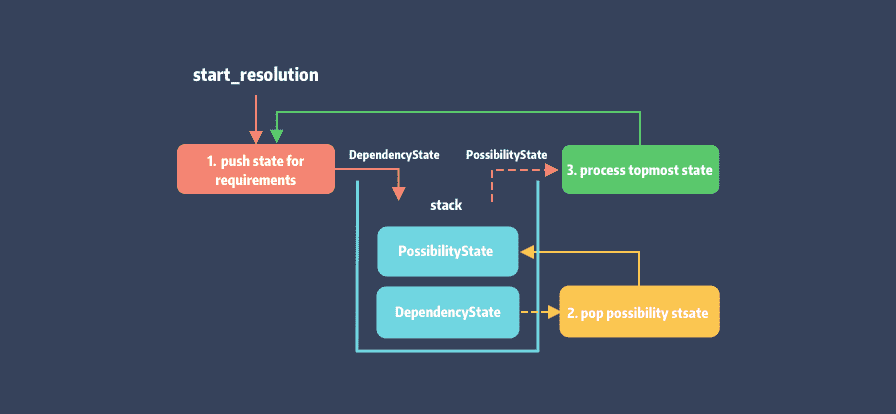
可以看到整个流程就是不断的将 requirement 的 possibility 过滤和处理,一层层剥离转换为 DependencyState,如此循环往复。
Molinillo 的入口为 Resolution::resolve 方法,也是上图对应的实现,逻辑如下:
## lib/molinillo/resolution.rb

def resolve
  ## 1. 初始化 timer 统计耗时初始位置打点
  ## 2. 内部会调用 push_initial_state 初始化 DependencyState 压栈
  ## 3. 初始化 DependencyGraph 实例
  start_resolution

  while state
    break if !state.requirement && state.requirements.empty?
    ## 输出一个进度占位
    indicate_progress
    if state.respond_to?(:pop_possibility_state) ## DependencyState
      ## 调试日志入口
      ## 如果环境变量 MOLINILLO_DEBUG 是非 nil 就输出 log
      ## 这里的调试日志有助于排查 Pod 组件的依赖问题
      debug(depth) { "Creating possibility state for #{requirement} (#{possibilities.count} remaining)" }
      state.pop_possibility_state.tap do |s|
        if s
          states.push(s)
          activated.tag(s)
        end
      end
    end
    ## 处理栈顶 Possibility State
    process_topmost_state
  end
 ## 遍历 Dependency Graph
  resolve_activated_specs
ensure
  end_resolution
end
- 首先
#start_resolution会初始化 timer 用于统计解析耗时,在这个方法中还会调用#push_initial_state初始化DependencyState入栈,以及DependencyGraph初始化。 - 获取栈顶
state检查是否存在待解析需求,接着调用#pop_possibility_state进行state转换并入栈。 - 调用
#process_topmost_state处理栈顶的 Possibility State,如果当前 state 可被激活,则将该 Possiblity 存入DependencyGraph对应顶点的 payload 中。否则判定为冲突,需要进行状态回滚。 - 循环直到 state 的可能性全部处理结束。
- 调用
#resolve_activated_specs,遍历DependencyGraph以存储更新需求的可能性,解析结束。
当然,依赖处理并非这么简单,复杂的过滤和回溯逻辑都隐藏在 #process_topmost_state 中。
ResolutionState 的变化
其实从 ResolutionState 的定义能够看出,为了方便回溯和数据还原,state 是以 Struct 结构定义的。同时在每次 #pop_possibility_state 中,通过 #dup[7] 对 diff 数据进行了复制。
这里用依赖传递的例子来展示解析后状态栈的变化。假设我们在 Podfile 中声明了 A,B,C 三个依赖,他们的关系为:A -> B -> C。
target 'Example' do
  pod 'C', :path => '../'
  pod 'B', :path => '../'
  pod 'A', :path => '../’
end
在 #resolve_activated_specs 方法设置断点,在解析结束时打印状态栈 @states(简化处理后)如下:
[
   #<struct Molinillo::DependencyState name="C", requirements=[B, A], ...>,
   #<struct Molinillo::PossibilityState name="C", requirements=[B, A], ...>
   #<struct Molinillo::DependencyState name="B", requirements=[A], ...>
   #<struct Molinillo::PossibilityState name="B", requirements=[A], ...>
   ## 省略了 C、C、A、A...
   #<struct Molinillo::DependencyState name="B", requirements=[], ...,
   #<struct Molinillo::PossibilityState name="B", requirements=[], ...,
   #<struct Molinillo::DependencyState name="", requirements=[], ...,
]
可以看到栈内保存的 states 中 DependencyState 与 PossibilityState 是成对出现的。不过最后入栈的DependencyState 是一个空状态,requirements 也为空,此时无法再 pop state 循环结束。
DependencyGraph
其实包括 Molinillo 在内的依赖解析工具都会在运行期间对依赖关系进行建模来构建依赖图,毕竟这是我们表达依赖关系的方式。那么 DependencyGraph (以下简称 dg ) 是如何定义:
module Molinillo

  class DependencyGraph
    ## 有向边
    Edge = Struct.new(:origin, :destination, :requirement)
    ## @return [{String => Vertex}] 用字典保存顶点, key 为顶点名称(即 requirement.name)
    attr_reader :vertices
    ## @return [Log] 操作日志
    attr_reader :log
  ...
end
另外 Vertex 定义如下:
module Molinillo
  class DependencyGraph
    class Vertex
      attr_accessor :name
      ## @return [Object] 顶点的元数据,reqiuremnt 对应的 possiblity
      attr_accessor :payload
      ## @return [Array<Object>] 需要依赖该顶点可能性能的需求
      attr_reader :explicit_requirements
      ## @return [Boolean] 是否为根结点
      attr_accessor :root
      ## @return [Array<Edge>] 出度 {Edge#origin}
      attr_accessor :outgoing_edges
      ## @return [Array<Edge>] 入度 {Edge#destination}
      attr_accessor :incoming_edges
      ## @return [Array<Vertex>] 入度的起点
      def predecessors
        incoming_edges.map(&:origin)
      end
      ## @return [Array<Vertex>] 出度的终点
      def successors
        outgoing_edges.map(&:destination)
      end
      ...
    end
  end
end
熟悉图论的同学都了解,图的保存常用的方式是邻接表和邻接矩阵。
Molinillo 则通过 map + list,vertext 字典与边集数组来保存。如果仅用边集数组来查询顶点本身效率并不高,好在顶点直接用了字典保存了。
Molinillo 通过栈来维护解析状态,不断将解析结果 possibility 存入 dg 的 payload 中,同时记录了各个顶点的依赖关系,即 dg 的出度和入度。
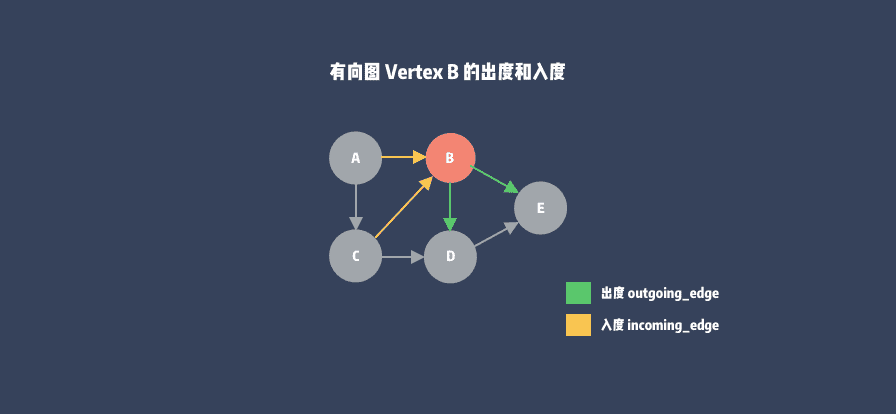
在有向图中对于一个顶点来说,如果 Molinillo 则通过 map + list,v一条边的终点是这个顶点,这条边就是这个顶点的入度;
在有向图中对于一个顶点来说,如果一条边的起点是这个顶点,这条边就是这个顶点的出度。
当成功解析的一刻,dg 图也构建完毕。
Operation Log
当解析过程出现冲突时,状态栈要回溯直接 pop 一下就完事了,而 dg 咋办 ? 它可没法 pop。
好在 Molinillo 设计了 Operation Log 机制,通过 Log 记录 dg 执行过的操作。这些操作类型包括:AddEdgeNoCircular、AddVertex、DeleteEdge、DetachVertexNamed、SetPayload、Tag。
Log 结构如下:
## frozen_string_literal: true

module Molinillo
  class DependencyGraph
    class Log
      def initialize
        @current_action = @first_action = nil
      end

      def pop!(graph)
        return unless action = @current_action
        unless @current_action = action.previous
          @first_action = nil
        end
        action.down(graph)
        action
      end

      ## 回撤到指定的操作节点
      def rewind_to(graph, tag)
        loop do
          action = pop!(graph)
          raise "No tag #{tag.inspect} found" unless action
          break if action.class.action_name == :tag && action.tag == tag
        end
      end

      private

      ## 插入操作节点
      def push_action(graph, action)

        action.previous = @current_action
        @current_action.next = action if @current_action
        @current_action = action
        @first_action ||= action
        action.up(graph)
      end
      ...
    end
  end
end
标准的链表结构,Log 提供了当前指针 @current_action 和表头指针 @first_action 便于链表的遍历。接着看看Action:
## frozen_string_literal: true

module Molinillo
  class DependencyGraph

    class Action
      ## @return [Symbol] action 名称
      def self.action_name
        raise 'Abstract'
      end

      ## 对图执行正向操作
      def up(graph)
        raise 'Abstract'
      end

      ## 撤销对图的操作
      def down(graph)
        raise 'Abstract'
      end

      ## @return [Action,Nil] 前序节点
      attr_accessor :previous
      ## @return [Action,Nil] 后序节点
      attr_accessor :next
    end
  end
end
Action 本身是个抽象类,Log 通过 Action 子类的 #up、#down 来完成对 dg 的操作和撤销。所提供的 Action 中除了Tag 特殊一点,其余均是对 dg 的顶点和边的 CURD 操作。这里以 AddVertex 为例:
## frozen_string_literal: true

require_relative 'action'
module Molinillo
  class DependencyGraph
  ## @!visibility private
    class AddVertex < Action ## :nodoc:
      def self.action_name
        :add_vertex
      end

      ## 操作添加顶点
      def up(graph)
        if existing = graph.vertices[name]
          @existing_payload = existing.payload
          @existing_root = existing.root
        end
        vertex = existing || Vertex.new(name, payload)
        graph.vertices[vertex.name] = vertex
        vertex.payload ||= payload
        vertex.root ||= root
        vertex
      end

      ## 删除顶点
      def down(graph)
        if defined?(@existing_payload)
          vertex = graph.vertices[name]
          vertex.payload = @existing_payload
          vertex.root = @existing_root
        else
          graph.vertices.delete(name)
        end
      end

      ## @return [String] 顶点名称 (或者说依赖名称)
      attr_reader :name
      ## @return [Object] 顶点元数据
      attr_reader :payload
      ## @return [Boolean] 是否为根
      attr_reader :root
  ...
    end
  end
end
Action 子类均声明为 private 的,通过 Log 提供的对应方法来执行。
def tag(graph, tag)
  push_action(graph, Tag.new(tag))
end

def add_vertex(graph, name, payload, root)
  push_action(graph, AddVertex.new(name, payload, root))
end

def detach_vertex_named(graph, name)
  push_action(graph, DetachVertexNamed.new(name))
end

def add_edge_no_circular(graph, origin, destination, requirement)
  push_action(graph, AddEdgeNoCircular.new(origin, destination, requirement))
end

def delete_edge(graph, origin_name, destination_name, requirement)
  push_action(graph, DeleteEdge.new(origin_name, destination_name, requirement))
end

def set_payload(graph, name, payload)
  push_action(graph, SetPayload.new(name, payload))
end
最后 log 声明的这些方法会由 dg 直接调用,如 #addVertext:
module Molinillo
  class DependencyGraph
    def add_vertex(name, payload, root = false)
      log.add_vertex(self, name, payload, root)
    end
    ...
  end
end
Unwind For Conflict
有了 op log 之后我们还需要一样重要的东西:哨兵节点。由 Tag 类来承载:
## frozen_string_literal: true
module Molinillo
  class DependencyGraph
    ## @!visibility private
    class Tag < Action

      def up(graph)
      end

      def down(graph)
      end

      attr_reader :tag

      def initialize(tag)
        @tag = tag
      end
    end
  end
end
作为哨兵节点 Tag 的 #up 与 #down 操作总是成对出现的。在 Molinillo 中有两处需要进行状态回溯,分别为可能性校验和冲突状态回撤。
可能性校验
#possibility_satisfies_requirements? 方法用于冲突产生的前后,用于判断该可能性能否同时满足多个需求:
def possibility_satisfies_requirements?(possibility, requirements)
  name = name_for(possibility)

  activated.tag(:swap)
  activated.set_payload(name, possibility) if activated.vertex_named(name)
  satisfied = requirements.all? { |r| requirement_satisfied_by?(r, activated, possibility) }
  activated.rewind_to(:swap)

  satisfied
end
为了直观的说明参数,我们举个例子。Case 1假设 Podfile 中存在 pod A 和 B,且 A、B 分别依赖了 Alamofire 3.0 和 4.0,那么对应的参数为:
possibility: #<Pod::Specification name="Alamofire" version="4.0.0">
requirements: [
 <Pod::Dependency name=Alamofire requirements=~> 3.0 source=nil external_source=nil>,   <Pod::Dependency name=Alamofire requirements=~> 4.0 source=nil external_source=nil>
]
现在来看方法实现:
- 首先
activated就是 Podfile 解析生成的 dg 对象,这里将 symbol:swap作为标识用于稍后的回撤; - 调用
#set_payload将顶点 Alamofire 的 payload 修改为 possibility 版本; - 遍历 requirements 并调用代理的
#requirement_satisfied_by以校验 possiblity 在 dg 中存在的可能性; - 调用
#rewind_to将顶点的修改回撤至:swap前的状态,最后返回检验结果。
Tips: 此处的代理是指 CocoaPods,它做为 Molinillo 的 client 实现了很多代理方法,后续会聊到。
作为候选项 possibility 当然不止一个,代理提供的查询方法 #search_for(dependency) 会返回所有符合 requiremnt 名称的依赖。在 CocoaPods 中,就是通过 Pod::Source 查询获得所有版本的 Pod::Specification,具体可以看上一篇文章:PodSpec 管理策略[8]。
冲突状态回撤
依赖解析过程出现冲突属于正常情况,此时通过回撤也许可以避免部分冲突,找出其它可行解。Molinillo 通过定义 Conflict 来记录当前的冲突的必要信息:
Conflict = Struct.new(
  :requirement,
  :requirements,
  :existing,
  :possibility_set,
  :locked_requirement,
  :requirement_trees,
  :activated_by_name,
  :underlying_error
)
重点关注 underlying_error,它记录了所拦截的指定类型错误,并用于状态回撤时的一些判断依据(后面会解释)。这里我们先看一下定义的错误类型:
## frozen_string_literal: true

module Molinillo

  class ResolverError < StandardError; end

  ## 错误信息:"Unable to find a specification for `#{dependency}`"
  class NoSuchDependencyError < ResolverError ... end

  ## 错误信息:"There is a circular dependency between ..."
  class CircularDependencyError < ResolverError ... end

  ## 当出现版本冲突时抛出
  ## 错误信息:"Unable to satisfy the following requirements:\n\n ..."
  class VersionConflict < ResolverError ... end
end
除了主动拦截错误之外,possiblity 不存在时也会主动生成冲突,同时进入状态回撤处理。发生冲突后调用 #create_conflict 和 #unwind_for_conflict 两个方法分别用于生成 Conflict 对象和状态回撤。
def process_topmost_state
  if possibility
    attempt_to_activate
  else
    create_conflict
    unwind_for_conflict
  end
rescue CircularDependencyError => underlying_error
  create_conflict(underlying_error)
  unwind_for_conflict
end

def attempt_to_activate
  debug(depth) { 'Attempting to activate ' + possibility.to_s }
  existing_vertex = activated.vertex_named(name)
  if existing_vertex.payload
    debug(depth) { "Found existing spec (#{existing_vertex.payload})" }
    attempt_to_filter_existing_spec(existing_vertex)
  else
    latest = possibility.latest_version
    possibility.possibilities.select! do |possibility|
      requirement_satisfied_by?(requirement, activated, possibility)
    end
    if possibility.latest_version.nil?
      ## ensure there's a possibility for better error messages
      possibility.possibilities << latest if latest
      create_conflict
      unwind_for_conflict
    else
      activate_new_spec
    end
  end
end

def attempt_to_filter_existing_spec(vertex)
  filtered_set = filtered_possibility_set(vertex)
  if !filtered_set.possibilities.empty?
    activated.set_payload(name, filtered_set)
    new_requirements = requirements.dup
    push_state_for_requirements(new_requirements, false)
  else
    create_conflict
    debug(depth) { "Unsatisfied by existing spec (#{vertex.payload})" }
    unwind_for_conflict
  end
end
可以看到这 3 个方法中处理了 4 处冲突的情况。其中 #process_topmost_state 方法拦截了 CircularDependencyError 并将其记录在 Conflict 的 underlying_error 中,其余的都是因为 possibility 可行解不存在而主动抛出冲突。
我们简化成下面的状态图:
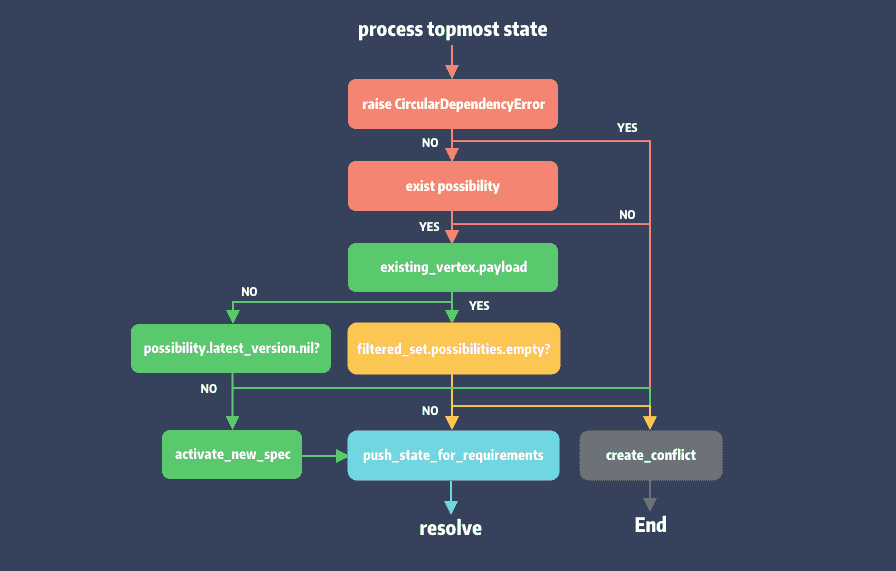
可以理解 possiblity 状态机,通过不断检查可能性,一旦出错主动生成异常。为什么要这么做 ?因为状态回溯的成本是很高的,一旦发生意味着我们之前检查工作可能就白费了。这也是 Molinillo 前向查询的充电,通过提早暴露问题,提前回溯。
unwind_for_conflict
了解了冲突时如何产生之后,接下来该 #unwind_for_conflict 登场了:
def unwind_for_conflict
  details_for_unwind = build_details_for_unwind
  unwind_options = unused_unwind_options
  debug(depth) { "Unwinding for conflict: #{requirement} to #{details_for_unwind.state_index / 2}" }
  conflicts.tap do |c|
    sliced_states = states.slice!((details_for_unwind.state_index + 1)..-1)
    raise_error_unless_state(c)
    activated.rewind_to(sliced_states.first || :initial_state) if sliced_states
    state.conflicts = c
    state.unused_unwind_options = unwind_options
    filter_possibilities_after_unwind(details_for_unwind)
    index = states.size - 1
    @parents_of.each { |_, a| a.reject! { |i| i >= index } }
    state.unused_unwind_options.reject! { |uw| uw.state_index >= index }
  end
end
冲突回溯就涉及到前面说过的两个状态需要处理,分别是状态栈 @states 和 dg 内容的回溯。@state 本身是数组实现的,其元素是各个状态的state, 要回溯到指定的 state 则要利用 state_index,它保存在 UnwindDetails 中:
UnwindDetails = Struct.new(
  :state_index,
  :state_requirement,
  :requirement_tree,
  :conflicting_requirements,
  :requirement_trees,
  :requirements_unwound_to_instead
)

class UnwindDetails
  include Comparable
  ...
end
这里解释一下 requirement_trees,这里是指以当前需求作为依赖的需求。以上面的 Case 1 为例,当前冲突的 requirement 就是 Alamofire,对应 requirement_trees 就是依赖了 Alamofire 的 Pod A 和 B:
[
  [
    <Pod::Dependency name=A requirements=nil source=nil external_source=nil>,
    <Pod::Dependency name=Alamofire requirements=~> 3.0 ...>
  ],[
    <Pod::Dependency name=B ...>,
    <Pod::Dependency name=Alamofire requirements=~> 4.0 ...>
  ]
]
#build_details_for_unwind 主要用于生成 UnwindDetails,大致流程如下:
def build_details_for_unwind
  current_conflict = conflicts[name]
  binding_requirements = binding_requirements_for_conflict(current_conflict)
  unwind_details = unwind_options_for_requirements(binding_requirements)

  last_detail_for_current_unwind = unwind_details.sort.last
  current_detail = last_detail_for_current_unwind

  ## filter & update details options
  ...
  current_detail
end
- 以 conflict.requirement 为参数,执行
#binding_requirements_for_conflict以查找出存在冲突的需求binding_requirements。查询是通过代理的#search_for(dependency)方法; - 通过
#unwind_options_for_requirements遍历查询到的binding_requirements获取 requirement 对应的 state 以及该 state 在栈中的 index,用于生成unwind_details; - 对
unwind_details排序,取 last 作为current_detail并进行其他相关的修改。
关于如何获取 state_index 和 unwind_details:
def unwind_options_for_requirements(binding_requirements)
  unwind_details = []

  trees = []
  binding_requirements.reverse_each do |r|
    partial_tree = [r]
    trees << partial_tree
    unwind_details << UnwindDetails.new(-1, nil, partial_tree, binding_requirements, trees, [])
    ## 1.1 获取 requirement 对应的 state
    requirement_state = find_state_for(r)
    ## 1.2 确认 possibility 存在
    if conflict_fixing_possibilities?(requirement_state, binding_requirements)
      ## 1.3 生成 detail 存入 unwind_details
      unwind_details << UnwindDetails.new(
        states.index(requirement_state),
        r,
        partial_tree,
        binding_requirements,
        trees,
        []
      )
    end

    ## 2. 沿着 requirement 依赖树的父节点获取其 state
    parent_r = parent_of(r)
    next if parent_r.nil?
    partial_tree.unshift(parent_r)
    requirement_state = find_state_for(parent_r)
    ## 重复 1.2, 1.3 步骤 ...

    ## 6. 沿着依赖树,重复上述操作
    grandparent_r = parent_of(parent_r)
    until grandparent_r.nil?
      partial_tree.unshift(grandparent_r)
      requirement_state = find_state_for(grandparent_r)
      ## 重复 1.2、1.3 步骤 ...
      parent_r = grandparent_r
      grandparent_r = parent_of(parent_r)
    end
  end

  unwind_details
end
确认 state_index 后,栈回溯反而比较简单了,直接 #slice! 即可:
sliced_states = states.slice!((details_for_unwind.state_index + 1)..-1)
dg 回撤还是 activated.rewind_to(sliced_states.first || :initial_state) if sliced_states。回撤结束后,流程重新回到 Resolution Loop。
SpecificationProvider
最后一节简单聊聊 SpecificationProvider。为了更好的接入不同平台,同时保证 Molinillo 的通用性和灵活性,作者将依赖描述文件查询等逻辑抽象成了代理。
SpecificationProvider 作为单独的 Module 声明了接入端必须实现的 API:
module Molinillo
   module SpecificationProvider

    def search_for(dependency)
      []
    end

    def dependencies_for(specification)
      []
    end
    ...
  end
end
而 Provider 就是在 Molinillo 初始化的时候注入的:
require_relative 'dependency_graph'

module Molinillo

  class Resolver
    require_relative 'resolution'

    attr_reader :specification_provider
    attr_reader :resolver_ui

    def initialize(specification_provider, resolver_ui)
      @specification_provider = specification_provider
      @resolver_ui = resolver_ui
    end

    def resolve(requested, base = DependencyGraph.new)
      Resolution.new(specification_provider,
                     resolver_ui,
                     requested,
                     base).
        resolve
    end
  end
end
而在 CocoaPods 中的初始化方法则是:
## /lib/CocoaPods/resolver.rb
def resolve
  dependencies = @podfile_dependency_cache.target_definition_list.flat_map do |target|
    @podfile_dependency_cache.target_definition_dependencies(target).each do |dep|
      next unless target.platform
      @platforms_by_dependency[dep].push(target.platform)
    end
  end.uniq
  @platforms_by_dependency.each_value(&:uniq!)
  @activated = Molinillo::Resolver.new(self, self).resolve(dependencies, locked_dependencies)
  resolver_specs_by_target
rescue Molinillo::ResolverError => e
  handle_resolver_error(e)
end
该方法则处于 pod install 中的 resolve dependencies 阶段:
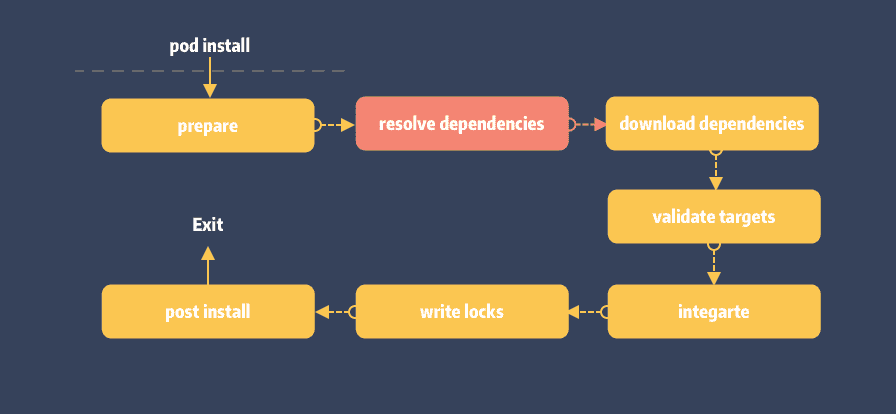
NoSuchDependencyError
另外,为了更好的处理产生的异常,同时保证核心逻辑对 provider 的无感知,Molinillo 将代理方法做了一层隔离,并且对异常做了统一拦截:
module Molinillo
  module Delegates

    module SpecificationProvider

      def search_for(dependency)
        with_no_such_dependency_error_handling do
          specification_provider.search_for(dependency)
        end
      end

      def dependencies_for(specification)
        with_no_such_dependency_error_handling do
          specification_provider.dependencies_for(specification)
        end
      end

      ...

      private

      def with_no_such_dependency_error_handling
        yield
      rescue NoSuchDependencyError => error
        if state
          ...
        end
        raise
      end
    end
  end
end
总结
本篇文章从依赖解析的状态维护、状态存储、状态回溯三个维度来解构 Molinillo 的核心逻辑,它们分别对应了 ResolutionState、DependencyGraph、UnwindDetail 这三种数据结构。
一开始写这篇内容时,头脑中对于这些概念是未知的,因为一开始就直接看了作者对 Molinillo 的架构阐述[9]更是完全找不到思绪,好在我有 VSCode !
最终依据不同 Case 下的数据呈现,一点点的进行源码调试,大致摸清的 Molinillo 的状态是如何变化转移的。最后一点,英文和数据结构还是很重要的,possiblity 你理解了吗 ?
知识点问题梳理
这里罗列了五个问题用来考察你是否已经掌握了这篇文章,如果没有建议你加入收藏再次阅读:
- 说说 Resolution 栈中的 state 是如何转移的 ?
- DependencyGraph 的数据通过什么方式进行回撤的 ?
#process_topmost_state处理了几种 conflict 情况 ?- UnwindDetail 的 state_index 是如何获取的 ?
- 作者如何利用 SpecificationProvider 来解偶的 ?
参考资料
- Molinillo
- 依赖地狱
- 致命错误
- PubGrub
- Selective dependency resolutions
- 回溯 (Backtracking)
#dup- PodSpec 管理策略
- Molinillo 的架构阐述
原文出处:8. Xcode 工程文件解析
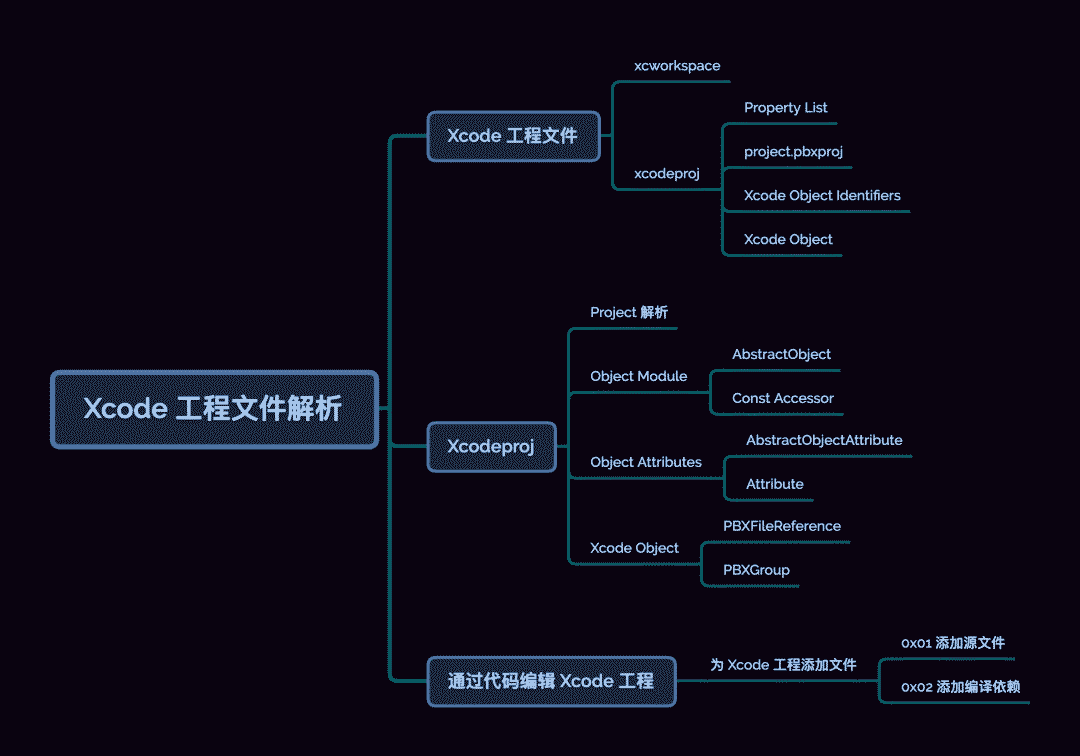
引子
在「Molinillo 依赖校验」通过后,CocoaPods 会根据确定的 PodSpec 下载对应的源代码和资源,并为每个 PodSpec 生成对应的 Xcode Target。本文重点就来聊聊 Xcode Project 的内容构成,以及 xcodeproj[1] 是如何组织 Xcode Project 内容的。
Xcode 工程文件
早在前文「Podfile 的解析逻辑」中,我们简单介绍过 Xcode 的工程结构:Workspace、Project、Target 及 Build Setting 等。
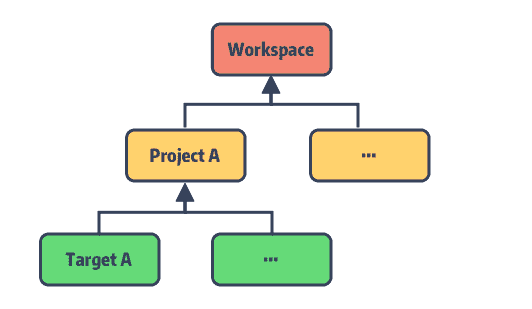
我们先来了解下这些数据在 Xcode 中是如何表示,了解这些结构才能方便我们理解 xcodeproj 的代码设计思路。
xcworkspace
早在 Xcode 4 之前就出现 workspace bundle 了,只是那会 workspace 仍内嵌于 .xcodeproj 中。Xcode 4 之后,我们才对 workspace 单独可见。让我们新建一个 Test.xcodeproj 项目,来看看其目录结构:
Test.xcodeproj
├── project.pbxproj
├── project.xcworkspace
│   ├── contents.xcworkspacedata
│   └── xcuserdata
│       └── edmond.xcuserdatad
│           └── UserInterfaceState.xcuserstate
└── xcuserdata
    └── edmond.xcuserdatad
        └── xcschemes
            └── xcschememanagement.plist
可以发现 Test.xcodeproj bundle 内包含 project.workspace。而当我们通过 pod install 命令成功添加 Pod 依赖后,Xcode 工程目录下会多出 Test.workspace,它是 Xcodeproj 替我们生成的,用于管理当前的 Test.project 与 Pods.pbxproj。新建的 workspace 目录如下:
Test.xcworkspace
└── contents.xcworkspacedata
生成的 workspace 文件夹内部只包含了 contents.xcworkspacedata,为 xml 格式的内容:
<?xml version="1.0" encoding="UTF-8"?>
<Workspace
   version = "1.0">
   <FileRef
      location = "group:Test.xcodeproj">
   </FileRef>
   <FileRef
      location = "group:Pods/Pods.xcodeproj">
   </FileRef>
</Workspace>
在标签 Workspace 下声明了两个 FileRef 其地址分别指向了 Test.xcodeproj 和 Pods.xcodeproj。这里注意的是 FileRef 属性的值使用前缀 group + path 来修饰的,而内嵌的project.xcworkspace,使用 self 作为前缀:
<?xml version="1.0" encoding="UTF-8"?>
<Workspace
   version = "1.0">
   <FileRef
      location = "self:">
   </FileRef>
</Workspace>
另外,当我们用 Xcode 打开项目后,能发现 workspace 目录下会自动生成 xcuserdata 目录,它用于保存用户的 Xcode 配置。比如:
UserInterfaceState.xcuserstate:以二进制的 Plist 保存,用于记录窗口布局等个性化设置。xcdebugger:记录各种断点数据。
这也是在日常开发中,经常会选择将 xcuserdata 目录 ignore 掉的原因。
xcodeproj
与 .xcworkspace 类似 .xcodeproj 同为 Xcode 工程配置的 bundle,接下来重点展开project.pbxproj,它记录了 Xcode 工程的各项配置,本质上是一种旧风格的 Plist 文件。
Property List
Plist 被设计为人类可读的、可以手工修改的格式,故采用了类似于编程语言的语法将数据序列化为ASCII数据。Plist 最早可追溯到 NeXTSTEP 时期,由于历史原因,目前它支持多种格式,string、binary、array、dictionary 等类型数据。相比于 JSON,Plist 还支持二进制数据的表示,以 <> 修饰文本形式的十六进制数,其中字典与数组的区别如下:
Array:
plist => ( "1", "2", "3" )
json => [ "1", "2", "3" ]

Dictionary:
plist => { "key" = "value"; ... }
json => { "key" : "value", ... }
处理 Plist 文件可使用 Unix 提供的 plutil 工具。比如将 Plist 文件转成 XML 格式:
plutil -convert xml1 -s -r -o project.pbxproj.xml project.pbxproj
-convert fmt 选项支持转换的格式有:xml1、binary1、json、swift、json。
project.pbxproj
pbxproj 文件全称为 Project Builder Xcode Project,光看第一层元数据比较简单:
// !$*UTF8*$!
{
 archiveVersion = 1;
 classes = {
 };
 objectVersion = 50;
 objects = {
  ...
   };
 rootObject = 8528A0D92651F281005BEBA5 /* Project object */;
}
文件以明确的编码信息开头,archiveVersion 通常为 1,表示序列化的版本号;classes 则似乎一直为空;objectVersion 表示所兼容的最低版本的 Xcode,该数字与 Xcode 的版本对应关系如下:
53 => 'Xcode 11.4',
52 => 'Xcode 11.0',
51 => 'Xcode 10.0',
50 => 'Xcode 9.3',
48 => 'Xcode 8.0',
47 => 'Xcode 6.3',
46 => 'Xcode 3.2',
45 => 'Xcode 3.1',
rootObject 记录的 16 进制数字,为 project 对象的索引。这里我们可以称其为 Xcode Object Identifier,pbxproj 中的每个 Xcode Object 创建时,都会生成对应唯一标识数字,而上面的 objects 字典则记录了整个 Xcode 项目的所有 Xcode Object。
Xcode Object Identifiers
Xcode Object Identifier 是用 24 位的 16 进制字符表示,我们暂且称其为 GUID。
⚠️ 注意这并不意味着它与其他称为 GUID 的其他事物相似。
生成的 GUID 不仅在项目文件中必须唯一,并且在 Xcode 中同时打开的其他项目文件中也必须唯一,即跨工程唯一性。只有这样能避免了多人合作中,同时新增或编辑工程文件带来的问题。这其实是一个有趣的竞争需求,有兴趣的可以查看 Premake[2] 这个项目,它能保证重新生成的项目具有相同的 GUID。
对于 Xcode 使用的 GUID 算法可参考 PBXProj Identifers[3],它是通过逆向 DevToolsCore.framework 获取的,从中可以窥见 GUID 的生成需要依赖 👇 这些数据:
struct globalidentifier {
    int8_t user;            // encoded username
    int8_t pid;             // encoded current pid ##
    int16_t _random;        // encoded random value
    int32_t _time;          // encoded time value
    int8_t zero;            // zero
    int8_t host_shift;      // encoded, shifted hostid
    int8_t host_h;          // high byte of lower bytes of hostid
    int8_t host_l;          // low byte of lower bytes of hostid
} __attribute__((packed));  // packed, so we always have a length of 12 bytes
Xcode Object
Xcode Object 是指所有记录在 objects 字典中的对象 (后续简称为 Object),内部以 isa 来标识类型。同时Xcode 按 isa 类型划分出若干 section,以注释的方式分节。
以 PBXProject 为例:
/* Begin PBXProject section */
   8528A0D92651F281005BEBA5 /* Project object */ = {
      isa = PBXProject;
      ...
      mainGroup = 8528A0D82651F281005BEBA5;
      productRefGroup = 8528A0E22651F281005BEBA5 /* Products */;
      projectDirPath = "";
      projectRoot = "";
      targets = (
         8528A0E02651F281005BEBA5 /* Test */,
      );
   };
/* End PBXProject section */
这里 Project object 的索引值正是 rootObject 记录的 8528A0D92651F281005BEBA5,其 isa 类型为 PBXProject,targets 数组记录了项目需要构建的任务:Test target。整个 PBXProject section 就定义在 objects 中。
Object 类型的引用关系大致如下图:
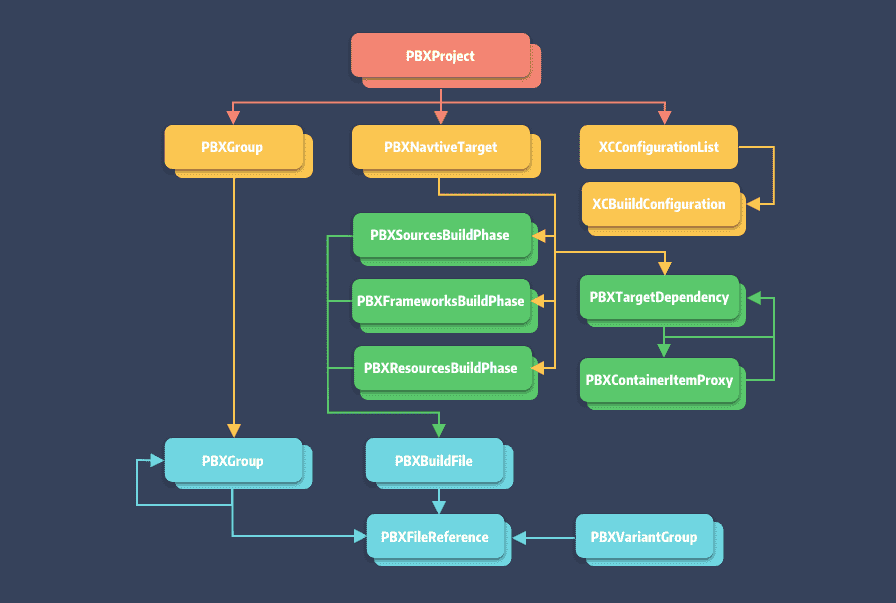
关于 pbxproj 内 Object 的详细说明,可参照 Xcode Project File Format[4]。
- PBXProject:Project 的设置,编译工程所需信息
- PBXNativeTarget:Target 的设置
- PBXTargetDependency:Target 依赖
- PBXContainerItemProxy:部署的元素
- XCConfigurationList:构建配置相关,包含 project 和 target 文件
- XCBuildConfiguration:编译配置,对应 Xcode 的 Build Setting 内容
- PBXVariantGroup:国际化对照表或
.storyboard文件 - PBXBuildFile:各类文件,最终会关联到 PBXFileReference
- PBXFileReference:源码、资源、库,Info.plist 等文件索引
- PBXGroup:虚拟文件夹,可嵌套,记录管理的 PBXFileReference 与子 PBXGroup
- PBXSourcesBuildPhase:编译源文件(.m、.swift)
- PBXFrameworksBuildPhase:用于 framework 的构建
- PBXResourcesBuildPhase:编译资源文件,有 xib、storyboard、plist 以及 xcassets 等资源文件
Xcodeproj
Xcodeproj[5] 能够通过 Ruby 来创建和修改 Xcode 工程文件,其内部完整映射了 project.pbxproj 的 Object 类型及其对应的属性,限于篇幅本文会重点介绍关键的 Object 和解析逻辑。
Project 解析
上节内容可知,Xcode 解析工程的是依次检查 *.xcworkspace > *.xcproject > project.pbxproj,根据 project.pbxproj 的数据结构,Xcodeproj 提供了 Project 类,用于记录根元素。
module Xcodeproj
  class Project
    ## object 模块,后面会提到
    include Object
    ...
    ## 序列化时 project 的最低兼容版本, 与 object_version 对应
    attr_reader :archive_version
    ## 作用未知
    attr_reader :classes
    ## project 最低兼容版本
    attr_reader :object_version
    ## project 所包含的 objects,结构为 [Hash{String => AbstractObject}]
    attr_reader :objects_by_uuid
    ## project 的根结点,即 PBXProject
    attr_reader :root_object
  end
end
在 pod install 的依赖解析阶段,会读取 project.pbxproj。
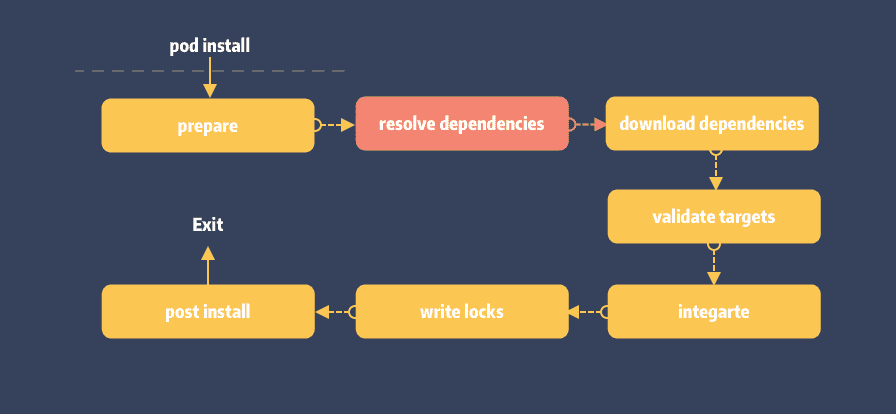
最终在 inspect_targets_to_integrate 方法内打开项目:
def inspect_targets_to_integrate
  project = Xcodeproj::Project.open(project_path)
  ...
end
继续看 Xcodeproj::Project::open 实现:
## lib/xcproject/Project.rb

def self.open(path)
  path = Pathname.pwd + path
  unless Pathname.new(path).exist?
    raise "[Xcodeproj] Unable to open `#{path}` because it doesn't exist."
  end
  project = new(path, true)
  project.send(:initialize_from_file)
  project
end

def initialize_from_file
  pbxproj_path = path + 'project.pbxproj'
  plist = Plist.read_from_path(pbxproj_path.to_s)
  root_object.remove_referrer(self) if root_object
  @root_object     = new_from_plist(plist['rootObject'], plist['objects'], self)
  @archive_version = plist['archiveVersion']
  @object_version  = plist['objectVersion']
  @classes         = plist['classes'] || {}
  @dirty           = false

  unless root_object
    raise "[Xcodeproj] Unable to find a root object in #{pbxproj_path}."
  end

  if archive_version.to_i > Constants::LAST_KNOWN_ARCHIVE_VERSION
    raise '[Xcodeproj] Unknown archive version.'
  end

  if object_version.to_i > Constants::LAST_KNOWN_OBJECT_VERSION
    raise '[Xcodeproj] Unknown object version.'
  end

  ## Projects can have product_ref_groups that are not listed in the main_groups["Products"]
  root_object.product_ref_group ||= root_object.main_group['Products'] || root_object.main_group.new_group('Products')
end
- 在 open 方法中会检验路径,初始化 Project 对象;
- 使用内部 Property List 类
Plist来读取project.pbxproj数据;
需要注意的是 new_from_plist 不仅完成了 rootObject 的解析,同时也完成 objects 的解析。
/* Begin PBXProject section */
   8528A0D92651F281005BEBA5 /* Project object */ = {
      isa = PBXProject;
      ...
      mainGroup = 8528A0D82651F281005BEBA5;
      productRefGroup = 8528A0E22651F281005BEBA5 /* Products */;
      projectDirPath = "";
      projectRoot = "";
      targets = (
         8528A0E02651F281005BEBA5 /* Test */,
      );
   };
/* End PBXProject section */
- 以 uuid 取出 Plist 数据并利用 isa kclass 完成 Project 对象的初始化和映射。
Object const中记录了支持的isa; - 将 object 存入
objects_by_uuid字典中,以覆盖原有的 GUID; - 执行
configure_with_plist递归,完成objects映射。
Tips:
configure_with_plist于下篇展开.
project.pbxproj 解析主体流程如下
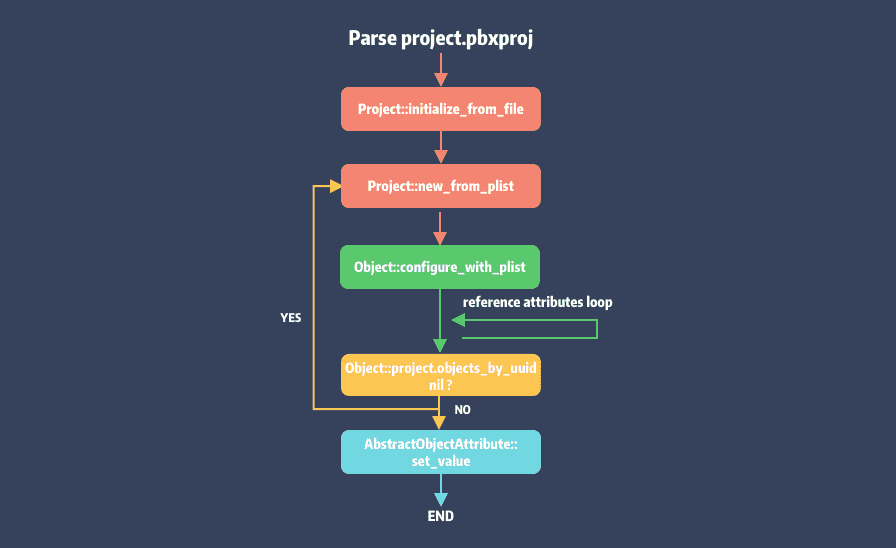
图中的 reference attributes 是指 Object 的引用属性,后面会有介绍。
Object Module
AbstractObject
Object 的抽象类,Xcode 项目并不存在对应的 isa 类型。先简单介绍部分属性,方便后续理解。
class AbstractObject
  ## object 类型
  attr_reader :isa
  ## object 唯一标识
  attr_reader :uuid
  ## 持有 object 的 project
  attr_reader :project

  def initialize(project, uuid)
    @project = project
    @uuid = uuid
    @isa = self.class.isa
    @referrers = []
    unless @isa =~ /^(PBX|XC)/
      raise "[Xcodeproj] Attempt to initialize an abstract class (#{self.class})."
    end
  end
  ...
end
注意,Object 类在 initialize 时关联了 project 对象,作者不建议我们直接使用,而在 Xcodeproj 模块内提供了 convince 方法。
def new(klass)
   if klass.is_a?(String)
     klass = Object.const_get(klass)
   end
   object = klass.new(self, generate_uuid)
   object.initialize_defaults
   object
end
作者保留 project 的引用是为了方便处理 Object 的引用计数,project 作为项目的根节点,记录了完整的工程配置和各模块的交叉引用关系,有了 project 的引用能给进行 object 的引用管理。
Const Accessor
这里先插播一下 Object 模块中 const 定义及其存储的值。在 Ruby 中 Module 可以在运行时添加模块级的常量,方法如下:
Module#const_get
Module#const_set
那么问题来了,这些 const 常量是在什么时机存入 Object 中的呢 ?
## lib/xcodeproj/project/object.rb

Xcodeproj::Constants::KNOWN_ISAS.each do |superclass_name, isas|
  superklass = Xcodeproj::Project::Object.const_get(superclass_name)
  isas.each do |isa|
    c = Class.new(superklass)
    Xcodeproj::Project::Object.const_set(isa, c)
  end
end
在 object.rb 文件中,可以定位到 Object.const_set 的调用,它是在 Object 类被加载时触发的。Xcodeproj 支持的 isa 类型名称都定义在 Xcodeproj::Constants::KNOWN_ISAS 中。Object 加载时通过遍历它来载入 isa class。
KNOWN_ISAS = {
  'AbstractObject' => %w(
    PBXBuildFile
    AbstractBuildPhase
    PBXBuildRule
    XCBuildConfiguration
    XCConfigurationList
    PBXContainerItemProxy
    PBXFileReference
    PBXGroup
    PBXProject
    PBXTargetDependency
    PBXReferenceProxy
    AbstractTarget
  ),

  'AbstractBuildPhase' => %w(
    PBXCopyFilesBuildPhase
    PBXResourcesBuildPhase
    PBXSourcesBuildPhase
    PBXFrameworksBuildPhase
    PBXHeadersBuildPhase
    PBXShellScriptBuildPhase
  ),

  'AbstractTarget' => %w(
    PBXNativeTarget
    PBXAggregateTarget
    PBXLegacyTarget
  ),

  'PBXGroup' => %w(
    XCVersionGroup
    PBXVariantGroup
  ),
}.freeze
Object Attributes
AbstractObject 作为 Xcodeproj 提供的 Object 基类,它不仅提供了基本属性,如 isa 类型和 uuid 等,还提供了特殊的属性修饰器如 Attribute,方便快速添加属性。光从 KNOWN_ISAS 看来这些 isa 类型就已经够多了,还要考虑属性的 CURD 以及数据到对象映射等一系列操作。
为此,Xcodeproj 实现了一套针对 project.pbxproj 的 DSL 解析。这些特性的实现正是依赖于属性修饰器和 Ruby 强大的 Runtime 能力。
AbstractObjectAttribute
AbstractObjectAttribute 是用于声明和存储 Object 属性的关键信息,定义如下:
class AbstractObjectAttribute

  ## 属性本身类型,:simple, :to_one, :to_many.
  attr_reader :type

  ## 属性名
  attr_reader :name

  ## 属性的持有者
  attr_accessor :owner

  def initialize(type, name, owner)
    @type  = type
    @name  = name
    @owner = owner
  end

  ## 属性支持的类型
  attr_accessor :classes

  ## 仅限于 :references_by_keys 关联的类型
  attr_accessor :classes_by_key

  ## 仅限于 :simple 类型指定默认值
  attr_accessor :default_value
  ...
end
AbstractObject 通过 Ruby 提供的 Singleton Classes 以实现属性修饰器方法的扩展。
对于单例模式,Ruby 提供了多种实现方式。在 Ruby 中,每个对象可以拥有一个匿名单例类。默认情况下,自定义类是不存在单例类,不过可通过class << obj 来打开对象的单例类空间。
class C
  class << self
    puts self ## 输出:#<Class:C>,类 C 类对象的单例类
  end
end
注意:Ruby 中每个对象 (Class / Module 也是对象) 都有自己所属的类,它们都是有具体名称的类。
Xcodeproj 针对 Attribute 提供了多种单例类方法,定义如下:
module Object
  class AbstractObject
    class << self
      ## 普通属性声明方法
      def attribute(name, klass, default_value = nil) ... end

      ## 单一引用的属性声明方法
      def has_one(singular_name, isas) ... end

      ## 多引用的属性声明方法
      def has_many(plural_name, isas) ... end

      ## 多引用且不同 key 的属性声明方法
      def has_many_references_by_keys(plural_name, classes_by_key) ... end
    end
  end
end
直接看如何使用,声明属性比较直观:
module Object
  class PBXProject < AbstractObject

    ## 声明为 [String] 类型的 project_dir_path,默认值为空
    attribute :project_dir_path, String, ''

    ## 声明为 [PBXGroup] 类型的 main_group
    has_one :main_group, PBXGroup

    ## 声明为 [ObjectList<AbstractTarget>] 类型的 targets
    has_many :targets, AbstractTarget

    ## 声明为 [Array<ObjectDictionary>] 类型的 project_references
    has_many_references_by_keys :project_references,
                                :project_ref   => PBXFileReference,
                                :product_group => PBXGroup
    ...
  end
end
所谓的单一或者多引用是指Object 之间引用关系。以 PBXProject 为例,一个项目只能指定一个 mainGroup,但对于 targets 可以存在多个。这里不直接使用 attribute 来修饰是因为,像 target 这种存在交叉引用的 Object 被删除时,我们需要知道谁引用了它,才保证所有的引用都能被清理干净。因此,Xcodeproj 实现了一套针对 Object 的引用计数管理(不在本文讨论范围)。
Attribute
今天先看普通属性的 DSL 实现,has_one 与 has_many 的属性修饰将在下篇展开。
## lib/xcodeproj/project/object_attributes.rb

def attribute(name, klass, default_value = nil)
  ## 1. 初始化 attribute,记录属性名,属性类型及默认值
  attrb = AbstractObjectAttribute.new(:simple, name, self)
  attrb.classes = [klass]
  attrb.default_value = default_value
  ## 2. 将 attrb 存入 @attributes
  add_attribute(attrb)

  ## 3. 添加名为 name 的 getter
  define_method(attrb.name) do
    @simple_attributes_hash ||= {}
    @simple_attributes_hash[attrb.plist_name]
  end

  ## 4. 添加名为 #{name}= 的 setter,并将值存入 @simple_attributes_hash 字典中
  define_method("#{attrb.name}=") do |value|
    @simple_attributes_hash ||= {}
    ## 5. 检查 value 是否为 klass 支持的类型
    attrb.validate_value(value)

    existing = @simple_attributes_hash[attrb.plist_name]
    if existing.is_a?(Hash) && value.is_a?(Hash)
      return value if existing.keys == value.keys && existing == value
    elsif existing == value
      return value
    end
    mark_project_as_dirty!
    @simple_attributes_hash[attrb.plist_name] = value
  end
end
代码比较长核心逻辑就 2 步:
- 初始化 attribute,记录属性名,属性类型及默认值,将 attrb 存入对象的
@attributes用于后续遍历; - 利用
define_method为修饰的对象添加实例变量存取方法。由于修饰的属性类型不同,accessor 方法直接使用 Hash 容器来保存变量值,key 为attribute.name,使用 Hash 是为了避免受到 Object 引用计数的影响。
本质上 attribute 为我们生成的 accessor 如下:
def project_dir_path
  @simple_attributes_hash[projectDirPath]
end

def project_dir_path=(value)
  attribute.validate_value(value)
  @simple_attributes_hash[projectDirPath] = value
end
Xcode Object
最后我们来聊两个 project.pbxproj 中的基础 Object 类型:PBXFileReference 和 PBXGroup。放在文章末尾,是希望看到这里的同学能理解Xcode 设计的背后思想。
PBXFileReference
PBXFileReference 记录了构建 Xcode 项目所需要的真实文件信息,主要记录了文件路径。这些PBXFileReference 就是我们在 Xcode 项目的左侧边栏中所见的文件。
F8DA09E31396AC040057D0CC /* main.m */ = {
  isa = PBXFileReference;
  fileEncoding = 4;
  lastKnownFileType = sourcecode.c.objc;
  path = main.m;
  sourceTree = SOURCE_ROOT;
};
对于 PBXFileReference 路径,重点在于确认该 path 是相对路径还是绝对路径,sourceTree 就是用来描述这个的,它有几种相对关系:
<absolute>:绝对路径<group>基于 PBXGroup 的相对路径SOURCE_ROOT基于 project 的相对路径DEVELOPER_DIR基于 developer directory 的相对路径BUILT_PRODUCTS_DIR基于 build products directory 的相对路径SDKROOT基于 SDK directory 的相对路径
Xcodeproj 提供了 GroupableHelper 用于获取各种状态的文件目录,比如文件的绝对目录:
def source_tree_real_path(object)
  case object.source_tree
  when '<group>'
    object_parent = parent(object)
    if object_parent.isa == 'PBXProject'.freeze
      object.project.project_dir + object.project.root_object.project_dir_path
    else
      real_path(object_parent)
    end
  when 'SOURCE_ROOT'
    object.project.project_dir
  when '<absolute>'
    nil
  else
    Pathname.new("${#{object.source_tree}}")
  end
end
PBXFileReference 主要定义如下:
module Object
  class PBXFileReference < AbstractObject
    attribute :name, String
    attribute :path, String
    attribute :source_tree, String, 'SOURCE_ROOT'
end
PBXGroup
基于 PBXFileReference 之上的一层抽象,能更好的对 PBXFileReference 进行管理和分组。PBXGroup 背后并不一定真实存在对应的文件夹,另外 PBXGroup 可以引用其他 PBXGroup,进行嵌套。定义如下:
module Object
  class PBXGroup < AbstractObject
    ## group 可包含的类型
    has_many :children, [PBXGroup, PBXFileReference, PBXReferenceProxy]
    attribute :source_tree, String, '<group>'
    ## 记录 group 在文件系统中的路径
    attribute :path, String
  ## group 名称,它和 path 不能同时存在
    attribute :name, String
end
举个例子:
F8E469631395739D00DB05C8 /* Frameworks */ = {
  isa = PBXGroup;
  children = (
    50ABD6EC159FC2CE001BE42C /* MobileCoreServices.framework */,
    ...
  );
  name = Frameworks;
  sourceTree = "<group>";
};
项目中并不存在真实的 Framework 文件夹,所以无需指定 path。
通过代码编辑 Xcode 工程
最后一章,一起来实践一下简单的功能。
为 Xcode 工程添加文件
0x01 添加源文件
project = Xcodeproj::Project.open(path)
target = project.targets.first
group = project.main_group.find_subpath(File.join('Xcodeproj', 'Test'), true)
group.set_source_tree('SOURCE_ROOT')
file_ref = group.new_reference(file_path)
target.add_file_references([file_ref])
project.save
给 Xcode 工程添加文件算是常规操作。这段代码引用自 draveness 的文章[6],作者对每一步都做了详细的解释了。我们从代码角度重点说一下new_reference 和 add_file_references。
PBXGroup::new_references
Xcode 工程会指定 main_group 作为项目资源的入口,所添加的文件资源需要先加入 main_group 内,以生成对应的PBXFileReference,这样 target 任务和 buildPhase 等配置才能访问该资源。因此,new_reference 核心是new_file_reference 代码如下:
def new_reference(group, path, source_tree)
  ref = case File.extname(path).downcase
        when '.xcdatamodeld'
          new_xcdatamodeld(group, path, source_tree)
        when '.xcodeproj'
          new_subproject(group, path, source_tree)
        else
          new_file_reference(group, path, source_tree)
        end

  configure_defaults_for_file_reference(ref)
  ref
end

def new_file_reference(group, path, source_tree)
  path = Pathname.new(path)
  ref = group.project.new(PBXFileReference)
  group.children << ref
  GroupableHelper.set_path_with_source_tree(ref, path, source_tree)
  ref.set_last_known_file_type
  ref
end
PBXNativeTarget::add_file_references
加入文件资源后,便可将其加入对应的构建任务中去。
def add_file_references(file_references, compiler_flags = {})
  file_references.map do |file|
    extension = File.extname(file.path).downcase
    header_extensions = Constants::HEADER_FILES_EXTENSIONS
    ## 依据资源类型区分是头文件还是源文件
    is_header_phase = header_extensions.include?(extension)
    phase = is_header_phase ? headers_build_phase : source_build_phase

    ## 将文件资源作为编译资源加入到编译源中
    unless build_file = phase.build_file(file)
      build_file = project.new(PBXBuildFile)
      build_file.file_ref = file
      phase.files << build_file
    end
  ...
    yield build_file if block_given?

    build_file
  end
end
0x02 添加编译依赖
这里的编译依赖是指,依赖的 framework、library、bundle。不同于文件,他有均有对应的虚拟 group。
## 添加 framework 引用
file_ref = project.frameworks_group.new_file('path/to/A.framework')
target.frameworks_build_phases.add_file_reference(file_ref)

## 添加 libA.a 引用
file_ref = project.frameworks_group.new_file('path/to/libA.a')
target.frameworks_build_phases.add_file_reference(file_ref)

## 添加 bundle 引用
file_ref = project.frameworks_group.new_file('path/to/xxx.bundle')
target.resources_build_phase.add_file_reference(file_ref)
大家有兴趣可以看看 CocoaPods 是如何配置 Pods.project,为 Pod 生成对应 target,入口在 Installer::generate_pods_project 处。
总结
Xcode 通过 project.pbxproj,在文件系统之上又抽象出基于 PBXFileReference 和 PBXGroup 的任务构建系统。对于这一操作一直是不能理解的。为什么不像其他 IDE 一样直接使用项目的文件目录,而是另起炉灶搞了一套似乎并不好用构建件系统呢 ?
在了解完 project.pbxproj 和 Xcodeproj 后,似乎能理解一些设计者的意图。
假设你参与的是一个多人合作的超大型项目 (Project),它将同时存在多个子任务 (Target),同时这些任务之间可能存在大量交叉的资源依赖。这些资源不限于 File、Framework、Target、Project。如果我们直接基于文件路径来记录这些资源及其依赖关系,那么当资源发生产生变化时,将会产生大量的修改,例如文件路径变更。
这其实是不能接受的。而有了 PBXFileReference 的存在,任务构建者只需关心 PBXFileReference这唯一引用,无需在意它背后的文件是否存在,路径是否正确,甚至是内容是否变更,这些都不重要。通过 PBXFileReference这层隔离,实现了任务的构建行为及资源关系的固化。
知识点问题梳理
这里罗列了五个问题用来考察你是否已经掌握了这篇文章,如果没有建议你加入收藏再次阅读:
- 说说
xcworkspace和xcodeproj本质是什么,有什么区别 ? pbxproj中isa关键字的作用,有哪些类型 ?- 说说
pbxproj中是如何定义和引用源文件的 ? pbxproj如何映射为 Xcodeproj 中的对象的 ?- 谈谈你对
PBXGroup和PBXFileReference的理解 ?