C++ function技术浅谈
std::function是一个函数对象的包装器,std::function的实例可以存储,复制和调用任何可调用的目标,包括:
- 函数。
- lamada表达式。
- 绑定表达式或其他函数对象。
- 指向成员函数和指向数据成员的指针。
当std::function对象没有初始化任何实际的可调用元素,调用std::function对象将抛出std::bad_function_call异常。
本文我们来谈一下std::function的实现原理。
1. std::function简介
在讨论其原理的时候,我们来熟悉一下这个东西是怎么使用的,C++标准库详细说明了这个的基本使用http://www.cplusplus.com/reference/functional/function/.
这里我们大概总结一下。
1.1 Member types
| 成员类型 | 说明 |
|---|---|
| result_type | 返回类型 |
| argument_type | 如果函数对象只有一个参数,那么这个代表参数类型。 |
| first_argument_type | 如果函数对象有两个个参数,那么这个代表第一个参数类型。 |
| second_argument_type | 如果函数对象有两个个参数,那么这个代表第二个参数类型。 |
1.2 Member functions
| 成员函数声明 | 说明 |
|---|---|
| constructor | 构造函数:constructs a new std::function instance |
| destructor | 析构函数:destroys a std::function instance |
| operator= | 给定义的function对象赋值 |
| operator bool | 检查定义的function对象是否包含一个有效的对象 |
| operator() | 调用一个对象 |
1.3 基本使用
#include <iostream>
#include <functional>

int fun(int a, int b, int c, int d)
{
    std::cout << a << std::endl;
    std::cout << b << std::endl;
    std::cout << c << std::endl;
    std::cout << d << std::endl;
    return 0;
}

class CCaller
{
public:
    int operator()(int a, int b, int c, int d)
    {
    std::cout << a << std::endl;
    std::cout << b << std::endl;
    std::cout << c << std::endl;
    std::cout << d << std::endl;
    return 0;
    }
};

int main()
{
    CCaller Caller;
    std::function<int(int, int, int, int)> f;

    f = [](int a, int b, int c, int d) -> int
    {
    std::cout << a << std::endl;
    std::cout << b << std::endl;
    std::cout << c << std::endl;
    std::cout << d << std::endl;
    return 0;
    };
    f(1, 2, 3, 4);

    f = Caller;
    f(10, 20, 30, 40);

    f = fun;
    f(100, 200, 300, 400);

    return 0;
}
从上面我们可以发现,std::function可以表示函数,lamada,可调用类对象。
2. std::function实现
在标准库中STL设计为如下:
template<class... _Types>
    struct _Arg_types
    { // provide argument_type, etc. (sometimes)
    };

template<class _Ty1>
    struct _Arg_types<_Ty1>
    { // provide argument_type, etc. (sometimes)
    typedef _Ty1 argument_type;
    };

template<class _Ty1,
    class _Ty2>
    struct _Arg_types<_Ty1, _Ty2>
    { // provide argument_type, etc. (sometimes)
    typedef _Ty1 first_argument_type;
    typedef _Ty2 second_argument_type;
    };

template<class _Ret,
    class... _Types>
    class _Func_class
    : public _Arg_types<_Types...>
    { // implement function template
public:
    typedef _Ret result_type;

    typedef _Func_class<_Ret, _Types...> _Myt;
    typedef _Func_base<_Ret, _Types...> _Ptrt;

private:
    bool _Local() const _NOEXCEPT
    { // test for locally stored copy of object
    return (_Getimpl() == _Getspace());
    }

    union _Storage
    { // storage for small objects (basic_string is small)
    max_align_t _Dummy1; // for maximum alignment
    char _Dummy2[_Space_size]; // to permit aliasing
    _Ptrt *_Ptrs[_Num_ptrs]; // _Ptrs[_Num_ptrs - 1] is reserved
    };
        _Storage _Mystorage;
        };

template<class _Ret, \
    class... _Types> \
    struct _Get_function_impl<_Ret CALL_OPT (_Types...)> \
    { /* determine type from argument list */ \
    typedef _Func_class<_Ret, _Types...> type; \
    };

template<class _Fty>
    class function
    : public _Get_function_impl<_Fty>::type
    { // wrapper for callable objects
public:
    typedef function<_Fty> _Myt;
    };
上面的std::function继承关系比较简单,主要使用
union _Storage
{
    // storage for small objects (basic_string is small)
    max_align_t _Dummy1; // for maximum alignment
    char _Dummy2[_Space_size]; // to permit aliasing
    _Ptrt *_Ptrs[_Num_ptrs]; // _Ptrs[_Num_ptrs - 1] is reserved
};
这个来存储我们设置的可调用对象,我们从std::function的使用过程看一下整个原理。
2.1 函数对象赋值
我们使用的时候一般使用f = Caller;来设置函数对象,我们看下这个的实现过程。
template<class _Fx>
    _Myt& operator=(reference_wrapper<_Fx> _Func) _NOEXCEPT
{
    // assign wrapper holding reference_wrapper to function object
    this->_Tidy();
    this->_Reset(_Func);
    return (*this);
}
我们看this->_Reset(_Func)这个函数,因为这个才是设置函数可调用对象的东西。
void _Set(_Ptrt *_Ptr) _NOEXCEPT
{ // store pointer to object
    _Mystorage._Ptrs[_Num_ptrs - 1] = _Ptr;
}

void _Reset_impl(_Fx&& _Val, const _Alloc& _Ax,
    _Myimpl *, _Alimpl& _Al, false_type)
{ // store copy of _Val with allocator, small (locally stored)
    _Myimpl *_Ptr = static_cast<_Myimpl *>(_Getspace());
    _Al.construct(_Ptr, _STD forward<_Fx>(_Val), _Ax);
    _Set(_Ptr);
}

template<class _Fx,
class _Alloc>
    void _Reset_alloc(_Fx&& _Val, const _Alloc& _Ax)
{ // store copy of _Val with allocator
    if (!_Test_callable(_Val))
    { // null member pointer/function pointer/std::function
    return; // already empty
    }

    typedef typename decay<_Fx>::type _Decayed;
    typedef _Func_impl<_Decayed, _Alloc, _Ret, _Types...> _Myimpl;
    _Myimpl *_Ptr = 0;

    typedef _Wrap_alloc<_Alloc> _Alimpl0;
    typedef typename _Alimpl0::template rebind<_Myimpl>::other _Alimpl;
    _Alimpl _Al(_Ax);

    _Reset_impl(_STD forward<_Fx>(_Val), _Ax,
    _Ptr, _Al, _Is_large<_Myimpl>());
}

template<class _Fx>
    void _Reset(_Fx&& _Val)
{
    // store copy of _Val
    _Reset_alloc(_STD forward<_Fx>(_Val), allocator<int>());
}
这个代码的主要意思就是创建一个_Func_impl<_Decayed, _Alloc, _Ret, _Types...>指针,然后赋值_Mystorage._Ptrs[_Num_ptrs - 1] = _Ptr;。
设置之后,我们看下调用操作怎么完成。
2.2 operator() 的实现
调用操作主要是通过operator()来实现的,我们看下这个的实现过程。
_Ptrt *_Getimpl() const _NOEXCEPT
{ // get pointer to object
    return (_Mystorage._Ptrs[_Num_ptrs - 1]);
}

_Ret operator()(_Types... _Args) const
{ // call through stored object
    if (_Empty())
    _Xbad_function_call();
    return (_Getimpl()->_Do_call(_STD forward<_Types>(_Args)...));
}
因此,我们是通过_Func_impl<_Decayed, _Alloc, _Ret, _Types...>转发了调用操作_Do_call
2.3 _Func_impl的实现
class _Func_impl
    : public _Func_base<_Rx, _Types...>
{ // derived class for specific implementation types
public:
    typedef _Func_impl<_Callable, _Alloc, _Rx, _Types...> _Myt;
    typedef _Func_base<_Rx, _Types...> _Mybase;
    typedef _Wrap_alloc<_Alloc> _Myalty0;
    typedef typename _Myalty0::template rebind<_Myt>::other _Myalty;
    typedef is_nothrow_move_constructible<_Callable> _Nothrow_move;


    virtual _Rx _Do_call(_Types&&... _Args)
    { // call wrapped function
    return (_Invoke_ret(_Forced<_Rx>(), _Callee(),
    _STD forward<_Types>(_Args)...));
    }

    _Compressed_pair<_Alloc, _Callable> _Mypair;
};
_Func_impl这个类通过_Do_call来转发函数对象的调用操作。
3. 总结
这里我们看下std::function的结构信息,如下:
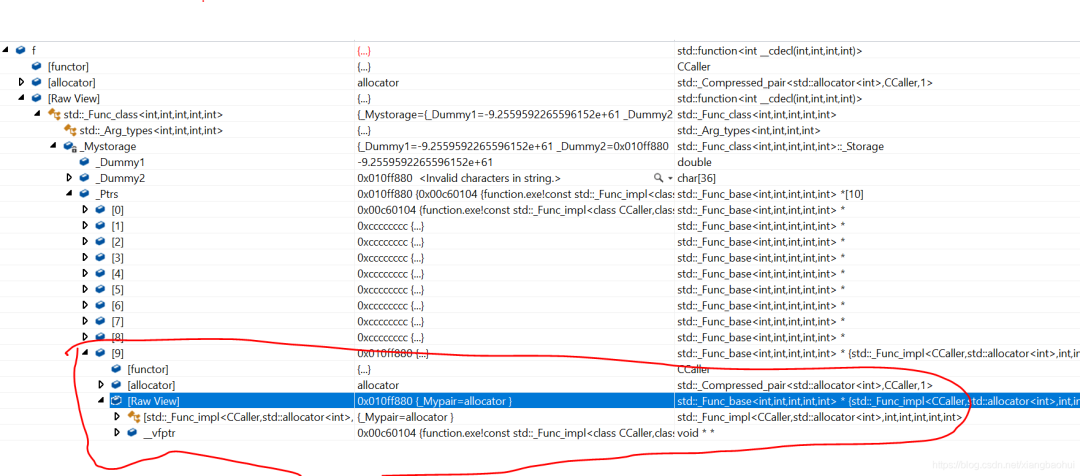
从这里我们发现_Storage大小为:
const int _Num_ptrs = 6 + 16 / sizeof (void *);
const size_t _Space_size = (_Num_ptrs - 1) * sizeof (void *);
_Num_ptrs值为10。
如果我们赋值的对象有成员变量会是什么情况呢?例如如下:
class CCaller
{
public:
    int operator()(int a, int b, int c, int d)
    {
    std::cout << a << std::endl;
    std::cout << b << std::endl;
    std::cout << c << std::endl;
    std::cout << d << std::endl;
    return 0;
    }

    int a = 1;
    int b = 10;
    int c = 100;
};

int main()
{
    CCaller Caller;
    std::function<int(int, int, int, int)> f;

    f = Caller;
    f(10, 20, 30, 40);
    return 0;
}
内存结构如下:
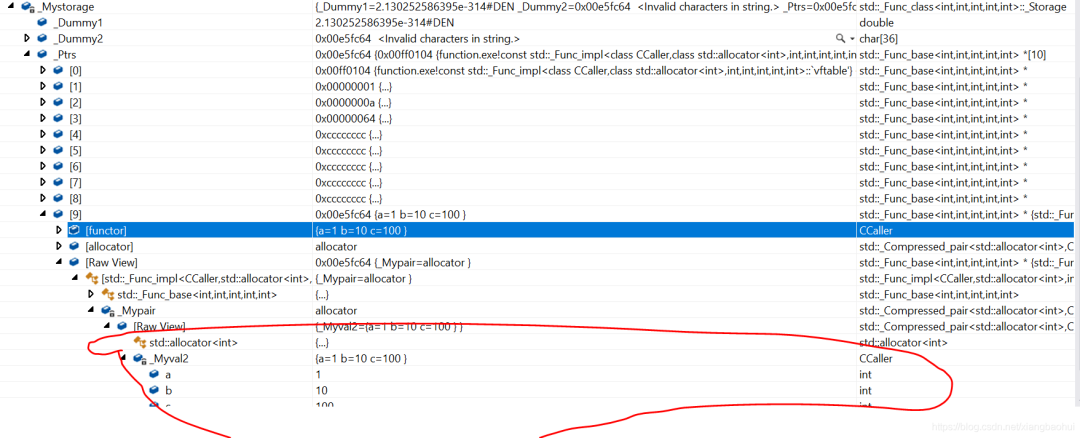
由此我们可以发现std::function是利用一个_Compressed_pair<_Alloc, _Callable> _Mypair;拷贝了元素的数据信息。
主要的初始化过程为:
emplate<class _Fx,
class _Alloc>
    void _Reset_alloc(_Fx&& _Val, const _Alloc& _Ax)
{ // store copy of _Val with allocator
    if (!_Test_callable(_Val))
    { // null member pointer/function pointer/std::function
    return; // already empty
    }

    typedef typename decay<_Fx>::type _Decayed;
    typedef _Func_impl<_Decayed, _Alloc, _Ret, _Types...> _Myimpl;
    _Myimpl *_Ptr = 0;

    typedef _Wrap_alloc<_Alloc> _Alimpl0;
    typedef typename _Alimpl0::template rebind<_Myimpl>::other _Alimpl;
    _Alimpl _Al(_Ax);

    _Reset_impl(_STD forward<_Fx>(_Val), _Ax,
    _Ptr, _Al, _Is_large<_Myimpl>());
}
其中decay<_Fx>::type定义了_Compressed_pair<_Alloc, _Callable> _Mypair;中_Callable的类型,这个声明如下(也就是去掉引用和其他属性信息):
template<class _Ty>
struct decay
{ // determines decayed version of _Ty
    typedef typename remove_reference<_Ty>::type _Ty1;

    typedef typename _If<is_array<_Ty1>::value,
    typename remove_extent<_Ty1>::type *,
    typename _If<is_function<_Ty1>::value,
    typename add_pointer<_Ty1>::type,
    typename remove_cv<_Ty1>::type>::type>::type type;
};
至此,我们大致上完成了std::function的原理分析了,希望在后续的使用中,我们能够知道std::function在什么情况下可以使用,以及背后完成的事情。