C++ folly库解读01
原文出处:C++ folly库解读(一) Fbstring —— 一个完美替代std::string的库(上)
string 常见的三种实现方式
- eager copy
- COW
- SSO
Fbstring 介绍
- Storage strategies
- Implementation highlights
- Benchmark
主要类
字符串存储数据结构
- small strings
- medium strings
- large strings
如何区分字符串类型 category
- 小端
- 大端
- small strings
- medium strings
- large strings
- category()
- capacity()
- size()
字符串初始化
- initSmall
- initMedium
- initLarge
- 特殊的构造函数 —— 不拷贝用户传入的字符串
在引入fbstring[1]之前,我们首先再回顾一下 string 常见的三种实现方式。
string 常见的三种实现方式
string 中比较重要的 3 个字段:
char *data. 指向存放字符串的首地址(在 SSO 的某些实现方案中可能没有此字段)。size_t size. 字符串长度。size_t capacity. 字符串容量。capacity >= size. 在字符串相加、reserve 等场景下会用到此字段。
eager copy
这个是最简单、最好理解的一种,在每次拷贝时将原 string 对应的内存以及所持有的动态资源完整地复制一份,即没有任何特殊处理。
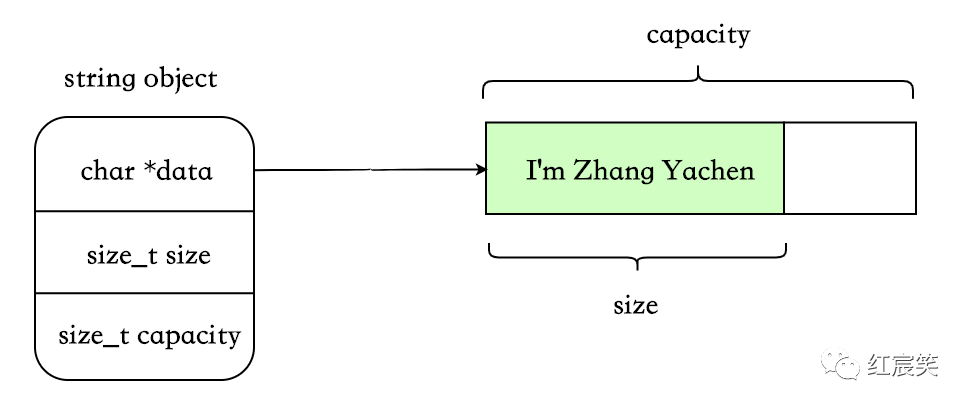
优点:
- 实现简单。
- 每个对象互相独立,不用考虑那么多乱七八糟的场景。
缺点:
- 字符串较大时,拷贝浪费空间。
COW
这个也算是计算机里的基本思想了。不同于 eager copy 的每次拷贝都会复制,此种实现方式为写时复制,即 copy-on-write。只有在某个 string 要对共享对象进行修改时,才会真正执行拷贝。
由于存在共享机制,所以需要一个std::atomic<size_t>,代表被多少对象共享。
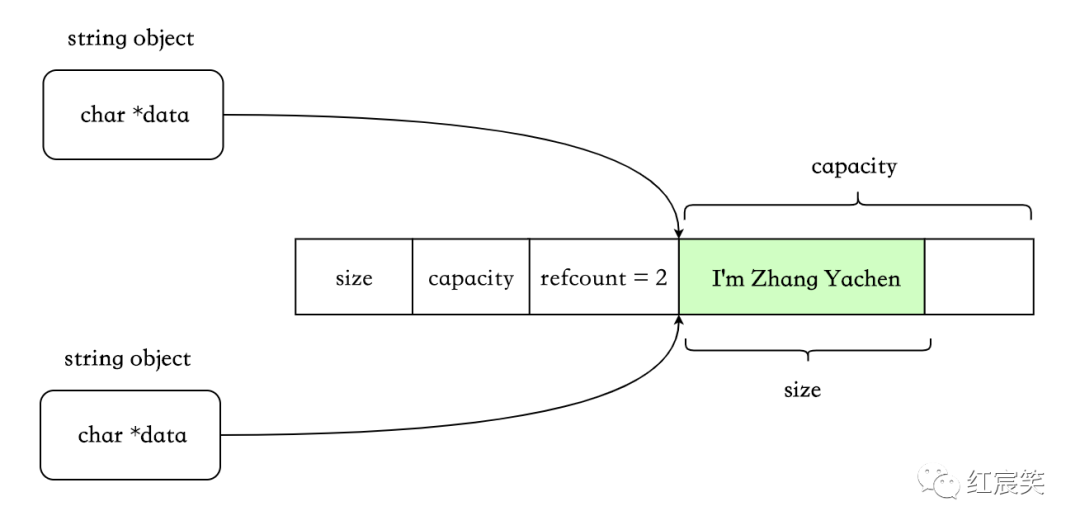
写时复制:
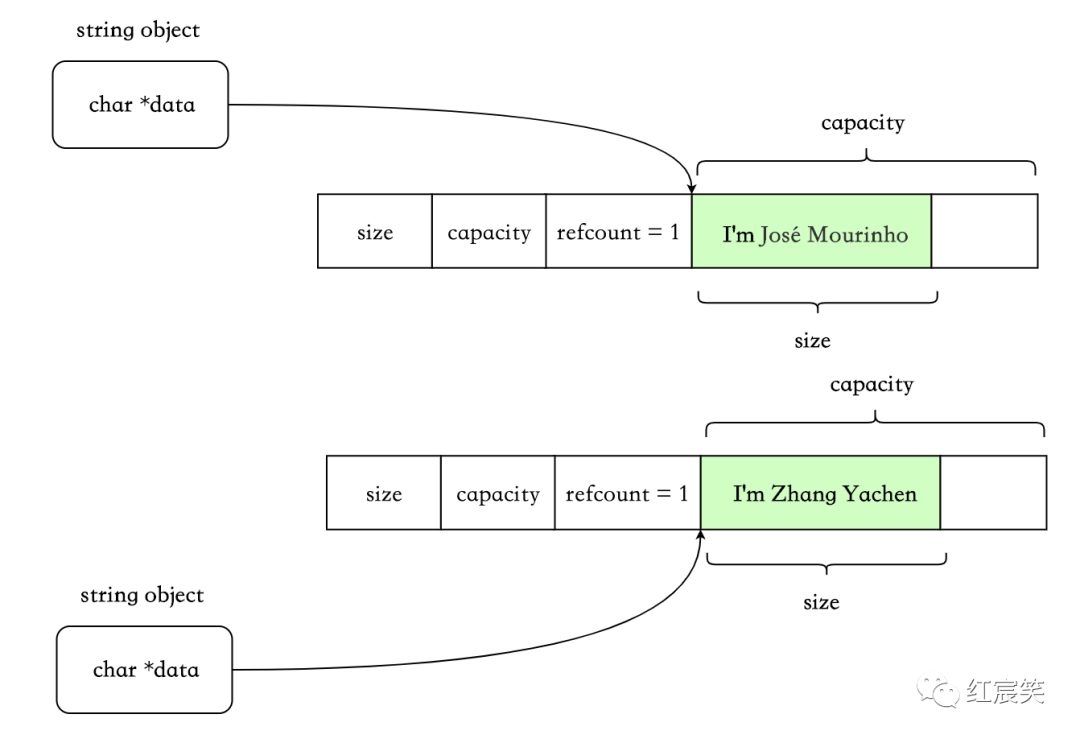
优点:
- 字符串空间较大时,减少了分配、复制字符串的时间。
缺点:
- refcount 需要原子操作,性能有损耗。
- 某些情况下会带来意外的开销。比如非 const 成员使用
[],这会触发 COW,因为无法知晓应用程序是否会对返回的字符做修改。典型的如Legality of COW std::string implementation in C++11[2]中举的例子:
std::string s("str");
const char* p = s.data();
{
    std::string s2(s);
    (void) s[0];         // 触发COW
}
std::cout << *p << '\n';      // p指向的原有空间已经无效
- 其他更细节的缺点可以参考:std::string 的 Copy-on-Write:不如想象中美好[3]
SSO
Small String Optimization. 基于字符串大多数比较短的特点,利用 string 对象本身的栈空间来存储短字符串。而当字符串长度大于某个临界值时,则使用 eager copy 的方式。
SSO 下,string 的数据结构会稍微复杂点,使用 union 来区分短字符串和长字符串的场景:
class string {
  char *start;
  size_t size;
  static const int kLocalSize = 15;
  union{
    char buffer[kLocalSize+1];      // 满足条件时,用来存放短字符串
    size_t capacity;
  }data;
};
短字符串,SSO:
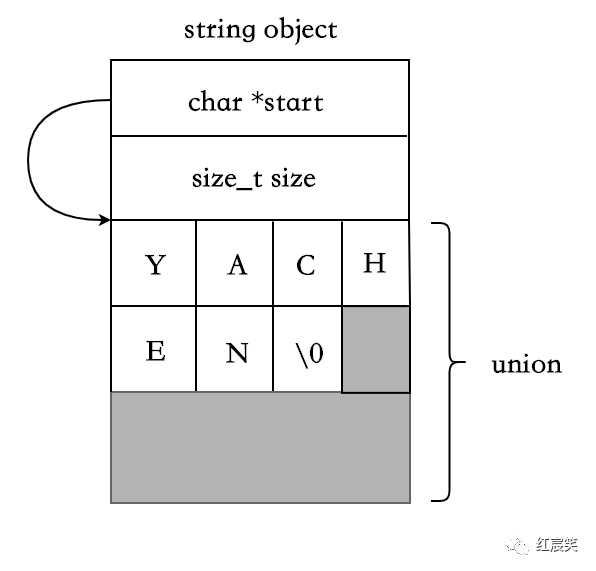
长字符串,eager copy:
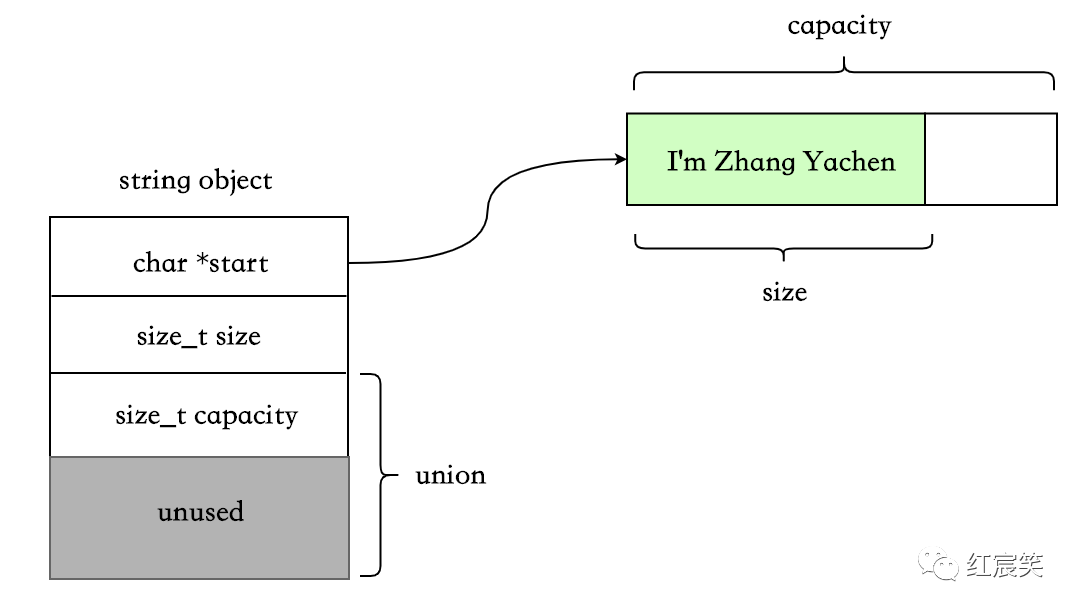
这种数据结构的实现下,SSO 的阈值一般是 15 字节。folly 的 fbstring 在 SSO 场景下,数据结构做了一些优化,可以存储 23 个字节,后面会提到。
优点:
- 短字符串时,无动态内存分配。
缺点:
- string 对象占用空间比 eager copy 和 cow 要大。
Fbstring 介绍
fbstring 可以 100%兼容 std::string。配合三种存储策略和jemalloc[4],可以显著的提高 string 的性能。
fbstring 支持 32-bit、64-bit、little-endian、big-endian.
Storage strategies
- Small Strings (<= 23 chars) ,使用 SSO.
- Medium strings (24 - 255 chars),使用 eager copy.
- Large strings (> 255 chars),使用 COW.
Implementation highlights
- 与 std::string 100%兼容。
- COW 存储时对于引用计数线程安全。
- 对 Jemalloc 友好。如果检测到使用 jemalloc,那么将使用 jemalloc 的一些非标准扩展接口来提高性能。
find()使用简化版的Boyer-Moore algorithm[5]。在查找成功的情况下,相对于string::find()有 30 倍的性能提升。在查找失败的情况下也有 1.5 倍的性能提升。- 可以与 std::string 互相转换。
Benchmark
在FBStringBenchmark.cpp[6]中。
主要类
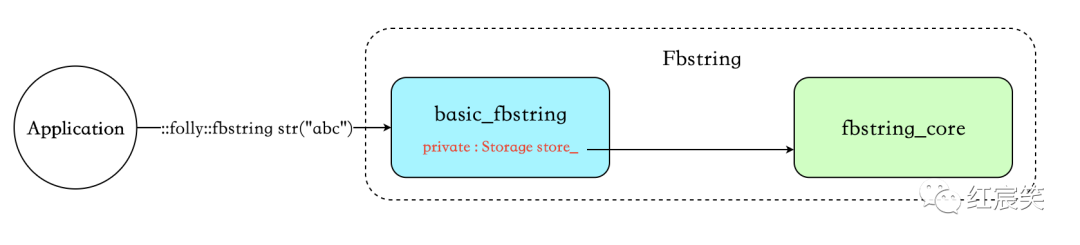
::folly::fbstring str("abc")中的 fbstring 为 basic_fbstring的别名 :typedef basic_fbstring<char> fbstring;basic_fbstring在fbstring_core提供的接口之上,实现了 std::string 定义的所有接口。里面有一个私有变量store_,默认值即为fbstring_core``。basic_fbstring的定义如下,比std::basic_string只多了一个默认的模板参数 Storage:
template <
    typename E,
    class T = std::char_traits<E>,
    class A = std::allocator<E>,
    class Storage = fbstring_core<E>>
class basic_fbstring;
fbstring_core负责字符串的存储及字符串相关的操作,例如 init、copy、reserve、shrink 等等。
字符串存储数据结构
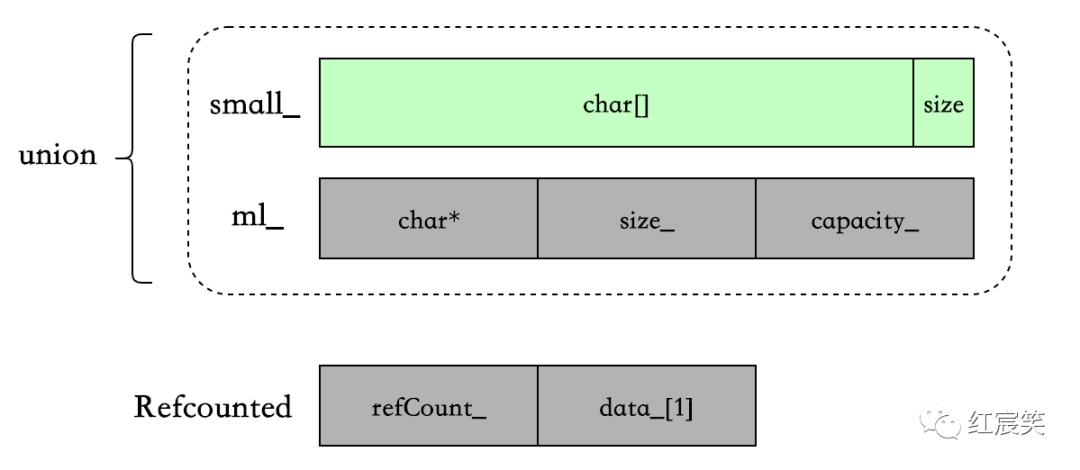
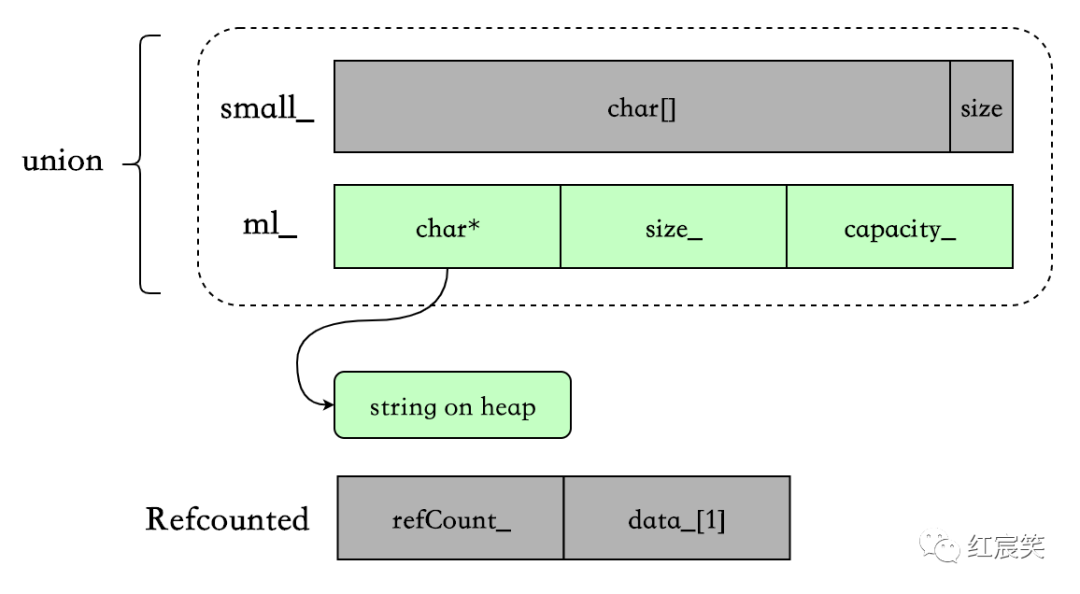
最重要的 3 个数据结构 union{Char small*, MediumLarge ml*}、MediumLarge、RefCounted,定义在fbstring_core 中,基本上所有的字符串操作都离不开这三个数据结构。
struct RefCounted {
    std::atomic<size_t> refCount_;
    Char data_[1];
    static RefCounted * create(size_t * size);       // 创建一个RefCounted
    static RefCounted * create(const Char * data, size_t * size);     // ditto
    static void incrementRefs(Char * p);     // 增加一个引用
    static void decrementRefs(Char * p);    // 减少一个引用
    // 其他函数定义
}
;
struct MediumLarge {
  Char* data_;
  size_t size_;
  size_t capacity_;

  size_t capacity() const {
    return kIsLittleEndian ? capacity_ & capacityExtractMask : capacity_ >> 2;
  }

  void setCapacity(size_t cap, Category cat) {
    capacity_ = kIsLittleEndian
        ? cap | (static_cast<size_t>(cat) << kCategoryShift)
        : (cap << 2) | static_cast<size_t>(cat);
  }
};

union {
    uint8_t bytes_[sizeof(MediumLarge)];          // For accessing the last byte.
    Char small_[sizeof(MediumLarge) / sizeof(Char)];
    MediumLarge ml_;
};
- small strings(SSO)时,使用 union 中的
Char small_存储字符串,即对象本身的栈空间。 - medium strings(eager copy)时,使用 union 中的
MediumLarge ml_Char* data_:指向分配在堆上的字符串。size_t size_:字符串长度。size_t capacity_:字符串容量。
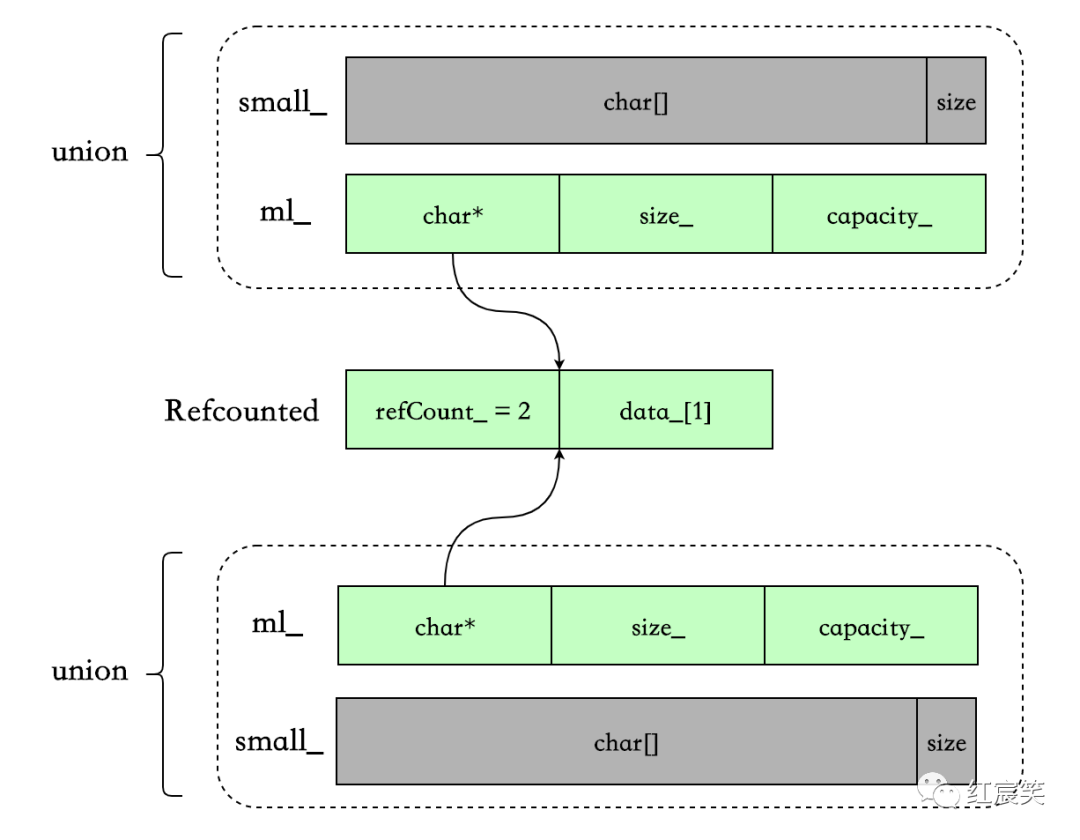
- large strings(cow)时, 使用
MediumLarge ml_和RefCounted:RefCounted.refCount_:共享字符串的引用计数。RefCounted.data_[1]: flexible array. 存放字符串。ml*.data_指向RefCounted.data_,ml*.size_与 ml_.capacity_的含义不变。
但是这里有一个问题是:SSO 情况下的 size 和 capacity 存在哪里了?
- capacity : 首先 SSO 的场景并不需要 capacity,因为此时利用的是栈空间,或者理解此种情况下的 capacity=maxSmallSize.
- size : 利用 small_的一个字节来存储 size,而且具体存储的不是 size,而是
maxSmallSize - s(maxSmallSize=23,再转成 char 类型),因为这样可以 SSO 多存储一个字节,具体原因后面详细讲。
small strings :
medium strings :
large strings :
如何区分字符串类型 category
字符串的 small/medium/large 类型对外部透明,而且针对字符串的各种操作例如 copy、shrink、reserve、赋值等等,三种类型的处理方式都不一样,所以,我们需要在上面的数据结构中做些“手脚”,来区分不同的字符串类型。
因为只有三种类型,所以只需要 2 个 bit 就能够区分。相关的数据结构为:
typedef uint8_t category_type;
enum class Category : category_type {
    isSmall = 0,
    isMedium = kIsLittleEndian ? 0x80 : 0x2,       //  10000000 , 00000010
    isLarge = kIsLittleEndian ? 0x40 : 0x1,        //  01000000 , 00000001
};
kIsLittleEndian 为判断当前平台的大小端,大端和小端的存储方式不同。
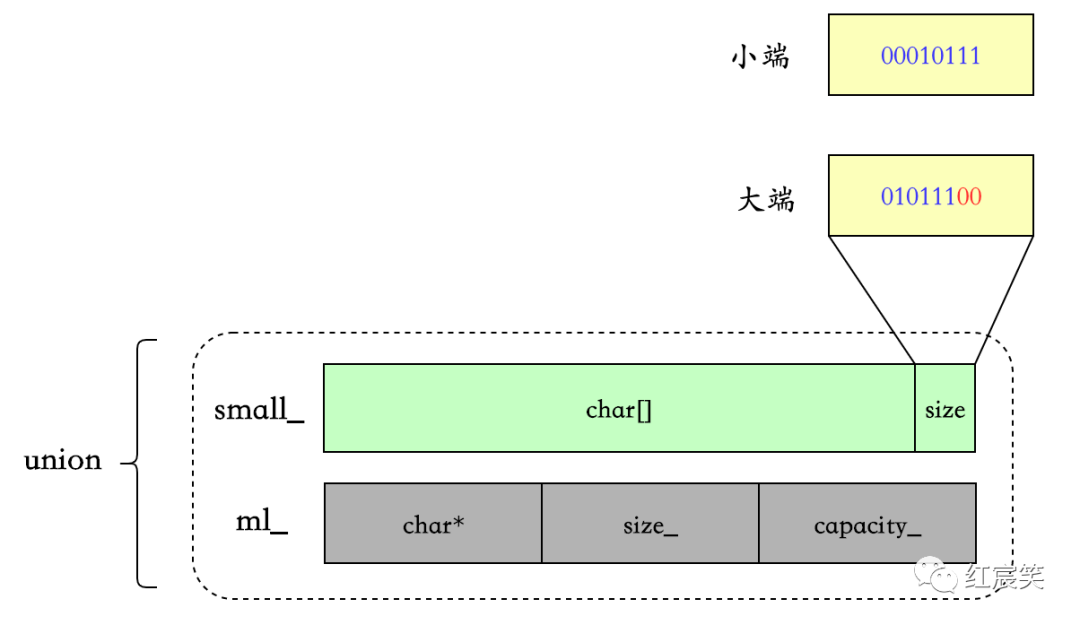
small strings
category 与 size 共同存放在 small_的最后一个字节中(size 最大为 23,所以可以存下),考虑到大小端,所以有移位操作,这主要是为了让 category()的判断更简单,后面再详细分析。具体代码在 setSmallSize 中:
void setSmallSize(size_t s) {
  ......
  constexpr auto shift = kIsLittleEndian ? 0 : 2;
  small_[maxSmallSize] = char((maxSmallSize - s) << shift);
  ......
}
medium strings
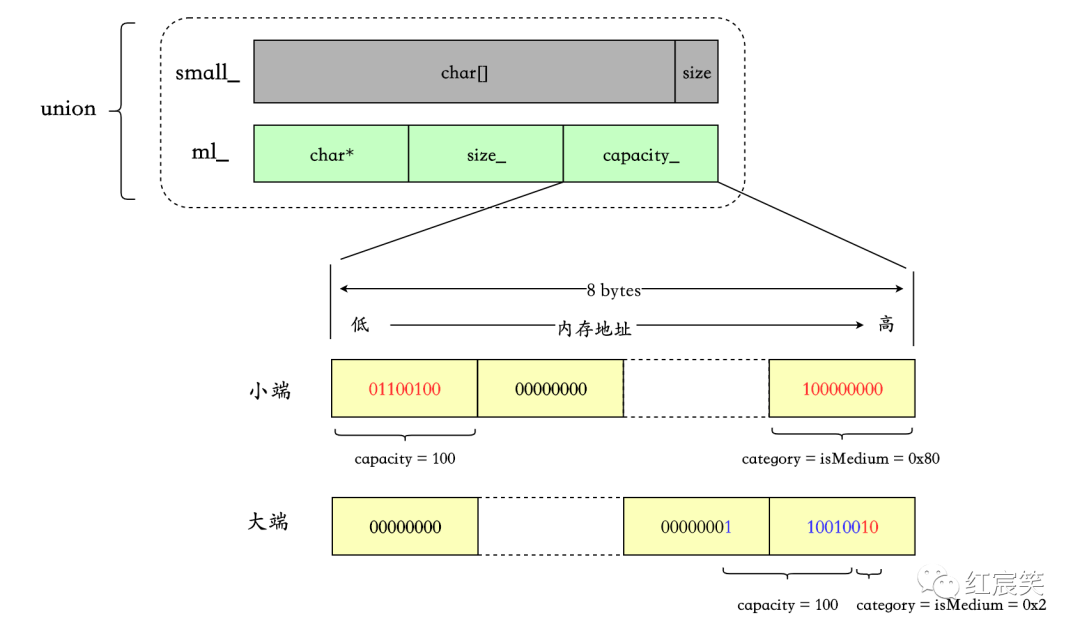
可能有人注意到了,在 MediumLarge 结构体中定义了两个方法,capacity()和setCapacity(size_t cap,
Category cat),其中 setCapacity 即同时设置 capacity 和 category :
constexpr static size_t kCategoryShift = (sizeof(size_t) - 1) * 8;
void setCapacity(size_t cap, Category cat) {
    capacity_ = kIsLittleEndian
        ? cap | (static_cast<size_t>(cat) << kCategoryShift)
        : (cap << 2) | static_cast<size_t>(cat);
}
- 小端时,将 category = isMedium = 0x80 向左移动
(sizeof(size_t) - 1) * 8位,即移到最高位的字节中,再与 capacity 做或运算。 - 大端时,将 category = isMedium = 0x2 与 cap << 2 做或运算即可,左移 2 位的目的是给 category 留空间。
举个例子,假设 64 位机器,capacity = 100 :
large strings
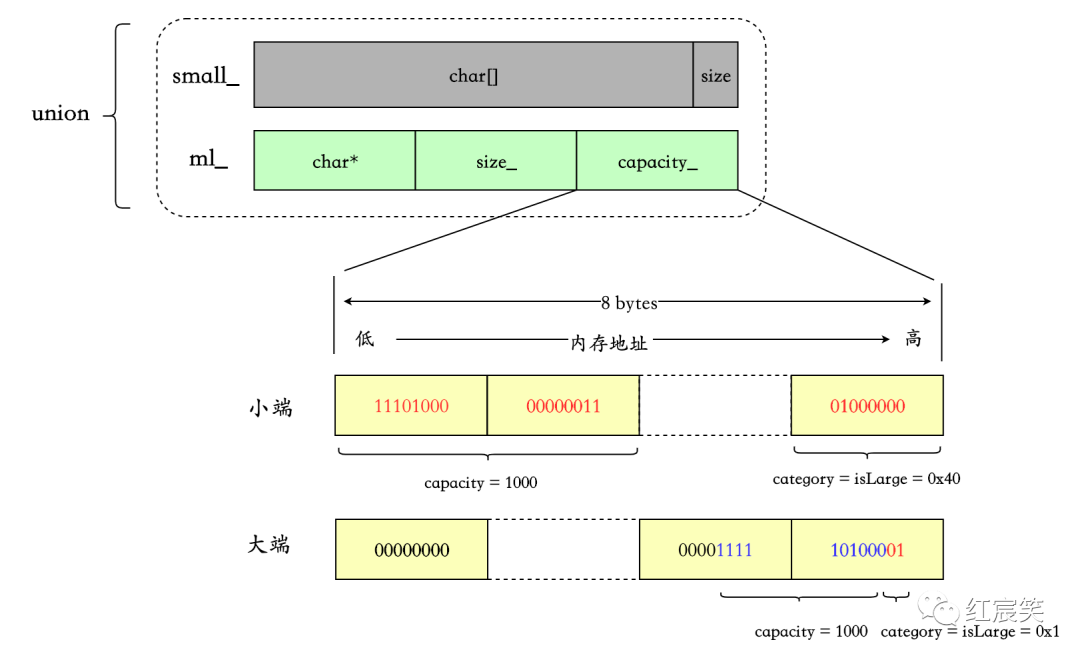
同样使用 MediumLarge 的 setCapacity,算法相同,只是 category 的值不同。
假设 64 位机器,capacity = 1000 :
category()
category()为最重要的函数之一,作用是获取字符串的类型:
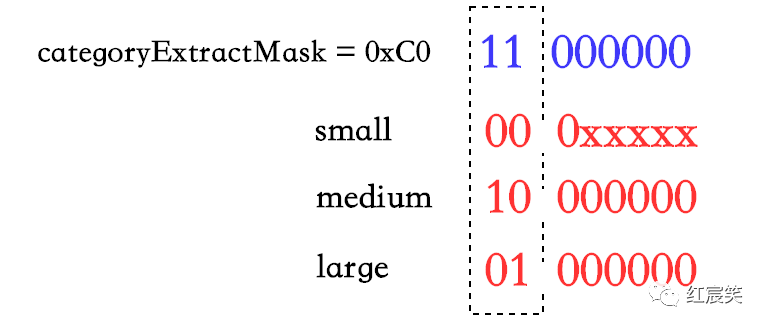
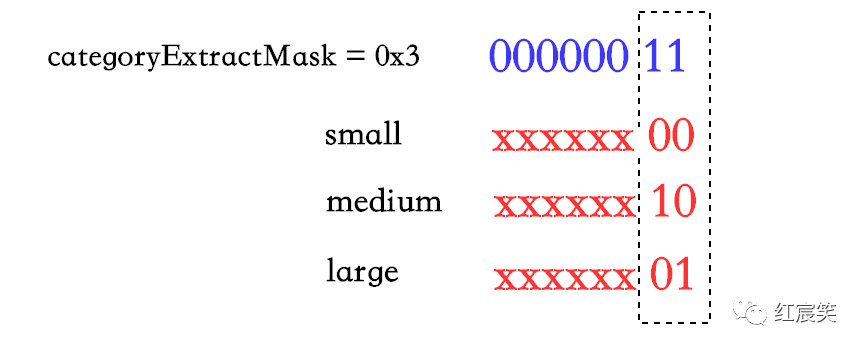
constexpr static uint8_t categoryExtractMask = kIsLittleEndian ? 0xC0 : 0x3;    // 11000000 , 00000011
constexpr static size_t lastChar = sizeof(MediumLarge) - 1;

union {
    uint8_t bytes_[sizeof(MediumLarge)];          // For accessing the last byte.
    Char small_[sizeof(MediumLarge) / sizeof(Char)];
    MediumLarge ml_;
};

Category category() const {
  // works for both big-endian and little-endian
  return static_cast<Category>(bytes_[lastChar] & categoryExtractMask);
}
bytes_定义在 union 中,从注释可以看出来,是为了配合 lastChar 更加方便的取该结构最后一个字节。
配合上面三种类型字符串的存储,可以很容易理解这一行代码。
小端
大端
capacity()
获取字符串的 capaticy,因为 capacity 与 category 存储都在一起,所以一起看比较好。
同样分三种情况。
size_t capacity() const {
  switch (category()) {
    case Category::isSmall:
      return maxSmallSize;
    case Category::isLarge:
      // For large-sized strings, a multi-referenced chunk has no
      // available capacity. This is because any attempt to append
      // data would trigger a new allocation.
      if (RefCounted::refs(ml_.data_) > 1) {
        return ml_.size_;
      }
      break;
    case Category::isMedium:
    default:
      break;
  }
  return ml_.capacity();
}
- small strings : 直接返回 maxSmallSize,前面有分析过。
- medium strings : 返回
ml_.capacity()。 - large strings :
- 当字符串引用大于 1 时,直接返回 size。因为此时的 capacity 是没有意义的,任何 append data 操作都会触发一次 cow
- 否则,返回
ml_.capacity()。
看下 ml.capacity() :
constexpr static uint8_t categoryExtractMask = kIsLittleEndian ? 0xC0 : 0x3;
constexpr static size_t kCategoryShift = (sizeof(size_t) - 1) * 8;

constexpr static size_t capacityExtractMask = kIsLittleEndian
      ? ~(size_t(categoryExtractMask) << kCategoryShift)
      : 0x0 /* unused */;

size_t capacity() const {
      return kIsLittleEndian ? capacity_ & capacityExtractMask : capacity_ >> 2;
}
categoryExtractMask 和 kCategoryShift 之前遇到过,分别用来计算 category 和小端情况下将 category 左移
kCategoryShift 位。capacityExtractMask 的目的就是消掉 category,让 capacity_中只有 capacity。
对着上面的每种情况下字符串的存储的图,应该很好理解,这里不细说了。
size()
size_t size() const {
  size_t ret = ml_.size_;

  if /* constexpr */ (kIsLittleEndian) {
    // We can save a couple instructions, because the category is
    // small iff the last char, as unsigned, is <= maxSmallSize.
    typedef typename std::make_unsigned<Char>::type UChar;

    auto maybeSmallSize = size_t(maxSmallSize) -
        size_t(static_cast<UChar>(small_[maxSmallSize]));

    // With this syntax, GCC and Clang generate a CMOV instead of a branch.
    ret = (static_cast<ssize_t>(maybeSmallSize) >= 0) ? maybeSmallSize : ret;
  } else {
    ret = (category() == Category::isSmall) ? smallSize() : ret;
  }

  return ret;
}
小端的情况下,medium strings 和 large strings 对应的 ml_的高字节存储的是 category(0x80、0x40),而 small strings 存储的是 size,所以正如注释说的,可以先判断 kIsLittleEndian && maybeSmall,会快一些,不需要调用 smallSize()。而且现在绝大多数平台都是小端。
如果是大端,那么如果是 small,调用 smallSize(),否则返回 ml.size_;
size_t smallSize() const {
  assert(category() == Category::isSmall);
  constexpr auto shift = kIsLittleEndian ? 0 : 2;
  auto smallShifted = static_cast<size_t>(small_[maxSmallSize]) >> shift;
  assert(static_cast<size_t>(maxSmallSize) >= smallShifted);
  return static_cast<size_t>(maxSmallSize) - smallShifted;
}
比较简单,不说了。
字符串初始化
首先 fbstring_core 的构造函数中,根据字符串的长度,调用 3 种不同类型的初始化函数:
fbstring_core(
    const Char* const data,
    const size_t size,
    bool disableSSO = FBSTRING_DISABLE_SSO) {
  if (!disableSSO && size <= maxSmallSize) {
    initSmall(data, size);
  } else if (size <= maxMediumSize) {
    initMedium(data, size);
  } else {
    initLarge(data, size);
  }
}
initSmall
template <class Char>
inline void fbstring_core<Char>::initSmall(
    const Char* const data,
    const size_t size) {

// If data is aligned, use fast word-wise copying. Otherwise,
// use conservative memcpy.
// The word-wise path reads bytes which are outside the range of
// the string, and makes ASan unhappy, so we disable it when
// compiling with ASan.
#ifndef FOLLY_SANITIZE_ADDRESS
  if ((reinterpret_cast<size_t>(data) & (sizeof(size_t) - 1)) == 0) {
    const size_t byteSize = size * sizeof(Char);
    constexpr size_t wordWidth = sizeof(size_t);

    switch ((byteSize + wordWidth - 1) / wordWidth) { // Number of words.
      case 3:
        ml_.capacity_ = reinterpret_cast<const size_t*>(data)[2];
        FOLLY_FALLTHROUGH;
      case 2:
        ml_.size_ = reinterpret_cast<const size_t*>(data)[1];
        FOLLY_FALLTHROUGH;
      case 1:
        ml_.data_ = *reinterpret_cast<Char**>(const_cast<Char*>(data));
        FOLLY_FALLTHROUGH;
      case 0:
        break;
    }
  } else
#endif
  {
    if (size != 0) {
      fbstring_detail::podCopy(data, data + size, small_);
    }
  }
  setSmallSize(size);
}
- 首先,如果传入的字符串地址是内存对齐的,则配合 reinterpret_cast 进行 word-wise copy,提高效率。
- 否则,调用 podCopy 进行 memcpy。
- 最后,通过 setSmallSize 设置 small string 的 size。
setSmallSize :
void setSmallSize(size_t s) {
  // Warning: this should work with uninitialized strings too,
  // so don't assume anything about the previous value of
  // small_[maxSmallSize].
  assert(s <= maxSmallSize);
  constexpr auto shift = kIsLittleEndian ? 0 : 2;
  small_[maxSmallSize] = char((maxSmallSize - s) << shift);
  small_[s] = '\0';
  assert(category() == Category::isSmall && size() == s);
}
之前提到过,small strings 存放的 size 不是真正的 size,是maxSmallSize - size,这样做的原因是可以 small strings 可以多存储一个字节 。因为假如存储 size 的话,small_中最后两个字节就得是\0 和 size,但是存储maxSmallSize - size,当 size == maxSmallSize 时,small_的最后一个字节恰好也是\0。
initMedium
template <class Char>
FOLLY_NOINLINE inline void fbstring_core<Char>::initMedium(
    const Char* const data,
    const size_t size) {
  // Medium strings are allocated normally. Don't forget to
  // allocate one extra Char for the terminating null.
  auto const allocSize = goodMallocSize((1 + size) * sizeof(Char));

  ml_.data_ = static_cast<Char*>(checkedMalloc(allocSize));
  if (FOLLY_LIKELY(size > 0)) {
    fbstring_detail::podCopy(data, data + size, ml_.data_);
  }

  ml_.size_ = size;
  ml_.setCapacity(allocSize / sizeof(Char) - 1, Category::isMedium);
  ml_.data_[size] = '\0';
}
folly 会通过 canNallocx 函数检测是否使用 jemalloc,如果是,会使用 jemalloc 来提高内存分配的性能。关于 jemalloc 我也不是很熟悉,感兴趣的可以查查,有很多资料。
- 所有的动态内存分配都会调用 goodMallocSize,获取一个对 jemalloc 友好的值。
- 再通过 checkedMalloc 真正申请内存,存放字符串。
- 调用 podCopy 进行 memcpy,与 initSmall 的 podCopy 一样。
- 最后再设置 size、capacity、category 和\0。
initLarge
template <class Char>
FOLLY_NOINLINE inline void fbstring_core<Char>::initLarge(
    const Char* const data,
    const size_t size) {
  // Large strings are allocated differently
  size_t effectiveCapacity = size;

  auto const newRC = RefCounted::create(data, &effectiveCapacity);
  ml_.data_ = newRC->data_;
  ml_.size_ = size;
  ml_.setCapacity(effectiveCapacity, Category::isLarge);
  ml_.data_[size] = '\0';
}
与 medium strings 最大的不同是会通过 RefCounted::create 创建 RefCounted 用于共享字符串:
struct RefCounted {
    std::atomic<size_t> refCount_;
    Char data_[1];

    constexpr static size_t getDataOffset() {
      return offsetof(RefCounted, data_);
    }

    static RefCounted* create(size_t* size) {
      const size_t allocSize =
          goodMallocSize(getDataOffset() + (*size + 1) * sizeof(Char));
      auto result = static_cast<RefCounted*>(checkedMalloc(allocSize));
      result->refCount_.store(1, std::memory_order_release);
      *size = (allocSize - getDataOffset()) / sizeof(Char) - 1;
      return result;
    }

    static RefCounted* create(const Char* data, size_t* size) {
      const size_t effectiveSize = *size;
      auto result = create(size);
      if (FOLLY_LIKELY(effectiveSize > 0)) {
        fbstring_detail::podCopy(data, data + effectiveSize, result->data_);
      }
      return result;
    }
};
需要注意的是:
ml*.data*指向的是RefCounted.data_.- getDataOffset()用 offsetof 函数获取
data*在 RefCounted 结构体内的偏移,Char data*[1]为 flexible array,存放字符串。 - 注意对
std::atomic<size_t> refCount_进行原子操作的 c++ memory model :- store,设置引用数为 1 :
std::memory_order_release - load,获取当前共享字符串的引用数:
std::memory_order_acquire - add/sub。增加/减少一个引用 :
std::memory_order_acq_rel
- store,设置引用数为 1 :
c++ memory model 是另外一个比较大的话题,可以参考:
- Memory model synchronization modes[7]
- 一文带你看懂 C++11 的内存模型
- C++11 中的内存模型下篇 - C++11 支持的几种内存模型[8]
特殊的构造函数 —— 不拷贝用户传入的字符串
上面的三种构造,都是将应用程序传入的字符串,不管使用 word-wise copy 还是 memcpy,拷贝到 fbstring_core 中,且在 medium 和 large 的情况下,需要动态分配内存。
fbstring 提供了一个特殊的构造函数,让 fbstring_core 接管应用程序自己分配的内存。
basic_fbstring 的构造函数,并调用 fbstring_core 相应的构造函数。注意这里 AcquireMallocatedString 为 enum class,比使用 int 和 bool 更可读。
/**
  * Defines a special acquisition method for constructing fbstring
  * objects. AcquireMallocatedString means that the user passes a
  * pointer to a malloc-allocated string that the fbstring object will
  * take into custody.
  */
enum class AcquireMallocatedString {};

// Nonstandard constructor
basic_fbstring(value_type *s, size_type n, size_type c,
                  AcquireMallocatedString a)
      : store_(s, n, c, a) {
}
basic_fbstring 调用相应的 fbstring_core 构造函数:
// Snatches a previously mallocated string. The parameter "size"
// is the size of the string, and the parameter "allocatedSize"
// is the size of the mallocated block.  The string must be
// \0-terminated, so allocatedSize >= size + 1 and data[size] == '\0'.
//
// So if you want a 2-character string, pass malloc(3) as "data",
// pass 2 as "size", and pass 3 as "allocatedSize".
fbstring_core(Char * const data,
              const size_t size,
              const size_t allocatedSize,
              AcquireMallocatedString) {
  if (size > 0) {
    FBSTRING_ASSERT(allocatedSize >= size + 1);
    FBSTRING_ASSERT(data[size] == '\0');

    // Use the medium string storage
    ml_.data_ = data;
    ml_.size_ = size;

    // Don't forget about null terminator
    ml_.setCapacity(allocatedSize - 1, Category::isMedium);
  } else {
    // No need for the memory
    free(data);
    reset();
  }
}
可以看出这里没有拷贝字符串的过程,而是直接接管了上游传递过来的指针指向的内存。但是,正如注释说的,这里直接使用了 medium strings 的存储方式。
比如 folly/io/IOBuf.cpp 中的调用:
// Ensure NUL terminated
*writableTail() = 0;
fbstring str(
      reinterpret_cast<char*>(writableData()),
      length(),
      capacity(),
      AcquireMallocatedString());
参考资料
- [1] fbstring
- [2] Legality of COW std::string implementation in C++11
- [3] std::string 的 Copy-on-Write:不如想象中美好
- [4] jemalloc
- [5] Boyer-Moore algorithm
- [6] FBStringBenchmark.cpp
- [7] Memory model synchronization modes
- [8] C++11 中的内存模型下篇 - C++11 支持的几种内存模型
原文出处:C++ folly库解读(一) Fbstring —— 一个完美替代std::string的库(下)
- 字符串拷贝
- copySmall
- copyMedium
- copyLarge
- 析构
- COW
- non-const operator
- non-const 与 const
- Realloc
- 其他
- __builtin_expect
- CMOV 指令
- builtin_unreachable && assume(0)
- jemalloc
- find 算法
- 判断大小端
字符串拷贝
同初始化,也是根据不同的字符串类型,调用不同的函数:
fbstring_core(const fbstring_core& rhs) {
  assert(&rhs != this);
  switch (rhs.category()) {
    case Category::isSmall:
      copySmall(rhs);
      break;
    case Category::isMedium:
      copyMedium(rhs);
      break;
    case Category::isLarge:
      copyLarge(rhs);
      break;
    default:
      folly::assume_unreachable();
  }
}
copySmall
template <class Char>
inline void fbstring_core<Char>::copySmall(const fbstring_core& rhs) {
  // Just write the whole thing, don't look at details. In
  // particular we need to copy capacity anyway because we want
  // to set the size (don't forget that the last character,
  // which stores a short string's length, is shared with the
  // ml_.capacity field).
  ml_ = rhs.ml_;
}
正如注释中所说,虽然 small strings 的情况下,字符串存储在 small_ 中,但是我们只需要把 ml_ 直接赋值即可,因为在一个 union 中。
copyMedium
template <class Char>
FOLLY_NOINLINE inline void fbstring_core<Char>::copyMedium(
    const fbstring_core& rhs) {
  // Medium strings are copied eagerly. Don't forget to allocate
  // one extra Char for the null terminator.
  auto const allocSize = goodMallocSize((1 + rhs.ml_.size_) * sizeof(Char));
  ml_.data_ = static_cast<Char*>(checkedMalloc(allocSize));
  // Also copies terminator.
  fbstring_detail::podCopy(
      rhs.ml_.data_, rhs.ml_.data_ + rhs.ml_.size_ + 1, ml_.data_);
  ml_.size_ = rhs.ml_.size_;
  ml_.setCapacity(allocSize / sizeof(Char) - 1, Category::isMedium);
}
medium strings 是 eager copy,所以就是"深拷贝":
- 为字符串分配空间、拷贝
- 赋值 size、capacity、category.
copyLarge
template <class Char>
FOLLY_NOINLINE inline void fbstring_core<Char>::copyLarge(
    const fbstring_core& rhs) {
  // Large strings are just refcounted
  ml_ = rhs.ml_;
  RefCounted::incrementRefs(ml_.data_);
}
large strings 的 copy 过程很直观,因为是 COW 方式:
- 直接赋值 ml,内含指向共享字符串的指针。
- 共享字符串的引用计数加 1。
incrementRefs 和内部调用 fromData 这两个个函数值得看一下:
static RefCounted* fromData(Char* p) {
      return static_cast<RefCounted*>(static_cast<void*>(
          static_cast<unsigned char*>(static_cast<void*>(p)) -
          getDataOffset()));
}

static void incrementRefs(Char* p) {
  fromData(p)->refCount_.fetch_add(1, std::memory_order_acq_rel);
}
因为 ml_中指向的是 RefCounted 的 data_[1],所以我们需要通过 fromData 来找到 data_ 所属的 RefCounted 的地址。我把 fromData 函数内的运算拆开:
static RefCounted * fromData(Char * p) {
      // 转换data_[1]的地址
      void* voidDataAddr = static_cast<void*>(p);
      unsigned char* unsignedDataAddr = static_cast<unsigned char*>(voidDataAddr);
      // 获取data_[1]在结构体的偏移量再相减,得到的就是所属RefCounted的地址
      unsigned char* unsignedRefAddr = unsignedDataAddr - getDataOffset();
      void* voidRefAddr = static_cast<void*>(unsignedRefAddr);
      RefCounted* refCountAddr = static_cast<RefCounted*>(voidRefAddr);
      return refCountAddr;
}
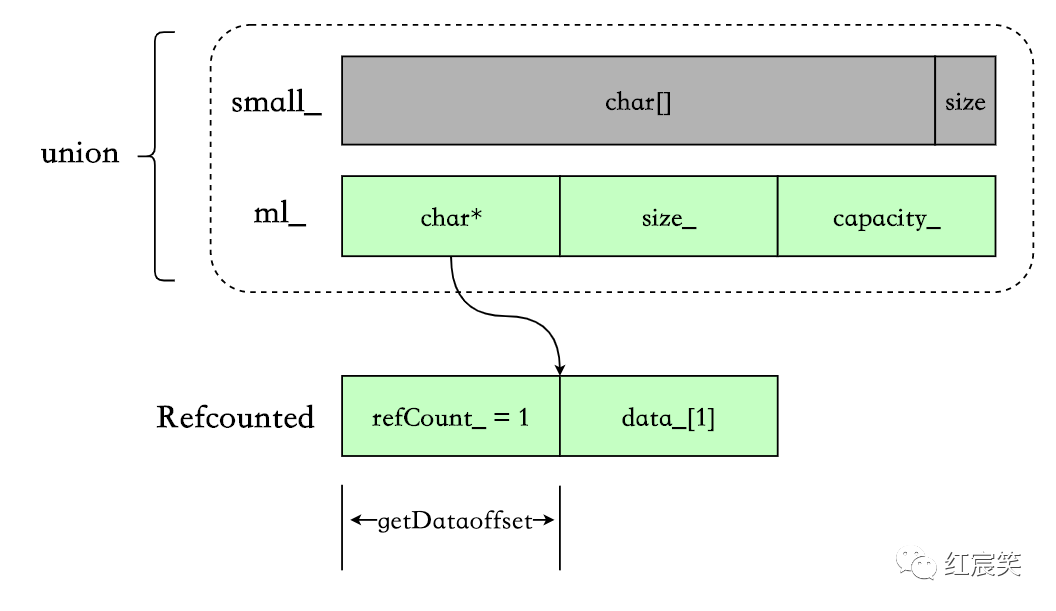
值得关注的是如何转换不同类型结构体的指针并做运算,这里的做法是 :Char* -> void* -> unsigned char* -> 与size_t做减法 -> void * -> RefCounted*
析构
~fbstring_core() noexcept {
    if (category() == Category::isSmall) {
      return;
    }
    destroyMediumLarge();
}
- 如果是 small 类型,直接返回,因为利用的是栈空间。
- 否则,针对 medium 和 large,调用 destroyMediumLarge。
FOLLY_MALLOC_NOINLINE void destroyMediumLarge() noexcept {
  auto const c = category();
  FBSTRING_ASSERT(c != Category::isSmall);
  if (c == Category::isMedium) {
    free(ml_.data_);
  } else {
    RefCounted::decrementRefs(ml_.data_);
  }
}
- medium :free 动态分配的字符串内存即可。
- large : 调用 decrementRefs,针对共享字符串进行操作。
static void decrementRefs(Char * p) {
  auto const dis = fromData(p);
  size_t oldcnt = dis->refCount_.fetch_sub(1, std::memory_order_acq_rel);
  FBSTRING_ASSERT(oldcnt > 0);
  if (oldcnt == 1) {
    free(dis);
  }
}
逻辑也很清晰:先对引用计数减 1,如果本身就只有 1 个引用,那么直接 free 掉整个 RefCounted。
COW
最重要的一点,也是 large strings 独有的,就是 COW. 任何针对字符串写的操作,都会触发 COW,包括前面举过的[]操作,例如:
non-const operator
reference operator[](size_type pos "") {
    return *(begin() + pos);
}

iterator begin() {
    return store_.mutableData();
}
来重点看下 mutableData() :
Char* mutableData() {
  switch (category()) {
  case Category::isSmall:
    return small_;
  case Category::isMedium:
    return ml_.data_;
  case Category::isLarge:
    return mutableDataLarge();
  }
  fbstring_detail::assume_unreachable();
}

template <class Char>
inline Char* fbstring_core<Char>::mutableDataLarge() {
  FBSTRING_ASSERT(category() == Category::isLarge);
  if (RefCounted::refs(ml_.data_) > 1) { // Ensure unique.
    unshare();
  }
  return ml_.data_;
}
同样是分三种情况。small 和 medium 直接返回字符串的地址,large 会调用 mutableDataLarge(),可以看出,如果引用数大于 1,会进行 unshare 操作 :
void unshare(size_t minCapacity = 0);

template <class Char>
FOLLY_MALLOC_NOINLINE inline void fbstring_core<Char>::unshare(
    size_t minCapacity) {
  FBSTRING_ASSERT(category() == Category::isLarge);
  size_t effectiveCapacity = std::max(minCapacity, ml_.capacity());
  auto const newRC = RefCounted::create(&effectiveCapacity);

  // If this fails, someone placed the wrong capacity in an
  // fbstring.
  FBSTRING_ASSERT(effectiveCapacity >= ml_.capacity());

  // Also copies terminator.
  fbstring_detail::podCopy(ml_.data_, ml_.data_ + ml_.size_ + 1, newRC->data_);

  RefCounted::decrementRefs(ml_.data_);
  ml_.data_ = newRC->data_;
  ml_.setCapacity(effectiveCapacity, Category::isLarge);
  // size_ remains unchanged.
}
基本思路:
- 创建新的 RefCounted。
- 拷贝字符串。
- 对原有的共享字符串减少一个引用 decrementRefs,这个函数在上面的析构小节里分析过。
- 设置
ml_的 data、capacity、category. - 注意此时还不会设置 size,因为还不知道应用程序对字符串进行什么修改。
non-const 与 const
大家可能注意到了,上面的 at 和[]强调了 non-const,这是因为 const-qualifer 针对这两个调用不会触发 COW ,还以[]为例:
// C++11 21.4.5 element access:
const_reference operator[](size_type pos "") const {
    return *(begin() + pos);
}

const_iterator begin() const {
    return store_.data();
}

// In C++11 data() and c_str() are 100% equivalent.
const Char* data() const { return c_str(); }

const Char* c_str() const {
    const Char* ptr = ml_.data_;
    // With this syntax, GCC and Clang generate a CMOV instead of a branch.
    ptr = (category() == Category::isSmall) ? small_ : ptr;
    return ptr;
}
可以看出区别,non-const 版本的 begin()中调用的是 mutableData(),而 const-qualifer 版本调用的是 data()-> c_str(),而 c_str() 直接返回的字符串地址。
所以,当字符串用到[]、at 且不需要写操作时,最好用 const-qualifer.
我们拿 folly 自带的benchmark 工具[1]测试一下:
#include "folly/Benchmark.h"
#include "folly/FBString.h"
#include "folly/container/Foreach.h"

using namespace std;
using namespace folly;

BENCHMARK(nonConstFbstringAt, n) {
  ::folly::fbstring str(
      "fbstring is a drop-in replacement for std::string. The main benefit of fbstring is significantly increased "
      "performance on virtually all important primitives. This is achieved by using a three-tiered storage strategy "
      "and by cooperating with the memory allocator. In particular, fbstring is designed to detect use of jemalloc and "
      "cooperate with it to achieve significant improvements in speed and memory usage.");
  FOR_EACH_RANGE(i, 0, n) {
    char &s = str[2];
    doNotOptimizeAway(s);
  }
}

BENCHMARK_DRAW_LINE();

BENCHMARK_RELATIVE(constFbstringAt, n) {
  const ::folly::fbstring str(
      "fbstring is a drop-in replacement for std::string. The main benefit of fbstring is significantly increased "
      "performance on virtually all important primitives. This is achieved by using a three-tiered storage strategy "
      "and by cooperating with the memory allocator. In particular, fbstring is designed to detect use of jemalloc and "
      "cooperate with it to achieve significant improvements in speed and memory usage.");
  FOR_EACH_RANGE(i, 0, n) {
    const char &s = str[2];
    doNotOptimizeAway(s);
  }
}

int main() { runBenchmarks(); }
结果是 constFbstringAt 比 nonConstFbstringAt 快了 175%
============================================================================
delve_folly/main.cc                             relative  time/iter  iters/s
============================================================================
nonConstFbstringAt                                          39.85ns   25.10M
----------------------------------------------------------------------------
constFbstringAt                                  175.57%    22.70ns   44.06M
============================================================================
Realloc
reserve、operator+等操作,可能会涉及到内存重新分配,最终调用的都是 memory/Malloc.h 中的 smartRealloc:
inline void* checkedRealloc(void* ptr, size_t size) {
  void* p = realloc(ptr, size);
  if (!p) {
    throw_exception<std::bad_alloc>();
  }
  return p;
}

/**
  * This function tries to reallocate a buffer of which only the first
  * currentSize bytes are used. The problem with using realloc is that
  * if currentSize is relatively small _and_ if realloc decides it
  * needs to move the memory chunk to a new buffer, then realloc ends
  * up copying data that is not used. It's generally not a win to try
  * to hook in to realloc() behavior to avoid copies - at least in
  * jemalloc, realloc() almost always ends up doing a copy, because
  * there is little fragmentation / slack space to take advantage of.
  */
FOLLY_MALLOC_CHECKED_MALLOC FOLLY_NOINLINE inline void* smartRealloc(
    void* p,
    const size_t currentSize,
    const size_t currentCapacity,
    const size_t newCapacity) {
  assert(p);
  assert(currentSize <= currentCapacity &&
          currentCapacity < newCapacity);

  auto const slack = currentCapacity - currentSize;

  if (slack * 2 > currentSize) {
    // Too much slack, malloc-copy-free cycle:
    auto const result = checkedMalloc(newCapacity);
    std::memcpy(result, p, currentSize);
    free(p);

    return result;
  }

  // If there's not too much slack, we realloc in hope of coalescing
  return checkedRealloc(p, newCapacity);
}
从注释和代码看为什么函数起名叫smartRealloc :
- 如果
(the currentCapacity - currentSize) _ 2 > currentSize,即currentSize < 2/3 _ capacity,说明当前分配的内存利用率较低,此时认为如果使用 realloc 并且 realloc 决定拷贝当前内存到新内存,成本会高于直接malloc(newCapacity) + memcpy + free(old_memory)。 - 否则直接
realloc.
其他
__builtin_expect
给编译器提供分支预测信息。原型为:
long __builtin_expect (long exp, long c)
表达式的返回值为 exp 的值,跟 c 无关。 我们预期 exp 的值是 c。例如下面的例子,我们预期 x 的值是 0,所以这里提示编译器,只有很小的几率会调用到 foo()
if (__builtin_expect (x, 0))
  foo ();
再比如判断指针是否为空:
if (__builtin_expect (ptr != NULL, 1))
  foo (*ptr);
在 fbstring 中也用到了builtin_expect,例如创建 RefCounted 的函数 (FOLLY_LIKELY 包装了一下builtin_expect):
#if __GNUC__
#define FOLLY_DETAIL_BUILTIN_EXPECT(b, t) (__builtin_expect(b, t))
#else
#define FOLLY_DETAIL_BUILTIN_EXPECT(b, t) b
#endif

//  Likeliness annotations
//
//  Useful when the author has better knowledge than the compiler of whether
//  the branch condition is overwhelmingly likely to take a specific value.
//
//  Useful when the author has better knowledge than the compiler of which code
//  paths are designed as the fast path and which are designed as the slow path,
//  and to force the compiler to optimize for the fast path, even when it is not
//  overwhelmingly likely.
#define FOLLY_LIKELY(x) FOLLY_DETAIL_BUILTIN_EXPECT((x), 1)
#define FOLLY_UNLIKELY(x) FOLLY_DETAIL_BUILTIN_EXPECT((x), 0)

static RefCounted* create(const Char* data, size_t* size) {
  const size_t effectiveSize = *size;
  auto result = create(size);
  if (FOLLY_LIKELY(effectiveSize > 0)) {       // __builtin_expect
    fbstring_detail::podCopy(data, data + effectiveSize, result->data_);
  }
  return result;
}
从汇编角度来说,会将可能性更大的汇编紧跟着前面的汇编,防止无效指令的加载。可以参考:
- likely() and unlikely()[2]
- What is the advantage of GCC's \_\_builtin_expect in if else statements?[3]
CMOV 指令
conditional move,条件传送。类似于 MOV 指令,但是依赖于 RFLAGS 寄存器内的状态。如果条件没有满足,该指令不会有任何效果。
CMOV 的优点是可以避免分支预测,避免分支预测错误对 CPU 流水线的影响。详细可以看这篇文档:amd-cmovcc.pdf[4]
fbstring 在一些场景会提示编译器生成 CMOV 指令,例如:
const Char* c_str() const {
  const Char* ptr = ml_.data_;
  // With this syntax, GCC and Clang generate a CMOV instead of a branch.
  ptr = (category() == Category::isSmall) ? small_ : ptr;
  return ptr;
}
builtin_unreachable && assume(0)
如果程序执行到了builtin_unreachable 和assume(0),那么会出现未定义的行为。例如builtin_unreachable出现在一个不会返回的函数后面,而且这个函数没有声明为attribute\\_\\_((noreturn))。例如6.59 Other Built-in Functions Provided by GCC给出的例子 :
void function_that_never_returns (void);
int g (int c)
{
  if (c)
    {
      return 1;
    }
  else
    {
      function_that_never_returns ();
      __builtin_unreachable ();
    }
}
如果不加__builtin_unreachable ();,会报error: control reaches end of non-void function [-Werror=return-type]
folly 将 builtin_unreachable 和assume(0) 封装成了assume_unreachable:
[[noreturn]] FOLLY_ALWAYS_INLINE void assume_unreachable() {
  assume(false);
  // Do a bit more to get the compiler to understand
  // that this function really will never return.
#if defined(__GNUC__)
  __builtin_unreachable();
#elif defined(_MSC_VER)
  __assume(0);
#else
  // Well, it's better than nothing.
  std::abort();
#endif
}
在 fbstring 的一些特性场景,比如 switch 判断 category 中用到。这是上面提到过的 mutableData() :
Char* mutableData() {
  switch (category()) {
    case Category::isSmall:
      return small_;
    case Category::isMedium:
      return ml_.data_;
    case Category::isLarge:
      return mutableDataLarge();
  }
  folly::assume_unreachable();
}
jemalloc
- 官网 [5]
- API 文档[6]
- 大致的算法和原理可以参考 facebook 的这篇博客 :Scalable memory allocation using jemalloc[7]
find 算法
使用的简化的 Boyer-Moore 算法,文档说明是在查找成功的情况下比 std::string 的 find 快 30 倍。benchmark代码在FBStringBenchmark.cpp[8]
我自己测试的情况貌似是搜索长字符串的情况会更好些。
判断大小端
// It's MSVC, so we just have to guess ... and allow an override
#ifdef _MSC_VER
# ifdef FOLLY_ENDIAN_BE
  static constexpr auto kIsLittleEndian = false;
# else
  static constexpr auto kIsLittleEndian = true;
# endif
#else
  static constexpr auto kIsLittleEndian =
  __BYTE_ORDER__ == __ORDER_LITTLE_ENDIAN__;
#endif
__BYTE_ORDER__ 为预定义宏:[9],值是ORDER_LITTLE_ENDIAN、ORDER_BIG_ENDIAN、ORDER_PDP_ENDIAN中的一个。
一般会这么使用:
/* Test for a little-endian machine */
#if __BYTE_ORDER__ == __ORDER_LITTLE_ENDIAN__
c++20 引入了std::endian[10],判断会更加方便。
(完)
参考资料
- [1] benchmark 工具
- [2] likely() and unlikely()
- [3] What is the advantage of GCC's __builtin_expect in if else statements?
- [4] amd-cmovcc.pdf
- [5] Jemalloc官网
- [6] API 文档
- [7] Scalable memory allocation using jemalloc
- [8] FBStringBenchmark.cpp
- [9] BYTE_ORDER为预定义宏
- [10] std::endian